How to use the map
Drag with your finger or mouse to move the map.
 Zoom in or out. You can also do this with the mousewheel or by pinching.
Marker of the position of an identified tree, while the map is zoomed out. For the details, zoom in until you see tree markers like the following …

 Clicking on a tree marker brings up a window (called a "popup")
identifying the species of the tree there, with a small photo of it and buttons
to display more photos and information. NB only a few hundred of the thousands
of trees are marked!
Clicking on a tree marker brings up a window (called a "popup")
identifying the species of the tree there, with a small photo of it and buttons
to display more photos and information. NB only a few hundred of the thousands
of trees are marked!
7Marker of a tree featured on the route, numbered from the start; clicking it will zoom and centre the map on this tree, and scroll the route description to show a photo of it.
 Marker of a British Isles champion tree in
The Tree Register.
Marker of a British Isles champion tree in
The Tree Register.
✕ Click the cross at the top right of any window, including this one, to get rid of it.
 ✕
Click to dismiss all the popups at once.
✕
Click to dismiss all the popups at once.
Choose alternative versions of the map. The tree markers, popups, map centre and zoom are all unaffected by switching.
 Turn on a flashing dot which tracks your live location on the map, surrounded
by a circle indicating the accuracy of the location. This will work
only if your device has a satellite navigation (GPS etc.) receiver which is
enabled and can acquire a signal. You will probably be asked to allow the
website to access "location services" the first time you press this button.
The button flashes orange while trying to locate you,
and green while your location is shown. Press it again to turn it off.
Turn on a flashing dot which tracks your live location on the map, surrounded
by a circle indicating the accuracy of the location. This will work
only if your device has a satellite navigation (GPS etc.) receiver which is
enabled and can acquire a signal. You will probably be asked to allow the
website to access "location services" the first time you press this button.
The button flashes orange while trying to locate you,
and green while your location is shown. Press it again to turn it off.
 Recentre the map on your present location, while live location is switched on.
 Reset the map to its original centre and zoom.
To click on a tree, zoom in until you see
tree markers
Central Whiteknights Tree Route
This route is an anticlockwise tour (as viewed on the map) of the central part of the Whiteknights campus. It begins and ends outside the main entrance on the west side of Whiteknights House, near the bus stop on Queen's Drive, because this is an easily identifiable point, but you could start anywhere.
The route is shown by the red line on the map, and described by the text below. The map stays in a fixed position on the screen, while the description scrolls. The trees included in the route are marked by red circles on the map. Each of these featured trees is shown and described in a white box in the text. The trees on the route are numbered in order of visiting; the number in each red circle on the map (e.g. 42) corresponds to the number in the red circle in the heading of the box describing the tree. If you click or press a red circle with a tree number in the description or on the map, the map will centre and zoom in on that tree, and the text will scroll to bring the tree's photo into view.
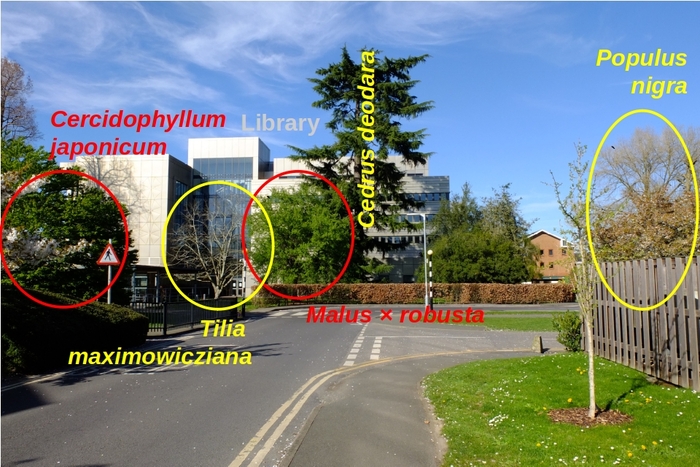
Please note that the photos of the trees included in the
route aren't always from the direction by which you'll approach them. They are
taken from angles that give the best view or which are least overshadowed. To
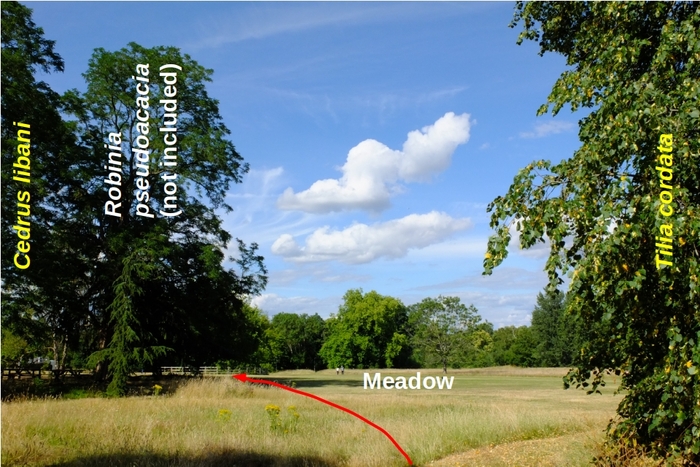
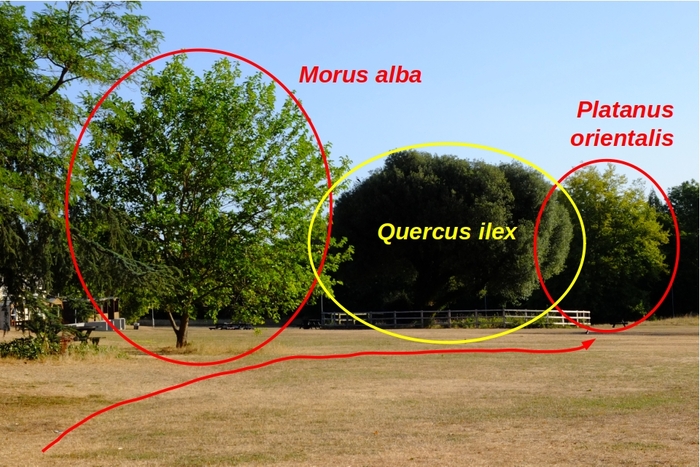
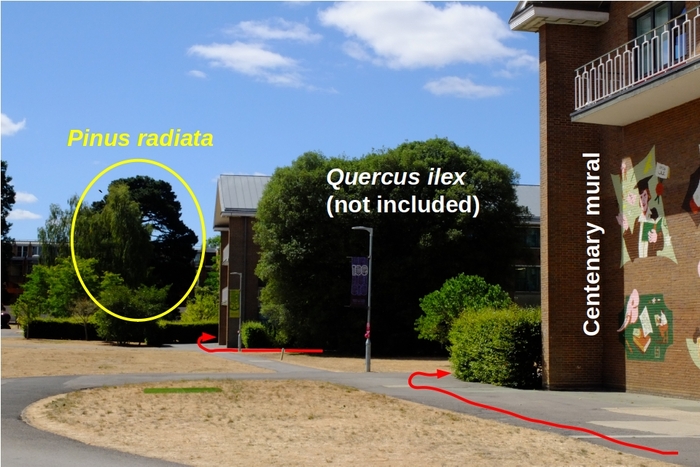
help with navigation, some annotated photos are included in the
description. They show the outlook that you will have while following the
route, with some of the featured trees that lie ahead indicated in red and
yellow. If you are reading this webpage on a device with geolocation services
(GPS etc.), you can show your present position on the map by pressing or
clicking on the button. See the map for further information.
You will pass many trees along the way which aren't featured in the route. A few of these also indicated on the navigational photos, in grey and white. Many of them are shown on the map by green tree markers, which you can click or press to see photos and information. Many more are not marked on the map, but can be seen in the satellite view.
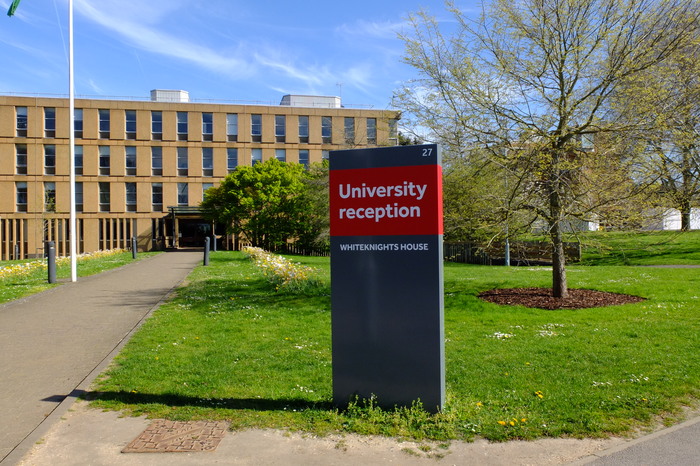
Start on Queen's Drive, facing Whiteknights House, at the bottom of the path which leads to its main entrance.
Betula utilis jacquemontii is a group of three trees on your right, just beyond the driveway that comes up from the basement of Whiteknights House. The copper-leaved Fagus sylvatica is to the right of the Betulus utilis jacquemontii group, i.e. continuing in the same direction from the start.
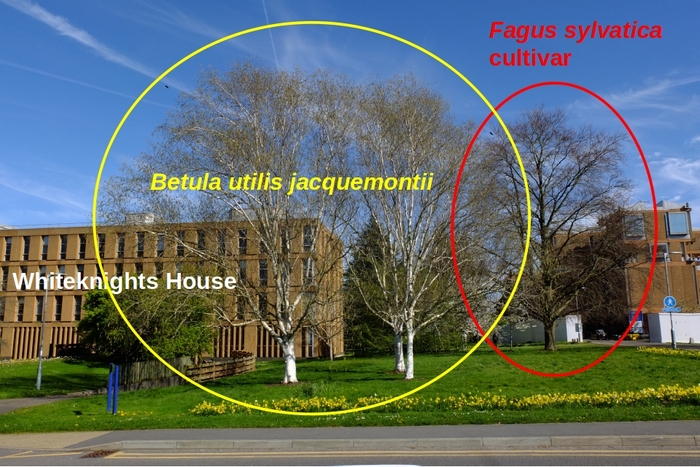
Press 1 in the white box below to centre the map on the first tree.
1 Betula utilis jacquemontii, Himalayan birch, Whiteknights House West
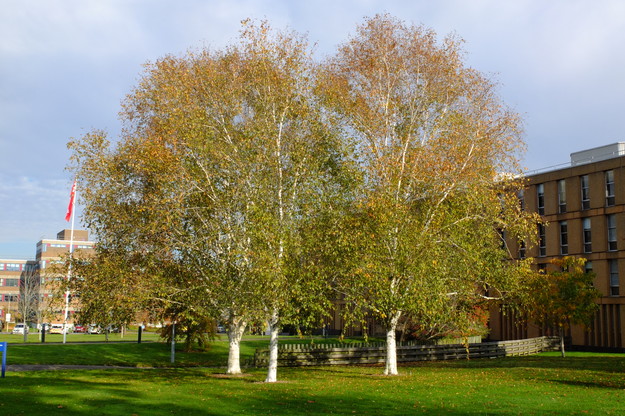
Betula utilis jacquemontii is a species of deciduous broadleaf flowering plants (in the Betulaceae or Birch family), native to the western Himalayas. It is a conspicuous tree on account of its striking smooth white bark, which has short horizontal lines. It peels away in thin papery layers and was historically used in parts of South Asia for writing sacred texts and manuscripts. Its oval green leaves turn golden-yellow in autumn, creating dramatic seasonal colour in mountain landscapes. Because of its elegant appearance and tolerance of cold conditions (in its native range, it grows to altitudes of 4500 m), it is widely planted in parks and gardens around the world.
about this species


2 Fagus sylvatica cultivar, Copper beech, Whiteknights House West
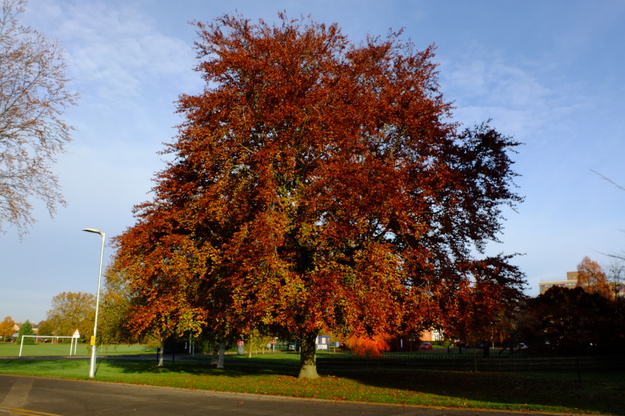
This is a cultivated variety of Fagus sylvatica, which is a species of deciduous broadleaf flowering plants (in the Fagaceae or Beech family). This variety is selected for the colour of its leaves. When they open in spring they are deep red, and they darken to purple in early summer. In the late summer they begin to lighten towards the green of the common beech, and their autumn colours are similar to common beech.
about this species

Pinus sylvestris and Quercus cerris are a little further along, on the other side of the road (Queen's Drive), past the junction on the right with the road (Chancellor's Way) to the Shinfield Road exit. Araucaria araucana is further along Queen's Drive, on the left side, at the corner where it bends to the left.
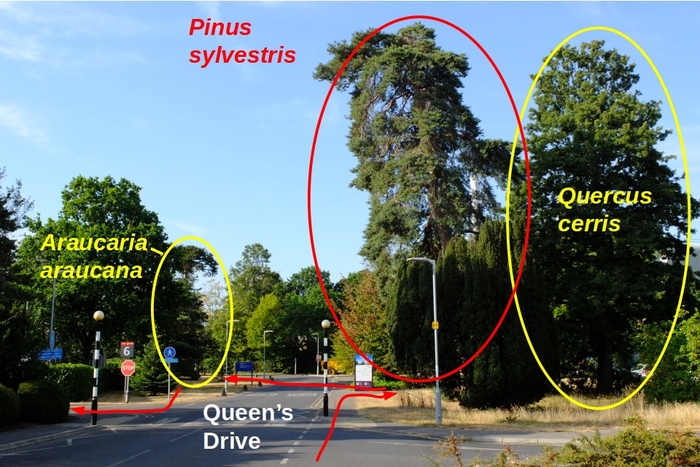
3 Pinus sylvestris, Scots pine, Chancellor's East
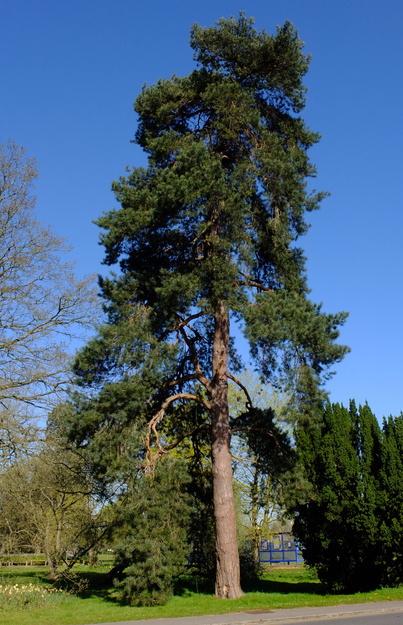
Pinus sylvestris is a species of evergreen needleleaf coniferous plants (in the Pinaceae or Pine family), native to Britain, nearly all of Europe and northern Asia. It is the national tree of Scotland, and one of only three native conifers (the others are Juniperus communis and Taxus baccata; there are no native fir or spruce species).
Pinus sylvestris grows to 30–40 metres and generally lives for 150–300 years. It has distinctive flaky orange-brown bark when young and on upper sections; older bark is dark brown. Its needles are blue-green and grow in pairs.
Pinus sylvestris thrives in poor, sandy soils and cold climates, making it well suited to upland and northern regions; on fertile sites other tree species outcompete it. It is widely planted and its wood is used for poles, posts, paper and construction.
about this species

4 Quercus cerris, Turkey oak, Chancellor's East
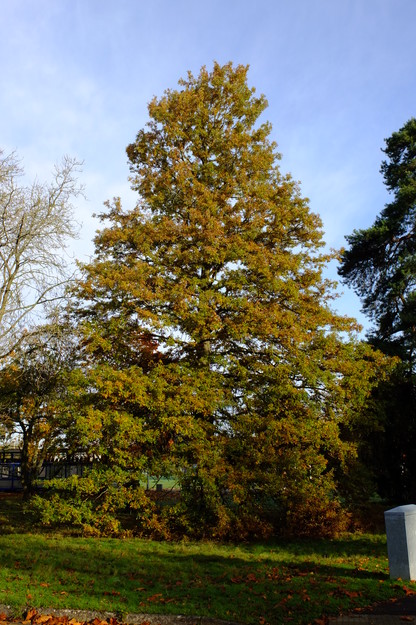
Quercus cerris is a species of deciduous broadleaf flowering plants (in the Fagaceae or Beech family), native to south-eastern Europe and Asia Minor, and naturalised in Britain. Turkey oak was introduced to the UK as an ornamental tree in the 18th century. It can act as host to the gall wasp, whose larvae damage the acorns of native British oaks. Its wood is liable to cracking so is only used for fencing and similar roles.
about this species
5 Araucaria araucana, Monkey puzzle tree, Blandford Lodge
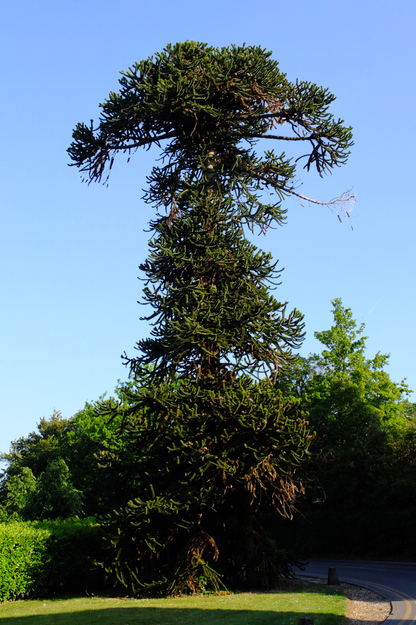
Araucaria araucana is a species of evergreen spiny-leaf coniferous plants (in the Araucariaceae family), native to temperate forests of Chile and Argentina. Araucaria araucana is adapted to volcanic soils and harsh mountain climates. It is easily recognized by its thick, armour-like, triangular leaves that spiral densely around its branches, giving the tree a dramatic, prehistoric appearance. Its popular name derives from a comment that climbing it would be a puzzle for a monkey. Growing up to 30–40 metres tall, it develops a straight trunk with a distinctive umbrella-shaped crown as it matures. Male and female cones grow on separate trees, with the large female cones producing edible seeds that have long been an important food source for Indigenous communities. Araucaria araucana is both an ecological and cultural symbol in its native range, though it is now considered endangered due to logging and habitat loss.
about this species
After visiting Araucaria, enter the small car-park opposite Pinus sylvestris. Leave the car-park by the path at the opposite corner to the entrance. Picea abies and Acer pseudoplatanus are on the other side of the car-park wall, on the left of the exit.
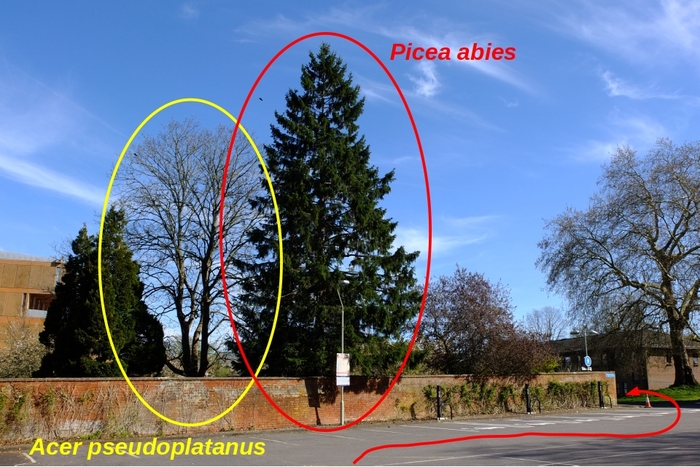
6 Picea abies, Norway spruce, Fountain Street
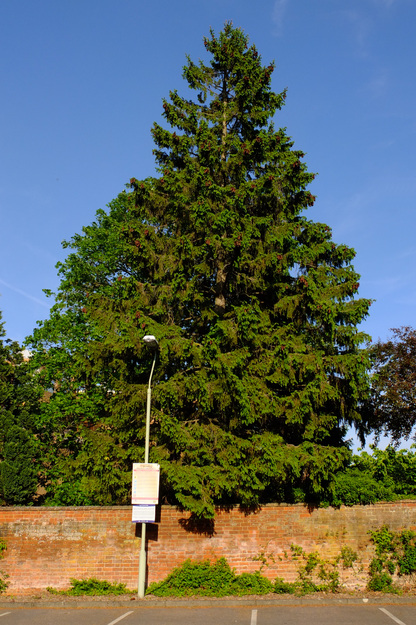
Picea abies is a species of evergreen needleleaf coniferous plants (in the Pinaceae or Pine family), native to northern, central and eastern Europe. This is a large tree, growing up to 35–55 metres, which produces long, cylindrical cones that hang downward from the branches. Norway spruce grows well in cool climates and well-drained soils, forming extensive forests across Europe. It is one of the most economically important coniferous species of the continent, its wood being used for construction, paper production, and musical instruments. It's also popular as a traditional Christmas tree. Every year the Norwegian capital city, Oslo, provides a Norway spruce for Trafalgar Square in London as thanks for the aid given during the Second World War.
about this species
7 Acer pseudoplatanus, Sycamore, Fountain Street
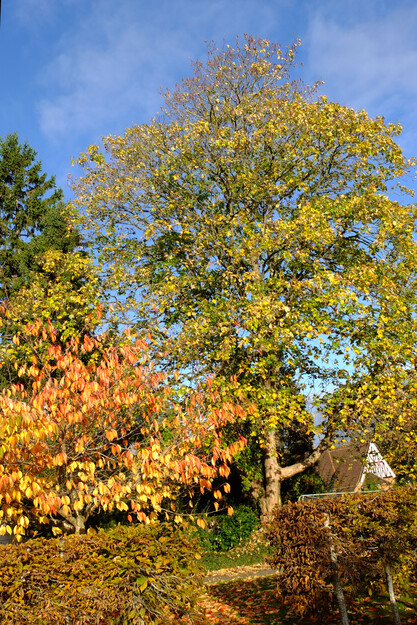
Acer pseudoplatanus is a species of deciduous broadleaf flowering plants (in the Sapindaceae or Soapberry family), native to central and southern Europe and the Caucasus, and naturalised in Britain. Acer pseudoplatanus can live to 400 years and grow to 35 metres tall. Its broad, rounded crown and dense foliage provide excellent shade. It has large five-lobed leaves with blunt points, and often with black spots, due to a fungus. The tree produces hanging clusters of small, greenish-yellow flowers in spring that develop into winged seeds (samaras), joined in pairs at an angle of 90 degrees or less. (The leaves of Acer saccharum have round-ended points, only one per lobe, and its samaras are horseshoe-shaped. The leaves of Acer platanoides have sharp points, often more than one per lobe, and its samaras are widely angled.)
On account of its adaptability, attractive form and relatively fast growth, Acer pseudoplatanus is often planted along streets, in parks and woodlands, and by reforestation and ecological restoration projects. It was introduced to Britain from mainland Europe, probably in the Middle Ages, and has been planted outside Europe as well, becoming an invasive species in some regions. Its creamy-white close-grained timber is used for musical instruments, furniture, joinery, wood flooring and kitchen utensils.
The Sycamore Gap Tree was a sycamore standing next to Hadrian's Wall in Northumberland, illegally felled in 2023. The Tolpuddle Martyrs' Tree is a sycamore in Dorset under which six agricultural labourers formed an early trades union in 1834, for which they were tried and transported to Australia, but three years later were reprieved and returned to Britain following public protest.
about this species
Follow the path away from the car-park you crossed, towards the two-storey brick building (the Miller Building), and turn right as you get near it, to cross between its two wings.
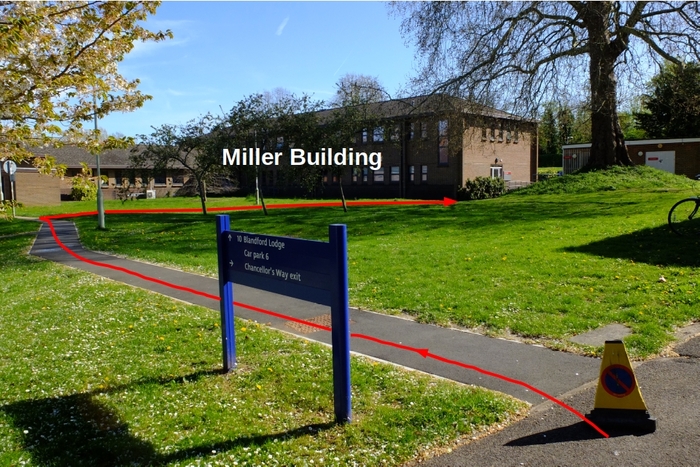
Passing the right-hand wing of the Miller Building, the footpath emerges onto a small road. Turn left and walk down the road, with the Miller Building on your left, and a grassy bank on your right.
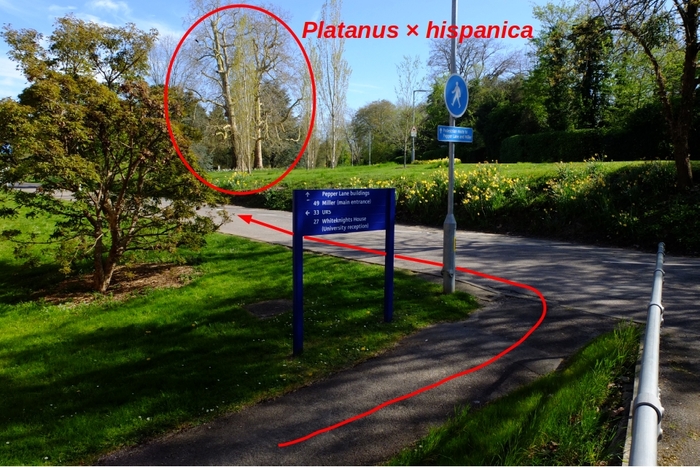
The bank on the right becomes lower as you continue along the road. At the point where there's a cul-de-sac road on the left, and a meeting-point sign on the right, turn right onto the lawn.
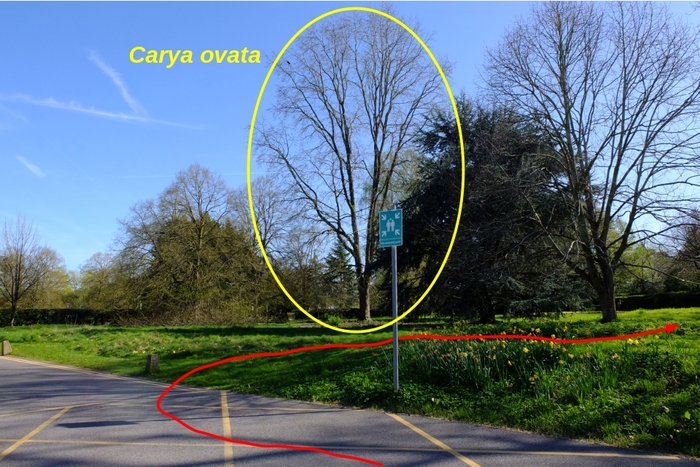
Platanus × hispanica is the pair of large trees on the lawn in front of you. Carya glabra, Tilia × europaea, Cedrus atlantica and Betula pendula are all among the group of trees on the left.
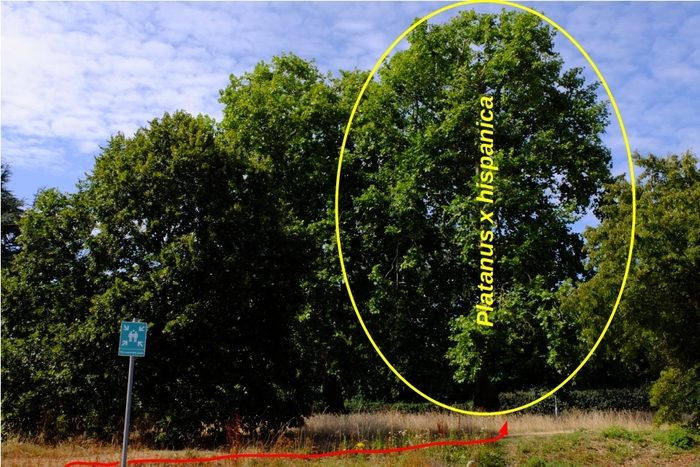
8 Platanus × hispanica, London plane, Miller Wager Triangle
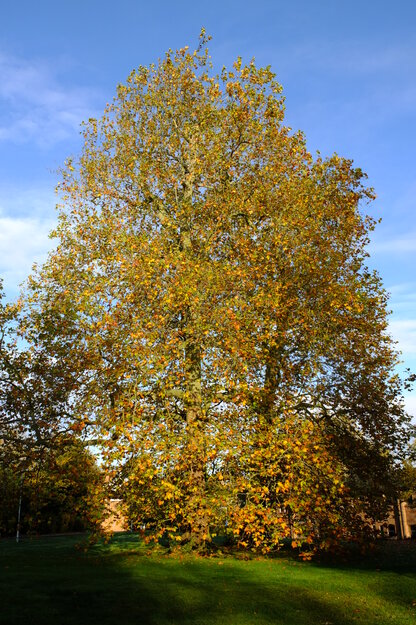
Platanus × hispanica is a species of deciduous broadleaf flowering plants (in the Platanaceae family). It is a hybrid between Platanus orientalis (oriental plane, also present in Whiteknights Park) and Platanus occidentalis (occidental plane, or American sycamore). Since these are Eurasian and American species, respectively, the hybrid arose only because they were planted in proximity by human intervention, probably in the 17th century. Once established, it grows rapidly and can reach 30 metres, and with a widely spreading crown and broad trunk. Its bark flakes off in plates, producing a mottled appearance of light brown and grey-green.
Platanus × hispanica has large bright green leaves, usually with five lobes, not as deeply divided as those of Platanus orientalis. They resemble maple leaves, as indicated by the synonym Platanus × acerifolia for the species, in which acerifolia means "maple leaves". (The similarity of plane and maple leaves is noted also by the common name "American sycamore" for Platanus occidentalis, whereas the species called "sycamore" in Britain is one of the maple family, Acer pseudoplatanus, in which pseudoplatanus means "false plane".) The leaves turn orange or bronze in autumn. The fruit of the tree are small round spiky balls that hang in pairs or clusters.
On account of the large size of the tree and its leaves, Platanus × hispanica is a good tree for shade. It is widely planted in cities for this reason, and for its resilience and adaptability. It tolerates pollution, compacted soils, and pollarding, making it one of the most successful trees for temperate climates in towns, where it improves air quality and contributes to the character of the urban landscape. It is a common sight along streets and in parks, for instance in London, Paris and New York City.
about this species
9 Carya ovata, Shagbark hickory, Miller Wager Triangle
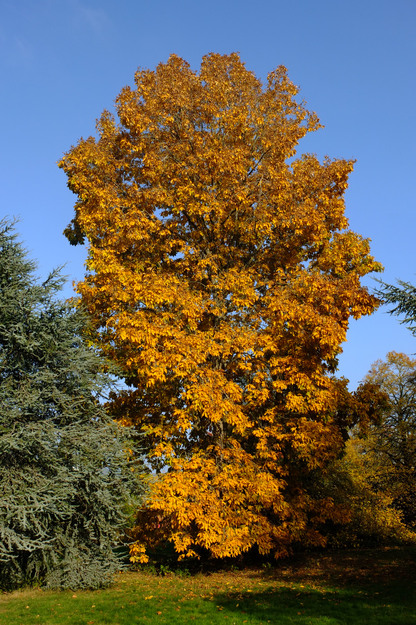
Carya ovata is a species of deciduous broadleaf flowering plants (in the Juglandaceae or Walnut family), native to eastern North America. It is a large tree, growing well over 30 m tall, with distinctive peeling bark. The long strips of grey bark curl away from the trunk, giving the tree its characteristic shaggy appearance and providing shelter for bats and insects. Catkins and leaves appear in late spring. The leaves grow in groups of five (technically a compound leaf comprising five leaflets); two on opposite sides of the stem, and three larger ones at the end of the stem. In autumn, the leaves turn brilliant shades of yellow and gold.
Carya ovata produces smooth round fruit, which are thick cases for sweet, edible nuts. These are an important food source for wildlife and have also traditionally been harvested by indigenous people. Its strong, dense wood is highly prized for making tool handles, furniture, ploughs and for smoking meats because it burns slowly and produces a rich aroma.
about this species
10 Tilia × europaea, Common lime or linden, Miller Wager Triangle
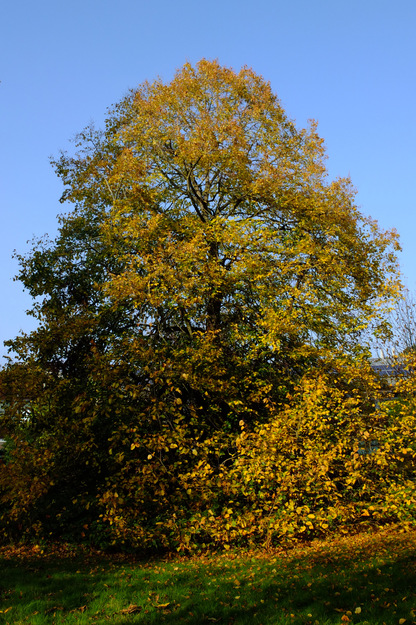
Tilia × europaea is a species of deciduous broadleaf flowering plants (in the Malvaceae or Mallow family), native to Britain and Europe. It is a vigorous tree, which can reach 50 metres, often with large rounded lumps (burrs) and many sprouts surrounding the base of the trunk. The species is a natural hybrid arising in European woodlands where both the parent species occur, namely Tilia cordata and Tilia platyphyllos, which are the other two native Tilia (lime or linden) species (also present in Whiteknights Park).
Tilia × europaea has red buds in winter. Its large heart-shaped finely toothed leaves are mid-green above and paler below, sometimes appearing a bit glossy. Tilia × europaea can be distinguished from the other two native species by the the smoothness of its leaves, which seem comparatively flimsy, and are hairless on the underside, except for small patches near the major veins, where the hairs are white or lighter brown than in the other species.
In late June and early July, Tilia × europaea bears small light yellow-green fragrant flowers in bunches of about seven, hanging below the leaves. As in all Tilia species, the flowers are accompanied by long ribbon-shaped leaves (bracts), which become noticeable in summer because they turn yellow earlier than the other leaves; nonetheless, they persist on the tree into autumn, along with the clusters of small round dry fruit.
Tilia × europaea is rarely found in the wild in this country, but has frequently been planted here and across Europe as an ornamental tree along streets (for example Shinfield Road on the western boundary of Whiteknights Park), thanks to its dense shade, rapid growth and tolerance of pollution and poor soils. It also features in parks and in historic lime avenues lining the grand entrances to stately homes. Unfortunately, it a particular favourite of aphids and their predators, resulting in sticky messy deposits underneath the trees.
about this species
11 Cedrus atlantica, Atlantic blue or Atlas cedar, Miller Wager Triangle
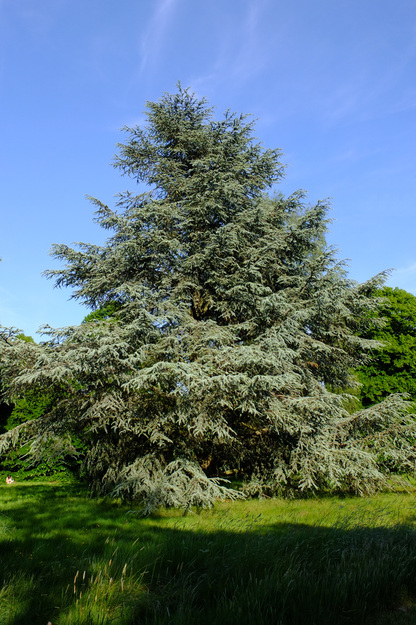
Cedrus atlantica is a species of evergreen needleleaf coniferous plants (in the Pinaceae or Pine family), native to Atlas mountains of North Africa. It is an impressive tree, which can grow 30–40 metres, with a broad pyramidal shape. Its spreading branches bear dense clusters of blue-green to silvery needles, and upright barrel-shaped female cones. The male cones are smaller and also upright; they grow during summer and fall off after shedding pollen in early autumn. It thrives in well-drained soils and sunny conditions, and forms large forests in its native range, especially Morocco. In our latitudes it is highly valued as an ornamental tree in parks, estates, and large gardens because of its graceful appearance and longevity. Its durable, aromatic wood has historically been used in construction and woodworking due to its resistance to decay.
There are three Cedrus species ("true" cedars) grown in Britain, and Whiteknights Park has examples of all three, namely Cedrus atlantica, Cedrus libani and Cedrus deodara. Although fairly similar, they can be distinguished by their general shape ("habit"), the direction in which their branch-tips point (typically upward in Cedrus atlantica), and the length of their needles; see here for a comparison.
about this species
12 Betula pendula, Silver birch, Miller Wager Triangle
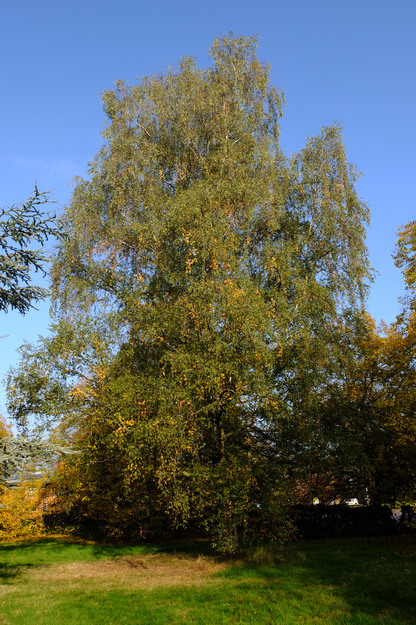
Betula pendula is a species of deciduous broadleaf flowering plants (in the Betulaceae or Birch family), native to Britain, Europe, the mountains of Morocco, the Caucasus, northern Turkey and Iran, temperate latitudes of Asia, Canada and Alaska. It is a medium-sized and fairly slender tree, up to about 20 metres tall. It has an airy canopy of pendulous branches that give the tree a graceful appearance and its specific name pendula, while its English name refers to the distinctive white papery bark of younger trees. Older bark develops dark diamond-shaped marks, forming a lattice around the remaining lighter bark, and eventually becomes entirely dark and rugged, especially at the base of the tree.
The twigs of Betula pendula are smooth except for small dark warts, distinctive for the species. It produces male catkins in an immature form during the winter, which become long, yellow and pendulous in spring, when the short green female catkins appear, with the leaves. After pollination by wind, the female catkins ripen over the summer into cylinders of small seeds, which are dispersed by the wind. The leaves are small, light green and roughly triangular, with a fairly flat base, pointed tip, and toothed edges (doubly serrated, meaning with two sizes of forward-facing teeth). They turn bright or golden yellow in autumn before they fall.
Despite looking somewhat delicate, Betula pendula is a hardy tree, a pioneer species, which can thrive in poor soils and exposed conditions, and grows at high latitude, well into the Arctic circle. It was elected the national tree of Finland in 1988. It is cultivated both for its appearance, and for timber, which is used for furniture, veneer and plywood, and is good as firewood.
about this species
The route heads through this group of trees to its far corner, meeting Queen's Drive again (which runs parallel to the boundary of the campus and Pepper Lane outside). Follow the verge of Queen's Drive, pass the car-park on the left, continue across the road which comes in from the left, and turn off Queen's Drive onto the next path on the left.
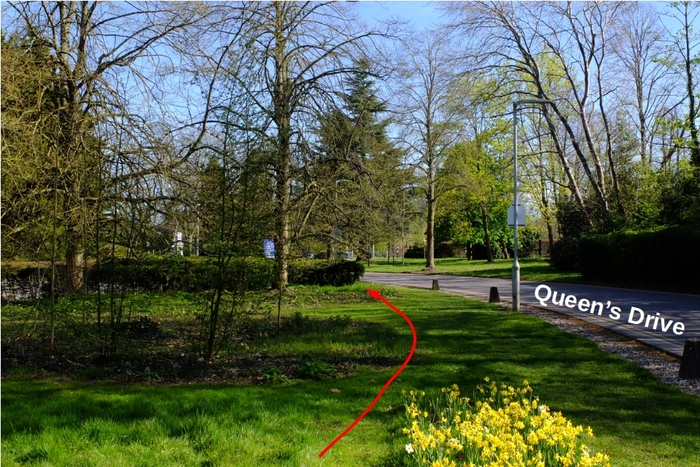
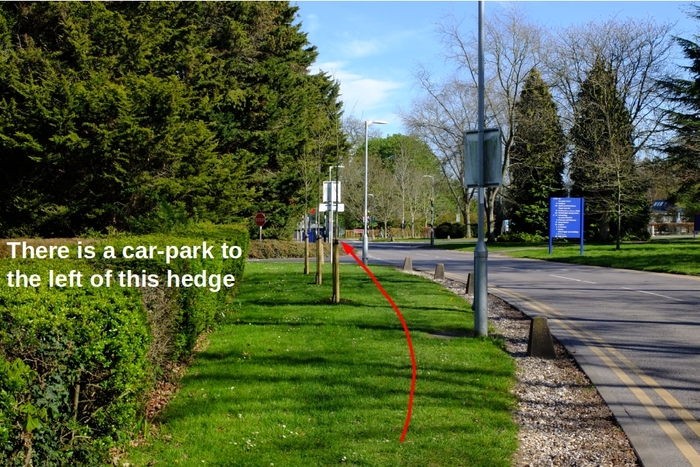
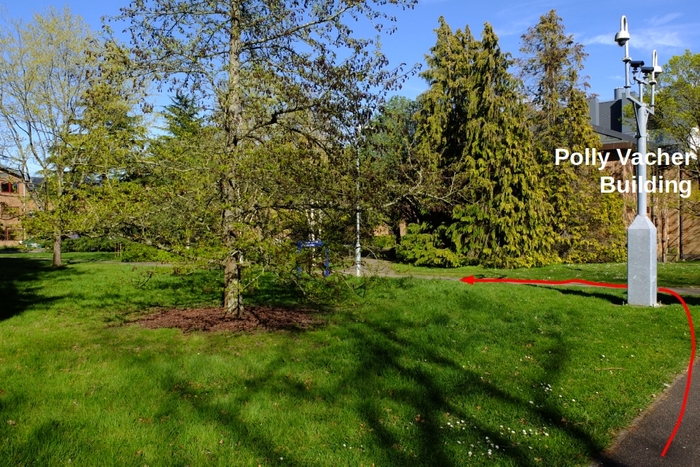
The path crosses a lawn, with trees on the left and a building on the right (the Polly Vacher Building). Acer saccharum is in front of you, on the left-hand side of the path. After Acer saccharum, cut left across the lawn to go between the pair of Liquidambar styraciflua and reach Prunus sargentii, which is by the side of the road crossing the far end of the path.
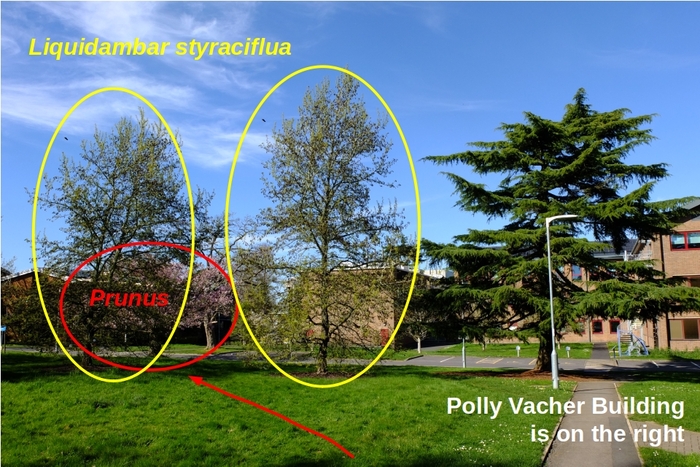
13 Acer saccharum, Sugar maple, Polly Vacher West
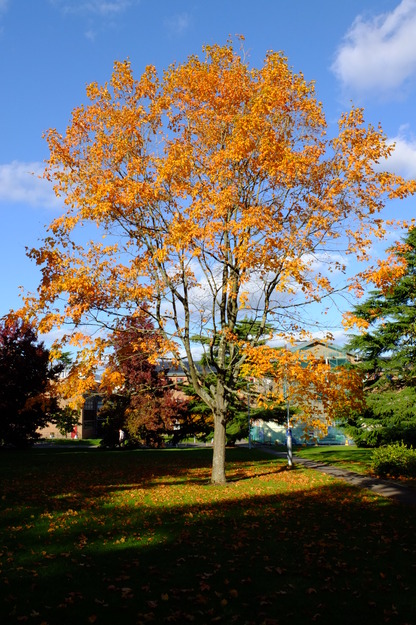
Acer saccharum is a species of deciduous broadleaf flowering plants (in the Sapindaceae or Soapberry family), native to east and central North America. Acer saccharum is remarkable for its autumn colour, ranging from vibrant reds to purples and yellows. It bears clusters of small yellow-green flowers in spring, which develop into winged fruit (samaras), paired in a horseshoe shape.
The leaves of Acer saccharum have five lobes with round-ended points, only one per lobe; in comparison, the leaves of Acer platanoides have sharp points, often more than one per lobe, and its samaras are widely angled, while the lobes of Acer pseudoplatanus leaves have blunt points, and its samaras are angled at 90 degrees or less. Acer saccharum and Acer saccharinum are similar names, and the species are native in similar regions, but they can be distinguished quite readily.
Acer saccharum is famous for producing the sap used in maple syrup. The tree can be tapped for syrup when it is about 40 years old. It takes about 30 litres of sap to make one litre of syrup. Canadian producers supply a global market with more than 45 million litres of syrup annually. A solid red stylised 11-pointed maple leaf appears in outline on the flag of Canada, similar to the Acer saccharum leaf but not intended to be botanically specific.
about this species
14 Liquidambar styraciflua, (American) sweetgum, Polly Vacher West
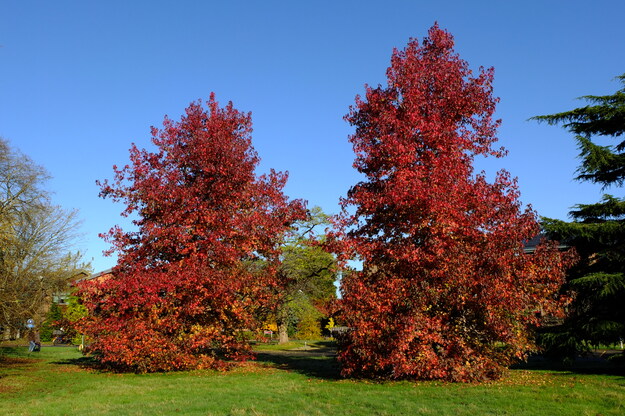
Liquidambar styraciflua is a species of deciduous broadleaf flowering plants (in the Altingiaceae family), native to eastern North America and parts of Central America. It has bright autumn colours and glossy star-shaped leaves with 5–7 pointed lobes, resembling those of Acer (maple) species (which are in a different family). Its fruit are hard spiky balls. The tree grows to 20–35 metres high. It has grey-brown bark with deep ridges when it matures, and produces a fragrant resin which has been used in medicines and perfumes; the genus name Liquidambar refers to the resin.
about this species
15 Prunus sargentii, North Japanese hill cherry or Sargent's cherry, Polly Vacher West
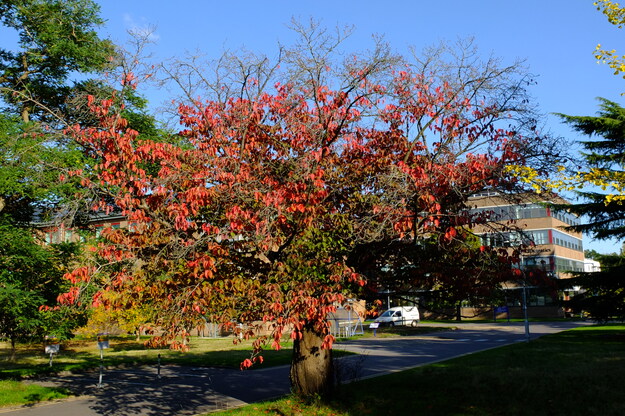
Prunus sargentii is a species of deciduous broadleaf flowering plants (in the Rosaceae or Rose family), native to Japan, Korea and the Russian far East. It produces abundant pale pink to white flowers in spring, followed by small fruits in summer. The foliage emerges bronze-green, develops into rich green during summer, and turns brilliant orange, red and scarlet in autumn. The tree was introduced to the USA by the Arnold Arboretum of Harvard University in Boston during the late 1800s, and is named after its director, Charles Sprague Sargent. Being among the most beautiful of cherry trees in both blossom and autumn colour, it makes an excellent specimen for parks and gardens, as well being suitable as a street tree.
about this species
When you reach Prunus sargentii, Robinia pseudoacacia is facing you across the road, and Aesculus indica and Aesculus flava are a little to the right, on the lawn over the road. After visiting them, return to the crossroads on the left.
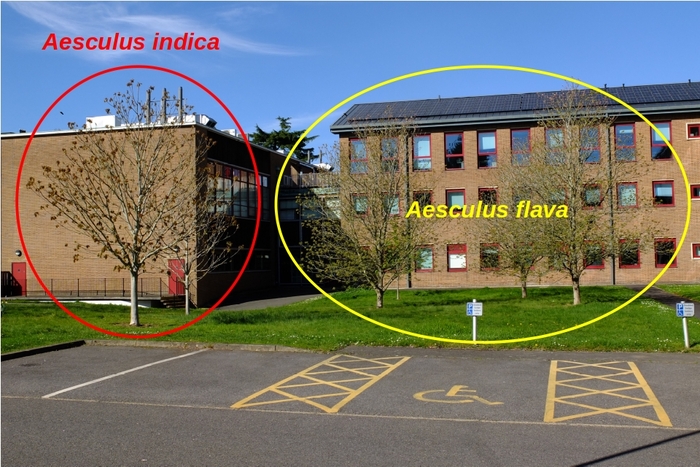
16 Aesculus indica, Indian horsechestnut, Thomson South
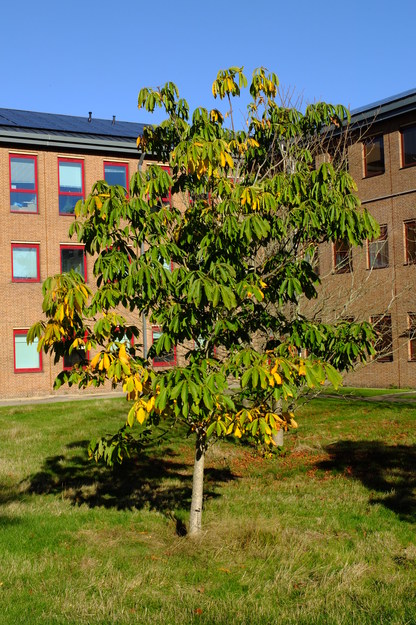
Aesculus indica is a species of deciduous broadleaf flowering plants (in the Sapindaceae or Soapberry family), native to the Himalayan lowlands. It grows to be a medium-sized tree with a dense canopy, and beautiful upright clusters ("candles") of white flowers that bloom in late spring and early summer. The flowers have yellow centres until they have been pollinated, at which point they turn pink, as a signal to pollinating insects, which avoid the pink ones. The tree thrives in cool mountain climates and is often planted along roadsides, in parks, and near temples for shade and ornamental beauty. Its leaves are narrow compared with Aesculus hippocastanum leaves, grow in groups of seven from a central point (technically seven leaflets comprising one leaf), and turn golden yellow in autumn. Its fruit are round with slightly rough skin, and contain glossy brown seeds, which can be ground to flour and used in making chapatis.
about this species
17 Aesculus flava,
Sweet or yellow buckeye,
Thomson South
Please note: we're uncertain about the species of this tree
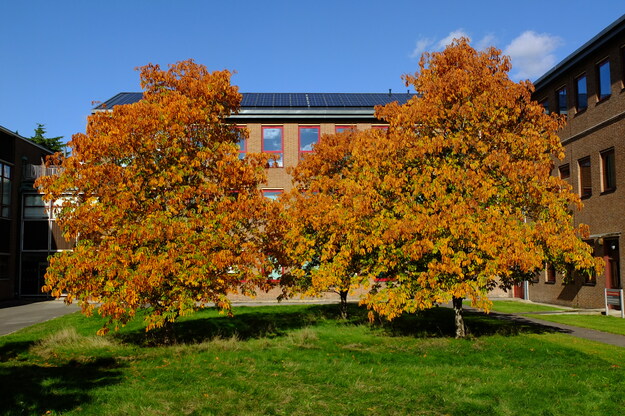
Aesculus flava is a species of deciduous broadleaf flowering plants (in the Sapindaceae or Soapberry family), native to the Ohio Valley and Appalachian Mountains of eastern North America, preferring river valleys and mountain slopes. It can grow to 30 m with a broad canopy. In spring it bears clusters of striking yellow-green flowers on upright stalks ("candles"). Its leaves grow in groups of five from a central point (technically one leaf comprising five leaflets). In autumn, they turn brilliant shades of gold and orange. Its fruit is round with smooth or slightly bumpy skin. The shiny brown seeds within, called buckeyes, resemble edible chestnuts, but are toxic to humans and many animals if eaten raw. They are collected as curiosities and symbols of good luck.
about this species
18 Robinia pseudoacacia, False acacia or black locust, Thomson South
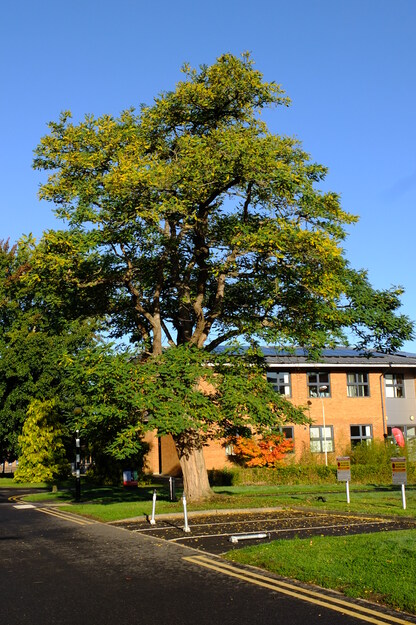
Robinia pseudoacacia is a species of deciduous broadleaf flowering plants (in the Fabaceae or Legume, pea or bean family), native to the Appalachian and Ozark mountains of eastern North America. It is a fast-growing tree, which can reach 30 metres. Its bark is reddish-brown or grey and deeply furrowed, with criss-crossing ridges. The tree forms a relatively narrow but spacious crown, which casts light shade. It is widely planted as ornamental in parks and streets.
The leaves are yellow-green or blue-green, arranged on stems with many opposite pairs (technically a compound leaf). They open in May, and turn yellow before falling in autumn. In late spring and early summer the tree produces hanging clusters of fragrant white flowers, followed by brown seed pods, like pea pods; peas and beans, as well as true acacia, also belong to the Fabaceae family. Like many plants of that family, Robinia pseudoacacia can grow in poor soils, which it can improve by fixing nitrogen. It tolerates drought but does not grow well in shade, being a pioneer species, and can colonise open areas by root suckers as well as by seed.
Robinia pseudoacacia has become naturalised, and in some regions invasive, throughout North America and elsewhere, including mainland Europe and Australia. The flowers are the source of nectar for "acacia honey", for which it is extensively planted in eastern and southern Europe. It is planted also for erosion control, windbreaks and land reclamation. Its wood is strong and durable, often used for fencing and furniture.
about this species
Populus alba and Chamaecyparis lawsoniana are at the north-west corner of the crossroads.
19 Populus alba,
White or silver poplar,
Archaeology corner
Please note: we're uncertain about the species of this tree
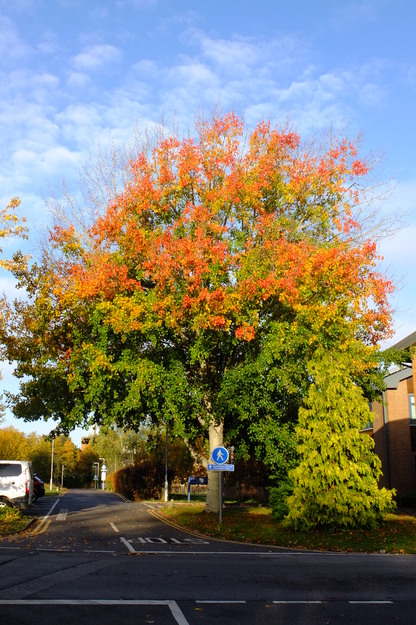
Populus alba is a species of deciduous broadleaf flowering plants (in the Salicaceae or Willow family), native to mainland Europe, Central Asia and parts of North Africa, and naturalised in Britain. It is a fast-growing tree which can attain 20 metres. The leaves are roundish with blunt teeth, dark green on top, but their undersides are bright white and silvery with a felt-like feel. The bark is smooth and grey-white when young, with characteristic diamond-shaped marks (like Populus tremula), and becomes darker and fissured as the tree grows older.
Populus alba can spread by means of root suckers growing from the lateral roots, often as far as 20–30 metres from the trunk, to form dense thickets. It prefers moist ground and is often found near rivers, flood plains and moist areas.
In Greek mythology the white poplar symbolised eternal life and renewal. Many early Italian Renaissance paintings, including the Mona Lisa, are painted on Populus alba wood panels.
about this species
20 Chamaecyparis lawsoniana, Lawson cypress, Archaeology corner
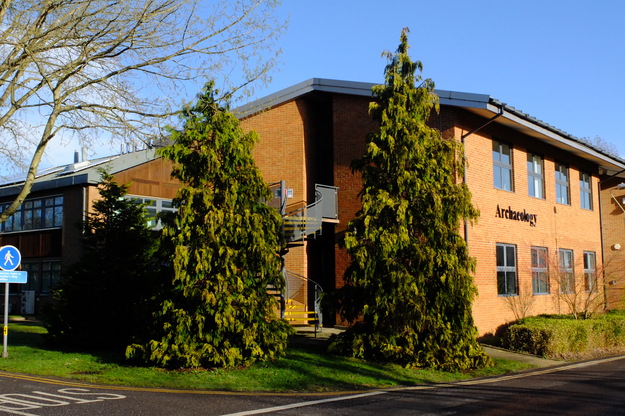
Chamaecyparis lawsoniana is a species of evergreen needleleaf coniferous plants (in the Cupressaceae or Cypress family), native to north-west North America. Chamaecyparis lawsoniana can live for 600 years and reach heights of 50 metres in the wild, forming a narrow, conical crown with drooping branches covered in fine, scale-like foliage that emits a scent when crushed, variously described as resinous and pungent. The small, round cones mature from green to brown, and the bark is reddish-brown and fibrous, peeling in thin strips. Chamaecyparis lawsoniana wood is light, strong, rot-resistant and aromatic. The species has a wide range of ornamental cultivars, commonly planted in gardens and landscapes.
about this species
From this corner, go downhill along the road, heading for Cedrus deodara and the large building behind it (the Library). Cercidiphyllum japonicum is on the left just before the zebra crossing, where the road turns right. Tilia maximowicziana and Malus × robusta are on the small lawn between the cycle parking and Cedrus deodara. After Cedrus deodara, cross the small road at the (south-east) corner of the Library to reach Populus nigra.
21 Cercidiphyllum japonicum, Katsura, Hill Walk Top
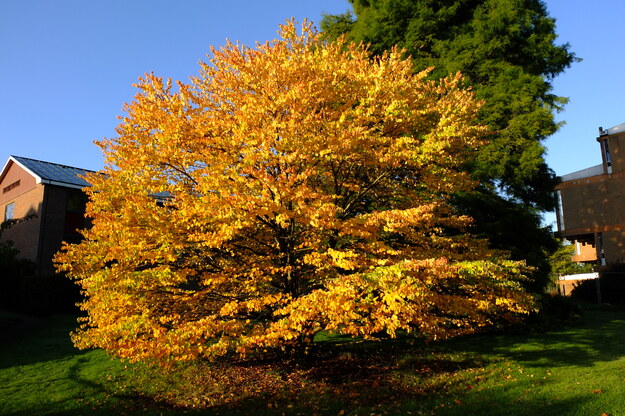
Cercidiphyllum japonicum is a species of deciduous broadleaf flowering plants (in the Cercidiphyllaceae family), native to Japan and China. This is a graceful tree with a delicate branching structure and attractive foliage. Its heart-shaped leaves emerge reddish-purple in spring, turn blue-green in summer, and transform into brilliant shades of yellow, orange, and pink in autumn. A distinctive feature is the sweet scent released by fallen autumn leaves, comparable with caramel, burnt sugar or candy floss.
Cercidiphyllum japonicum thrives in moist, well-drained soils and is widely planted as an ornamental specimen in parks and gardens. In Japan, it is also grown for its timber, which is used for construction and woodworking. The generic name Cercidophyllum indicates its leaves are like those of Cercis species, such as Cercis siliquastrum, which are also heart-shaped.
about this species
22 Malus × robusta 'Red Sentinel',
Ornamental crab apple,
Library South
Please note: we're uncertain about the species of this tree
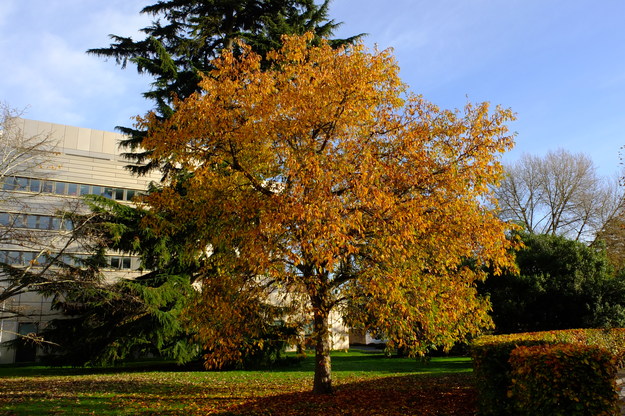
This is a cultivated variety of Malus, which is a genus of broadleaf flowering plants (in the Rosaceae or Rose family). It is an artificial hybrid between Malus baccata (Siberian crab apple) and Malus prunifolia (plum-leaved or Chinese crab apple). It has abundant white flowers in spring and attractive small fruit in the autumn that persist into winter.
about this species
23 Tilia maximowicziana, Maximowicz's lime, Library South
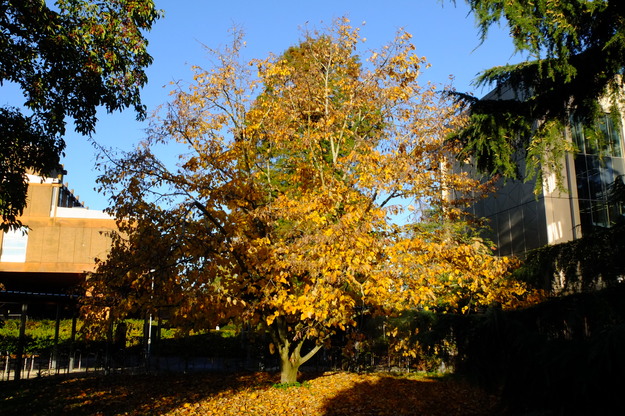
Tilia maximowicziana is a species of deciduous broadleaf flowering plants (in the Malvaceae or Mallow family), native to Japan and Kunashir Island. The tree can grow to 30 metres and forms the dominant canopy species in some mountain forests of northern Japan. It has large heart-shaped leaves with toothed edges, and bears small light yellow-green fragrant flowers which hang below the leaves in bunches of up to about 10, more than in native Tilia (lime or linden) species. As in all Tilia species, the flowers are accompanied by long ribbon-shaped leaves (bracts), which become noticeable in summer because they turn yellow earlier than the other leaves; nonetheless, they persist on the tree into autumn, along with the clusters of small round dry fruit.
about this species
24 Cedrus deodara, Deodar cedar or deodar, Library South
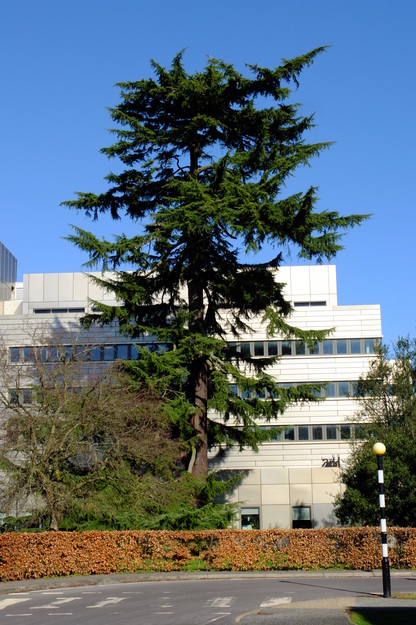
Cedrus deodara is a species of evergreen needleleaf coniferous plants (in the Pinaceae or Pine family), native to the western Himalayas. It is a magnificent tree, growing up to 40–50 metres tall with a towering shape, with drooping branch tips and soft, bluish-green needles arranged in dense clusters. It produces upright, barrel-shaped female cones that gradually disintegrate to release their seeds. Its wood is valued because of its durability, rot-resistant character and fine grain. The inner wood is aromatic and used to make incense; the name derives from the Sanskrit meaning "wood of the gods". The deodar is widely planted as an ornamental tree in parks and large gardens around the world.
There are three Cedrus species ("true" cedars) grown in Britain, and Whiteknights Park has examples of all three, namely Cedrus atlantica, Cedrus libani and Cedrus deodara. Although fairly similar, they can be distinguished by their general shape ("habit"), the direction in which their branch-tips point, and the length of their needles (longest in Cedrus deodara; see here for a comparison.
about this species
25 Populus nigra betulifolia, Black poplar, Park House Lodge
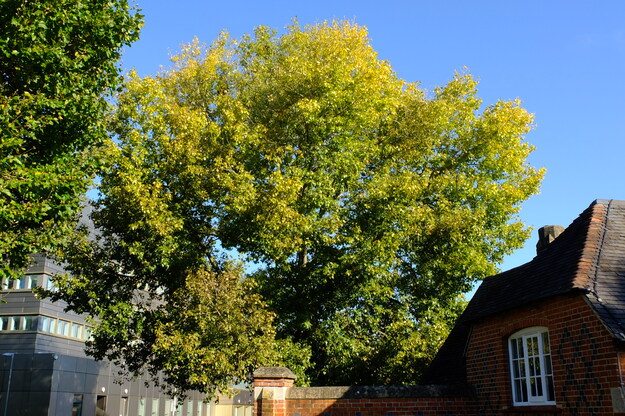
Populus nigra betulifolia is a species of deciduous broadleaf flowering plants (in the Salicaceae or Willow family), native to Britain and north-western Europe. It is the native subspecies of Populus nigra, which is found in much of western Eurasia. The columnar Lombardy Populus nigra cultivar is also present in Whiteknights Park. Populus nigra betulifolia prefers boggy ground in floodplains and wetlands, and supports a variety of wildlife. However, it has become very rare, with only a few thousand in the country; hybrids of Populus nigra with other Populus species are much more common.
Populus nigra betulifolia is an imposing tree, which can can grow up to around 30 metres tall, with a broad, spreading crown. Its bark is grey–brown and furrowed, typically with burrs (regions where the bark seems knotted or lumpy). The wood is soft, low-density, shock-resistant, and light brown to almost white in colour. Its leaves are green, triangular and tapered. As with all Populus species, male and female flowers are found on separate trees and appear as catkins in spring. Male catkins are red, female yellow–green and pollinated by the wind.
This individual is male, and has been identified by DNA testing as a Manchester poplar clone (CL28).
about this species
With Populus nigra behind you and a one-storey brick building on your left (the Chaplaincy Centre), cross the road in front of you. The next four trees are on the other side of the road, in front of the three-storey building on the other side (the Thomson Building). Prunus serrulata is by the pavement on the right of the building, Cercis siliquastrum is in the middle of the terrace on the right of the steps up to the Thomson entrance, Acer negundo is on the left of the entrance steps, and Carpinus betulus is by the pavement at the left-hand end of the building.
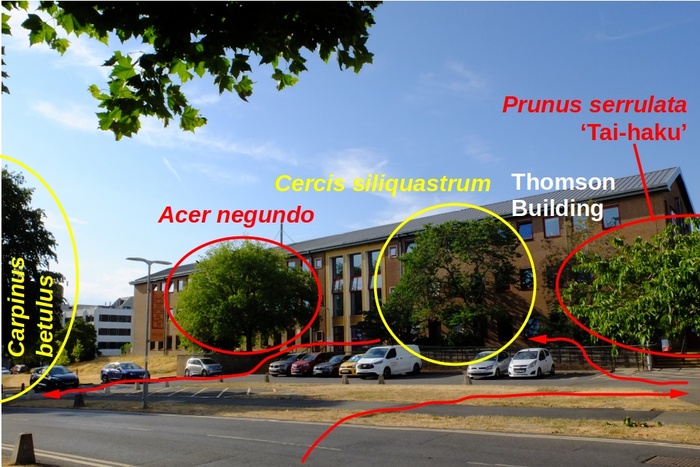
26 Prunus serrulata 'Tai-haku', Great white cherry, Park House Lodge
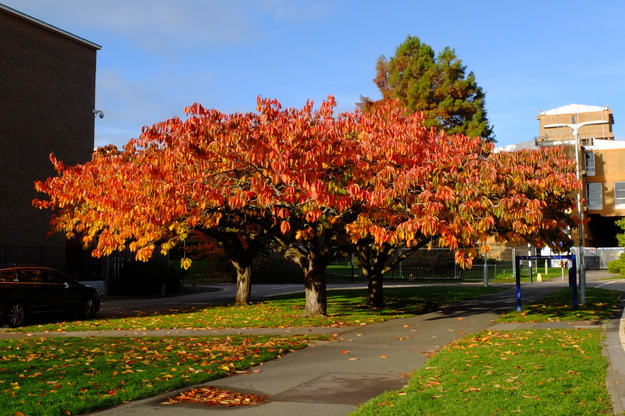
This is a cultivated variety of Prunus serrulata, which is a species of deciduous broadleaf flowering plants (in the Rosaceae or Rose family), native to east Asia. Prunus serrulata is celebrated for its spectacular spring blossom, comprising profuse clusters of pale pink to white flowers. In Japan it has a cultural significance, marked during the cherry blossom festival, when its flowering symbolises renewal and the fleeting nature of life.
about this species
27 Cercis siliquastrum, Judas tree, Thomson entrance
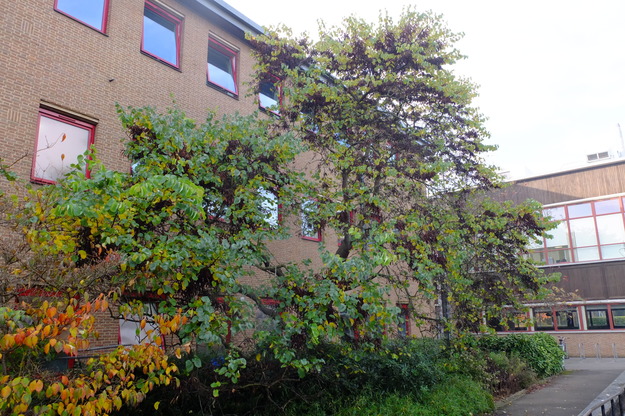
Cercis siliquastrum is a species of deciduous broadleaf flowering plants (in the Fabaceae or Legume, pea or bean family), native to southern Europe and western Asia. Cercis siliquastrum is celebrated for its striking abundant spring blossom. Before the leaves emerge, clusters of vivid pink to purple pea-like flowers appear directly on the branches and trunk (a behaviour called "cauliflory"). The tree later develops rounded, heart-shaped leaves that provide light shade and turn yellow in autumn.
Cercis siliquastrum thrives in warm climates and well-drained soils, making it a popular ornamental species in gardens, streets, and Mediterranean landscapes. Its unusual flowering habit, graceful form, and seasonal colour have made it a valued decorative tree for centuries, while its nectar-rich blooms also attract bees and other pollinators.
about this species
28 Acer negundo, Ash-leaf maple or box elder, Thomson entrance
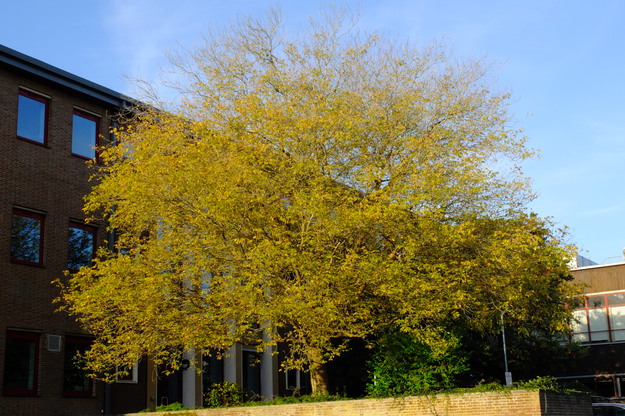
Acer negundo is a species of deciduous broadleaf flowering plants (in the Sapindaceae or Soapberry family), native to North America. Acer negundo grows quickly, tolerates harsh conditions, and thrives in a wide range of environments, including floodplains, urban areas, and disturbed soils, making it highly adaptable but sometimes invasive outside its native range. On the other hand, its relatively weak wood and its short lifespan limit its use in long-term landscaping. Native Americans had multiple uses for it, both medicinal and for its wood products: the earliest flute (620–670 AD) to be discovered in North America was made of an Acer negundo shoot. The tree produces paired winged seeds (samaras).
about this species
29 Carpinus betulus, (Common or European) hornbeam, Thomson North
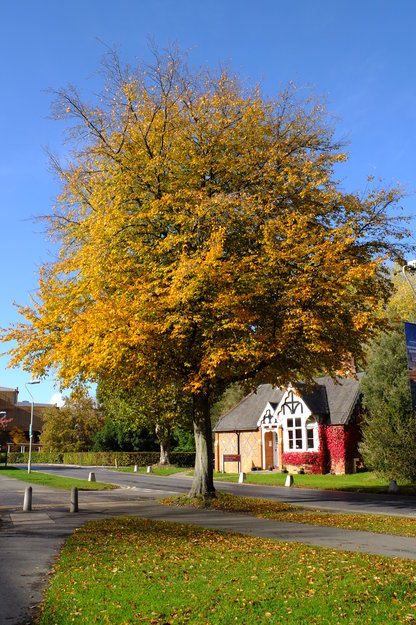
Carpinus betulus is a species of deciduous broadleaf flowering plants (in the Betulaceae or Birch family), native to Britain, Europe and western Asia. This is a common tree in Whiteknights Park, in both woodland and planted areas. It has a dense crown, smooth grey bark, and finely textured green leaves that turn shades of yellow and copper in autumn. They resemble the leaves of beech (Fagus sylvatica) in their shape and arrangement of veins, but have toothed edges, whereas those of beech have a wavy edge. From late spring thin seeds develop within groups of three small narrow leaves (bracts) that hang in chains, which are distinctive of the species.
Carpinus betulus wood is extremely hard and durable, traditionally used for tool handles, flooring, and items requiring strong timber. Its resilience to pollution, shade, and varied soil conditions makes it a popular choice in urban landscaping and sustainable forestry projects. It responds well to pruning and is often used for formal hedges, avenues, and topiary designs.
about this species
Continue gently downhill along the pavement, on the same side of the road as the Thomson Building. The purple-leaved Acer platanoides is on the right of this path. After visiting this tree, you pass a zebra crossing on the left and a car-park on the right. When you reach the next large building (Pharmacy) on the right, cross the road to Tilia cordata. It's the last tree on its side of the road before the rightward bend at the next zebra crossing.
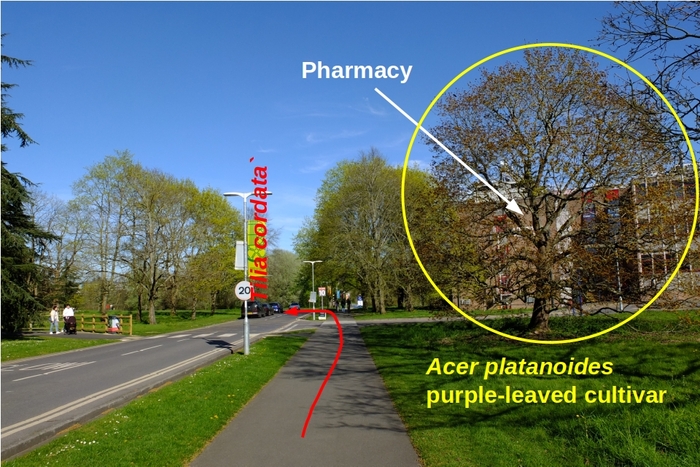
30 Acer platanoides cultivar, Purple-leaved Norway maple, Thomson North
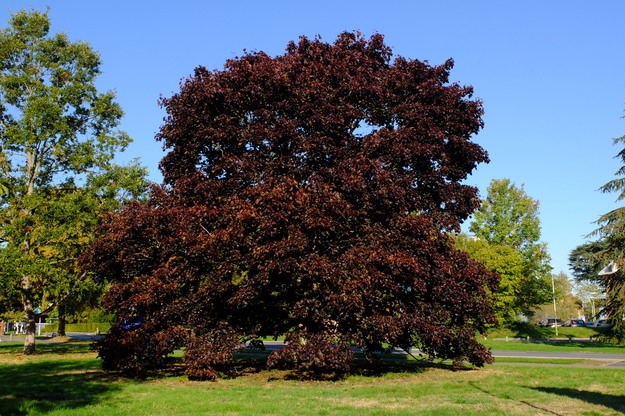
This is a cultivated variety of Acer platanoides, which is a species of deciduous broadleaf flowering plants (in the Sapindaceae or Soapberry family). This variety is selected for its leaf colour.
about this species
31 Tilia cordata, Small-leaved lime or linden, Park House
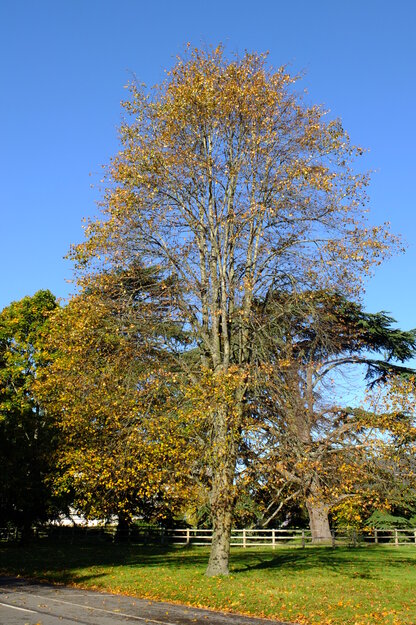
Tilia cordata is a species of deciduous broadleaf flowering plants (in the Malvaceae or Mallow family), native to Britain, Europe, western Asia and northern Iran. The tree can grow to about 30 metres tall, with a rounded or pyramidal shape, often with a surrounding of shoots growing from the base of the trunk. It has red buds in winter. Its leaves are finely toothed and heart-shaped, dark green above with a paler underside. In late June and early July it has small light yellow-green fragrant flowers in bunches of 5–10; they are attractive to bees and important for honey production. Lime flowers can also be used to make herbal tea (lime tea or linden tea, unrelated to citrus lime, which is genus Citrus). As in all Tilia species, the flowers are accompanied by long ribbon-shaped leaves (bracts), which become noticeable in summer because they turn yellow earlier than the other leaves; nonetheless, they persist on the tree into autumn, along with the clusters of small round dry fruit.
Tilia cordata is one of the three native Tilia (lime or linden) species (all present in Whiteknights Park). It can be distinguished by the tendency of its flowers to grow sideways or upwards, so that they are clearly visible above the leaves, whereas in the other species (Tilia platyphyllos and Tilia × europaea) all the flowers hang below the leaves. Also, the leaves are somewhat smaller, and their underside is hairless except for tufts of light red hairs near to the major veins.
Tilia cordata naturally grows in the forest understorey, but it is no longer common in British woods except in ancient ones. Traditionally it was cut back to the stump (the practice called "coppicing") to encourage rapid regrowth of many stems for firewood and poles (including Morris-dancing sticks). If this process is repeated a single tree, defined by its root system (since it does not have a single trunk), can live for centuries; one at the National Arboretum at Westonbirt is more than 2000 years old. The wood is white, finely-grained and soft, not strong but resistant to splitting and warping, and is used for wood carving, furniture and musical instruments.
In folklore across Europe limes are associated with fertility, justice, romance and liberty. In Germanic and Norse countries, it was the favourite tree of Freya, the goddess of love. Tilia cordata is widely planted along streets, in gardens, and in public landscapes.
about this species
Standing on the left of Tilia cordata and facing away from the road, Cedrus libani is on your left in a fenced-off area. There's another Cedrus deodara next to it; comparing the two of them, you may notice the differences in the characteristic shapes (habits) of these species.
32 Cedrus libani, Cedar of Lebanon, Park House
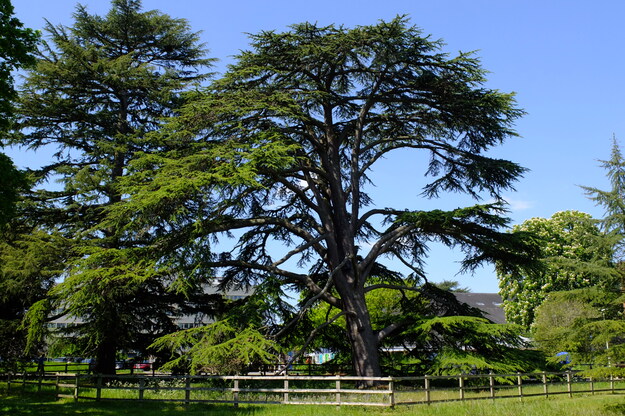
Cedrus libani is a species of evergreen needleleaf coniferous plants (in the Pinaceae or Pine family), native to the mountains of the eastern Mediterranean, particularly Lebanon, Syria, and Turkey. This majestic tree is distinguished by its broad, flat-topped crown and widely spreading branches with dense clusters of blue-green or dark green needles. It can grow to 40 metres and live for many centuries.
It has great historical and cultural significance, being long admired as a symbol of strength and endurance. The fragrant, durable wood of Cedrus libani was highly prized in ancient civilizations for building temples, ships, and palaces. Today, the species is widely planted as an ornamental tree in parks and large landscapes, where its impressive form and longevity make it a striking feature.
There are three Cedrus species ("true" cedars) grown in Britain, and Whiteknights Park has examples of all three, namely Cedrus atlantica, Cedrus libani and Cedrus deodara. Although fairly similar, they can be distinguished by their general shape ("habit", mature Cedrus libani being the most spreading), the direction in which their branch-tips point, and the length of their needles; see here for a comparison.
about this species
For the next three trees, the route curves round leftwards across the top of the meadow. Morus alba is near the old brick building (Park House), Quercus ilex is within a circular fence in the meadow, and Platanus orientalis is next to the path at the far side of the meadow.
33 Morus alba, White mulberry, Park meadow
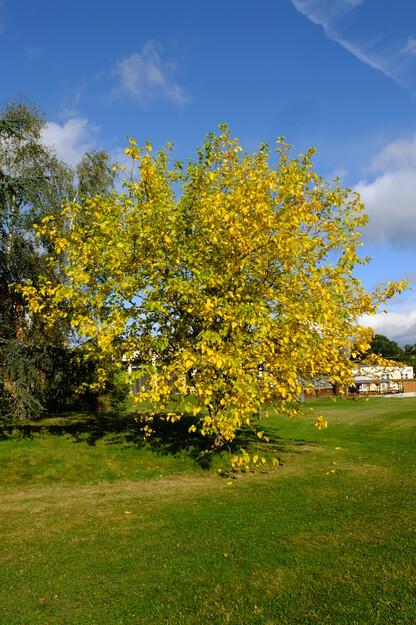
Morus alba is a species of deciduous broadleaf flowering plants (in the Moraceae or Mulberry family), native to central China. It is a small tree or large shrub up to about 15 metres tall.
The leaves of Morus alba are bright green and glossy, smooth on the upper surface, of variable size and irregular shape. On young shoots they may be divided into a small number of large lobes, and roughly serrated (with forward-pointing teeth) but on old shoots and mature trees they tend to be heart-shaped or oval, with a pointed tip, and rounded teeth.
The mulberry fruit is quite large and comprises a tight cluster of small fruits (in botanic terms, like a blackberry). It develops during spring and summer, initially green, then red, finally dark purple or black in the wild, but some cultivated varieties produce pink or white mulberries. They are edible and sweet but not strongly tasting, and are used traditionally for various culinary purposes in Asia.
Morus alba has been cultivated since at least 2700 BC in north-west China, being the tree on which domesticated and wild silkworms feed. Silk manufacture began in the Indian subcontinent not long after. Silkwork eggs were smuggled from Asia in 555 AD to begin silk production in the Eastern Roman Empire, using the leaves of Morus nigra (also present in Whiteknights Park). Morus alba was introduced to Europe in the 15th century, and probably to southern England in the 16th. The bark of the Morus alba is fibrous and can be used to make paper.
about this species
34 Quercus ilex, Holm or evergreen or holly oak, Park meadow
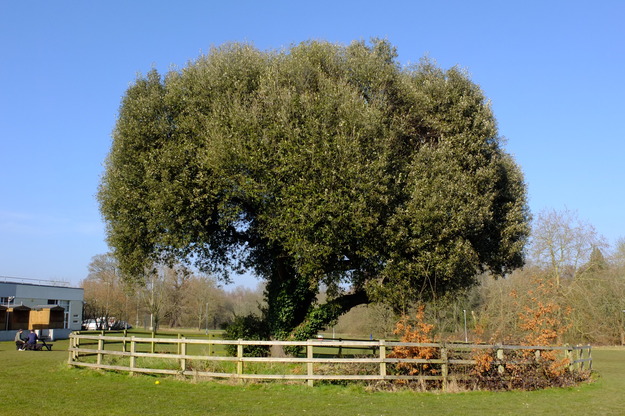
Quercus ilex is a species of evergreen broadleaf flowering plants (in the Fagaceae or Beech family), native to the Mediterranean, and naturalised in Britain. It was introduced here in the late 1500s. It can grow up 20–30 metres tall, forming a very broad and sometimes rounded crown, dense with leaves, casting deep shade. The leaves are narrow, sometimes with wavy or toothed edges, dark green on top with pale undersides. They are somewhat like holly (Ilex aquifolium), for which "holm" is an Old English name; the species name ilex is the Latin word for holm oak, and the botanic genus name for holly.
Quercus ilex can grow in dry and coastal conditions, but cannot withstand very sharp frost. Its wood is hard and dense; the Romans used it for making the wheels of carts and carriages. Its acorns are smaller than those of Quercus robur, the common oak.
about this species
35 Platanus orientalis, Oriental plane, Park meadow
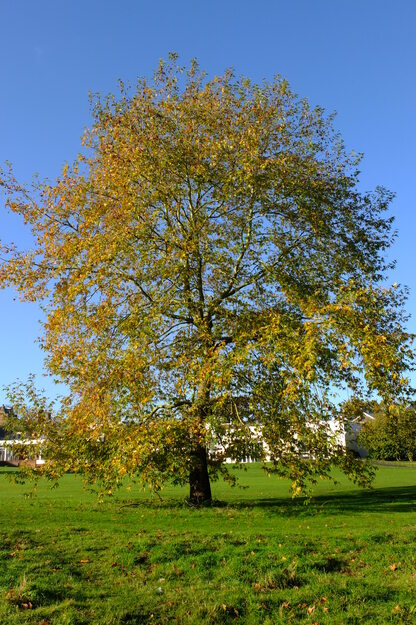
Platanus orientalis is a species of deciduous broadleaf flowering plants (in the Platanaceae family), native to south-eastern Europe, Turkey, the Caucasus and Iran. It can live for many centuries and grow into a huge tree, 40 metres in height, spreading very widely, with massive twisted branches and a thick trunk. Its bark is a distinctive patchwork that peels in irregular plates, revealing cream and grey-green colours underneath.
Platanus orientalis has large palm-shaped leaves with 5–7 lobes, similar to maple leaves; the lobes are more deeply divided than those of Platanus × hispanica (the London plane, also present in Whiteknights Park). Thanks to the size of both tree and leaves, plane trees cast a lot of shade, and are a feature of old towns and parks, although their natural habitat is riversides. The leaves of Platanus orientalis turn yellow and amber in autumn. Its fruit are spiky balls, borne in small groups.
The tree has a notable capability for sprouting anew and regenerating itself when damaged or coppiced. The species features in Greek and Roman history, being remarked upon by Pliny the Elder. According to legend, Hippocrates (considered the father of medicine) taught his pupils the art of medicine under a plane tree.
about this species
At Platanus orientalis, turn left uphill on the path, towards the one-storey white building (the Student Union). The next tree on the route is the tall Quercus robur in the corner of the car-park at the top of this path. There is another one just behind it too. Alternatively, you can cut across the meadow on the right to visit the pair of large Quercus robur at the right-hand end of the car-park which you can see from here, then turn left and walk along the car-park to rejoin the route at the tall Quercus robur.
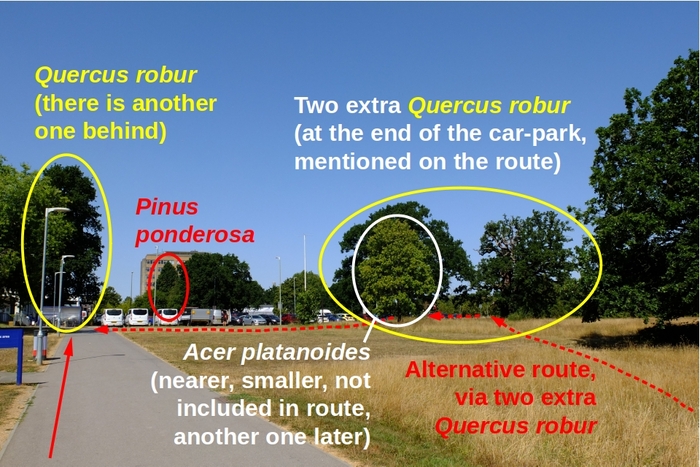
36 Quercus robur, Pedunculate or common oak, Nursery East
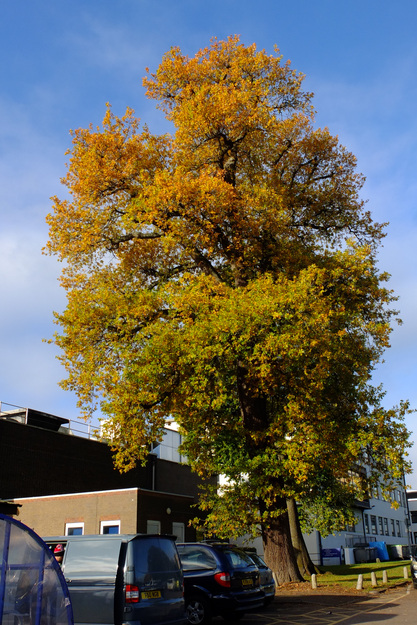
Quercus robur is a species of deciduous broadleaf flowering plants (in the Fagaceae or Beech family), native to Britain, Europe and northern Iran. This is a large tree, which grows to 20–40 metres tall and has thick branches that form a widely spreading and open canopy. When it grows in open spaces its breadth can exceed its height. It can live for many centuries, with some individuals more than 1000 years old, such as King Offa's oak.
Quercus robur is found throughout European woodlands. It is the dominant species of tree in English woods and open landscapes, excluding forestry plantations, and a key species in forest ecosystems. There are many mature Quercus robur around Whiteknights Park, and rows of younger ones planted along both sides of Queen's Drive by SportsPark; reflecting its prevalence and my preference, it is the species with most examples in the virtual arboretum. The closely related Quercus petraea (also present in Whiteknights Park) is the only other native Quercus (oak) species, and also widespread in Britain, but less numerous in southern England, because Quercus robur does better in heavy and moist soils. Both species fit the role of "the oak" as a symbol of strength and longevity in British tradition.
The bark of mature Quercus robur is grey-brown with many closely spaced predominantly vertical grooves and ridges. The tree bears brown buds in winter, which open comparatively late in spring. Short green catkins emerge first, in early April, and leaves afterwards. The leaves are of medium size, with three to six rounded smooth-edged lobes on each side and and one at the end, the lobes not being deeply separated, and often not symmetrically arranged. The acorns (the fruit of the oak) occur in clusters of two or three, each in a cup; they are initially green and become brown. The leaves turn golden brown in autumn before falling. It is quite common to see deformed walnut-like acorns and cups; these are due to parasitisation by tiny wasps, and are called knopper galls.
Quercus robur can be distinguished from Quercus petraea by both its acorns and its leaves (see this comparison, which includes other Quercus species). Quercus robur acorns are "pedunculate" (meaning they are attached to the twigs by stalks, whereas Quercus petraea acorns lack stalks). By contrast, Quercus robur leaves have only very short stalks, being closely attached to the twig (unlike Quercus petraea leaves).
The timber of Quercus robur is hard, strong and rot-resistant, and used for structural purposes, flooring, furniture, barrels and boat-building. Historically Quercus robur was important in providing timber for the construction of the British navy, and for sheltering the fugitive King Charles II.
about this species
You might also like to visit the pair of large Quercus robur on your right, at the other end of the car-park, if you haven't already.
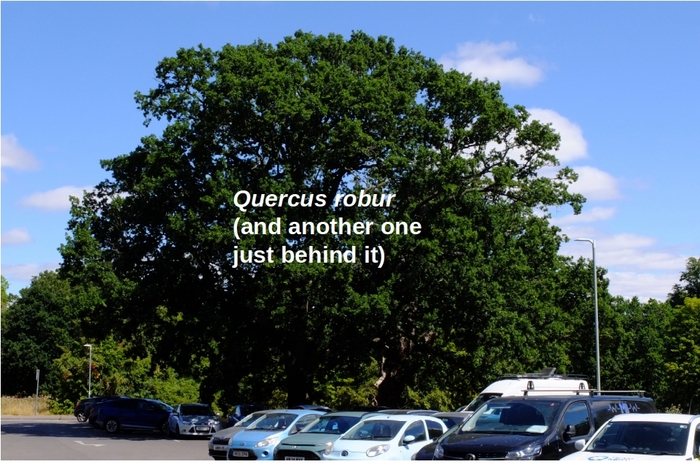
Continue past Quercus robur and the large building on the left (the Carrington Building), then turn right, along the boundary fence of the playground at the back of the one-storey Nursery. Pinus ponderosa is next to the other side of the Nursery fence. Populus tremula is at the junction of paths beyond, at the corner of the building ahead (the Knight Building).
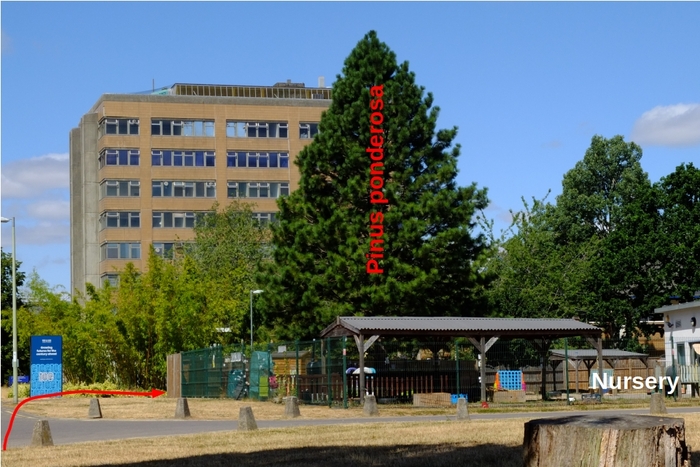
37 Pinus ponderosa, Ponderosa or western yellow pine, Nursery
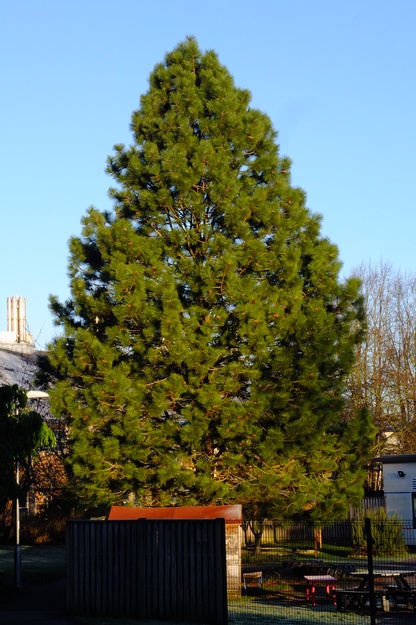
Pinus ponderosa is a species of evergreen needleleaf coniferous plants (in the Pinaceae or Pine family), native to western North America. It is a native of mountainous regions, adapted to dry conditions and wildfires every few years. The tree can grow live for for several centuries, and grow very large, to heights of up to 70 metres.
Pinus ponderosa has an upright columnar trunk, which is very obvious in mature trees because it has comparatively few and short branches, which sometimes point downwards; in young trees the branches are upward-pointing. The bark of is pinkish-brown and forms large plates. The needles are light green and in bundles of three.
Pinus ponderosa is the most widely distributed Pinus (pine) species of North America, and among the most important for timber. Its wood is moderately soft and fairly strong, and is used for construction and engineered wood products. Indigenous Americans made canoes from the trunks.
about this species
38 Populus tremula, Aspen, Knight Nursery
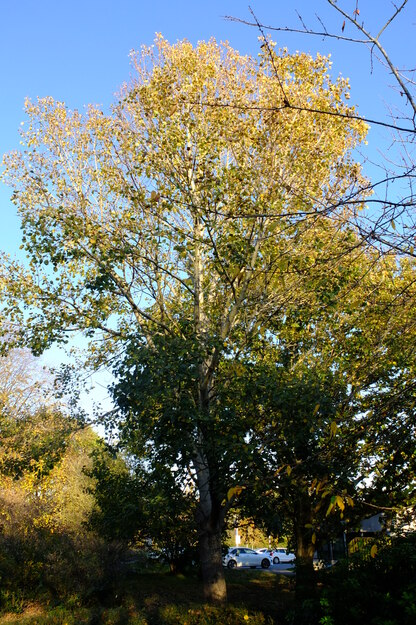
Populus tremula is a species of deciduous broadleaf flowering plants (in the Salicaceae or Willow family), native to Britain and most of Eurasia. It has round, bluntly toothed grey-green leaves that tremble or flutter even in the slightest breeze, giving the tree its characteristic shimmering appearance. The bark is smooth with diamond-shaped marks (like Populus alba) and is coloured pale green or grey.
Populus tremula is a pioneer species, often among the first to colonise open spaces after disturbances such as fire. It spreads extensively by suckers (root sprouts), which may be produced 35 metres away. Its light, soft wood of the aspen has traditionally been used for making paper, matches, plywood and musical instruments.
about this species
Turn left at Populus tremula. Acer griseum and Alnus cordata are at the entrance to the Knight Building.
39 Acer griseum, Paper-bark maple, Knight Palmer lawn
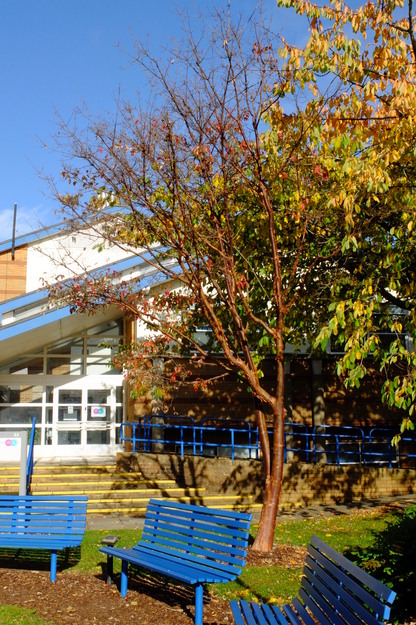
Acer griseum is a species of deciduous broadleaf flowering plants (in the Sapindaceae or Soapberry family), native to central China. Acer griseum is a small to medium-sized tree with ornamental qualities. It has distinctive cinnamon-brown bark, which peels away in thin, papery strips to reveal smooth layers beneath. It has green leaves in groups of three (in botanical terms, three leaflets comprising each compound leaf). They turn brilliant shades of red, orange, and scarlet in autumn.
about this species
40 Alnus cordata, Italian alder, Knight Palmer lawn
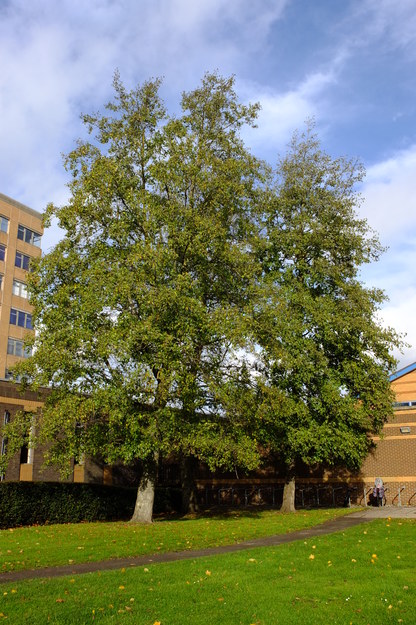
Alnus cordata is a species of deciduous broadleaf flowering plants (in the Betulaceae or Birch family), native to the southern Appenine mountains of Italy and the mountains of north-east Corsica. It is a fast-growing tree with a dense, pyramidal shape and glossy, heart-shaped green leaves that often remain on the tree late into autumn and remain green until they fall. Like other alders, it has pendulous male catkins, and upright female flowers which mature into small cones.
This species is particularly hardy and adaptable, thriving in a variety of soil conditions, including poor or dry soils, and it tolerates urban pollution well. Because of its rapid growth and resilience, Alnus cordata is often used in landscaping, reforestation projects, and as a windbreak in difficult sites to protect and encourage other species as they establish.
about this species
Turn away from the Knight Building and follow the path along the right of the building with white columns at the bottom (the Palmer Building). Tilia platyphyllos and Acer platanoides are between this path and the building on the right (the Minghella Studios).
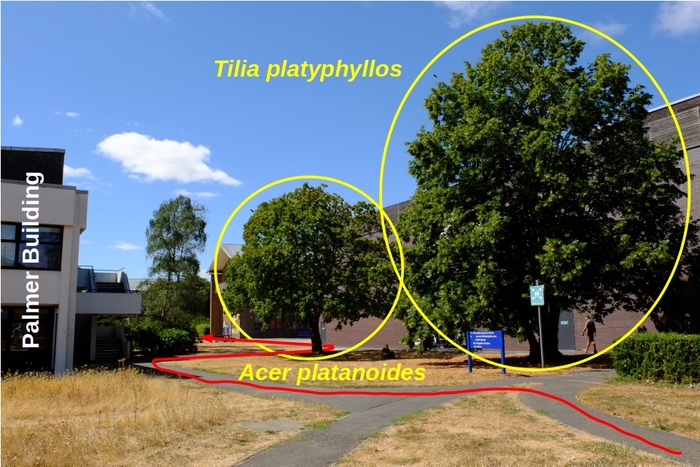
41 Tilia platyphyllos, Large-leaved lime or linden, Knight Palmer lawn
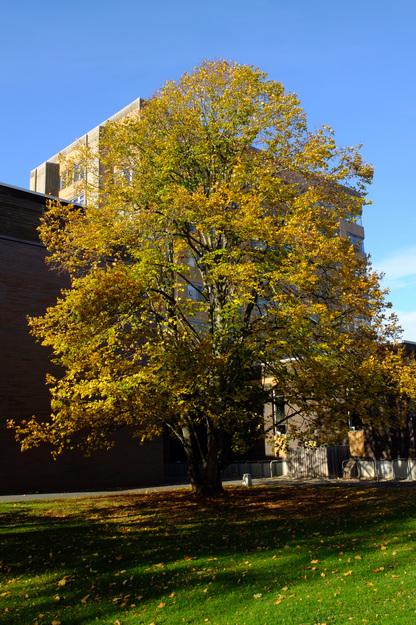
Tilia platyphyllos is a species of deciduous broadleaf flowering plants (in the Malvaceae or Mallow family), native to Britain, Europe and northern Iran. It is a large tree, which may grow to 40 metres. It has large heart-shaped sharply toothed leaves, which are dark green and slightly rough above and mid-green underneath.
In late June and early July it has small light yellow–green fragrant flowers in bunches of about four, hanging below the leaves; they are attractive to bees and important for honey production. Lime flowers can also be used to make herbal tea (lime tea or linden tea, unrelated to citrus lime, which is genus Citrus). As in all Tilia species, the flowers are accompanied by long ribbon-shaped leaves (bracts), which become noticeable in summer because they turn yellow earlier than the other leaves; nonetheless, they persist on the tree into autumn, along with the clusters of small round dry fruit.
Tilia platyphyllos is one of the three native Tilia (lime or linden) species (all present in Whiteknights Park). It can be distinguished by the small white hairs covering the underside of the leaves, giving them a furry feel, whereas the other species (Tilia × europaea and Tilia cordata) leaves are hairless on the underside, except for small patches near to the major veins. Also, the leaves of Tilia platyphyllos are generally larger than those of Tilia cordata, there are fewer flowers in the bunches, and Tilia platyphyllos does not have the tendency of the other species to sprout from the base of the trunk.
Tilia platyphyllos prefers well-drained soils, typically limestone (but the word "limestone" is unrelated to "lime" tree). It grows further south in Europe than Tilia cordata. Many ancient village limes of central Europe are Tilia platyphyllos. In folklore across Europe limes are associated with fertility, justice, romance and liberty. Because of its size, shade and beauty, Tilia platyphyllos is planted along streets, in gardens and in parks.
about this species
42 Acer platanoides, Norway maple, Minghella East
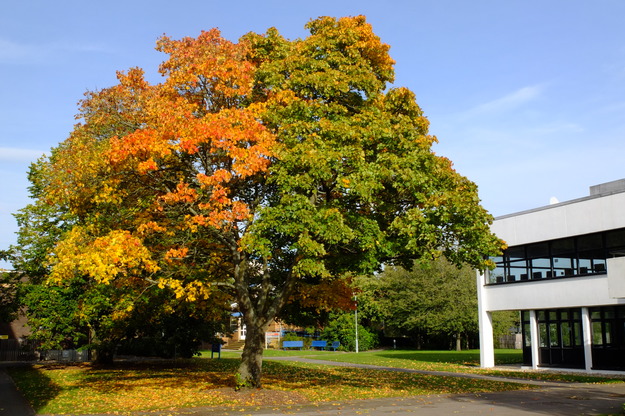
Acer platanoides is a species of deciduous broadleaf flowering plants (in the Sapindaceae or Soapberry family), native to Europe and western Asia. Acer platanoides is a large deciduous tree, recognisable from its broad, dense crown and distinctive large leaves that have five lobes, each with sharp points, often more than one point per lobe. In spring, Acer platanoides produces clusters of small yellow-green flowers before the leaves fully emerge, followed by widely angled pairs of winged seeds (samaras). (The leaves of Acer saccharum have rounded points, only one per lobe, and its samaras are horseshoe-shaped; see this comparison. The lobes of Acer pseudoplatanus leaves have blunt points, and its samaras are angled at 90 degrees or less.)
Tolerance to pollution, compacted soils and shade make Acer platanoides a popular street and park tree. However, it can become invasive where its dense canopy and prolific seed production may outcompete native vegetation. Its wood is used for furniture, flooring and musical instruments, especially for violins.
about this species
From Acer platanoides, go along the side of the Minghella Building, then straight on at the crossroads, passing the Centenary Mural on the end of the next building on the right. This is one wing of the three-storey part of the Edith Morley building, which forms a U-shape surrounding a lawn. Turn right after the Centenary Mural wall and go all the way round the lawn. The next two trees are on the lawn at the base of the U.
43 Pterocarya fraxinifolia, Caucasian wingnut, Edith Morley lawn
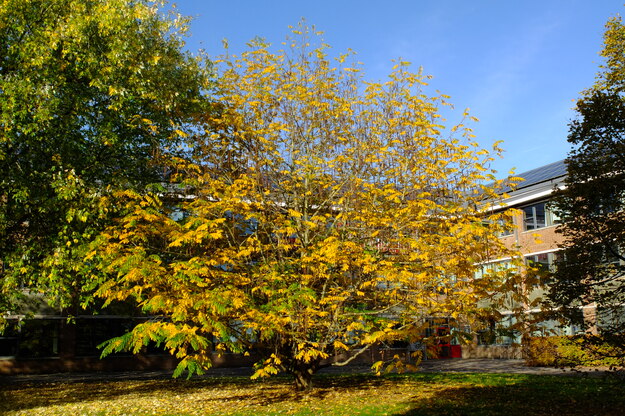
Pterocarya fraxinifolia is a species of deciduous broadleaf flowering plants (in the Juglandaceae or Walnut family), native to Turkey, the Caucasus and northern Iran. This is a fairly large tree, growing to about 30 metres, with a rounded shape. It has brown buds which open in late winter. In early spring it bears thick cyclindrical (male) catkins as its leave emerge. The leaves of Pterocarya fraxinifolia are medium-sized and oval, with small forward-facing teeth, arranged in pairs on opposite sides of a stem, and another at the end of the stem (technically these are leaflets making up a compound leaf). The specific name fraxinifolia means "with leaves like an ash" i.e. genus Fraxinus, because of the similarity of the leaf form e.g. Fraxinus excelsior.
The female flowers are in strings 30–50 cm long hanging from the branches; these develop over summer into strings of winged nuts, which are the fruit of the tree. The leaves turn golden-yellow before falling in autumn.
about this species
44 Acer saccharinum, Silver maple, Edith Morley lawn
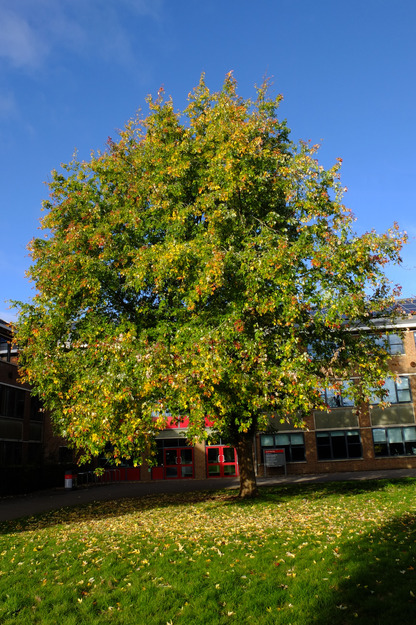
Acer saccharinum is a species of deciduous broadleaf flowering plants (in the Sapindaceae or Soapberry family), native to east and central North America. It is a fast-growing tree which attains 20–30 metres, and one of the commonest trees in the USA. Note that the scientific name is similar to Acer saccharum, the sugar maple, which is native to a similar region; the two species can be distinguished quite readily from appearance.
Acer saccharinum produces masses of small pink flowers in early spring, which are noticeable because they come before the leaves. The leaves are large, of long and jagged appearance. Each has five deeply divided lobes, of which the central one is the largest, and the ones nearest the stem are typically small. Each lobe itself has several irregularly arranged teeth. They are bright and somewhat glossy green on the upper side, very pale beneath, and produce a shimmering display in the wind. They turn yellow, orange and bright and dark red in autumn.
Acer saccharinum naturally occurs in floodplains and along waterways. It is commonly planted as an ornamental and street tree because of ease of propagation, quick growth and versatility regarding climate.
about this species
Turn right on leaving the Edith Morley U, resuming the same direction as you had before, to pass the end of the its other wing. This brings you to the square lawn (Whiteknights Quad) bounded by the Edith Morley Building, the Library, the URS Building (the one on stilts, currently being refurbished and fenced off) and Whiteknights House. There are many trees to visit in this area, including two British Isles champions (Arbutus andrachne and Gymnocladus dioicus). The route goes round it roughly anticlockwise (seen from above), and leaves through the gap between Whiteknights House and Edith Morley.
45 Arbutus andrachne, Grecian strawberry tree, Whiteknights Quad
On account of its exceptional size for its species, this tree is a British Isles champion in The Tree Register
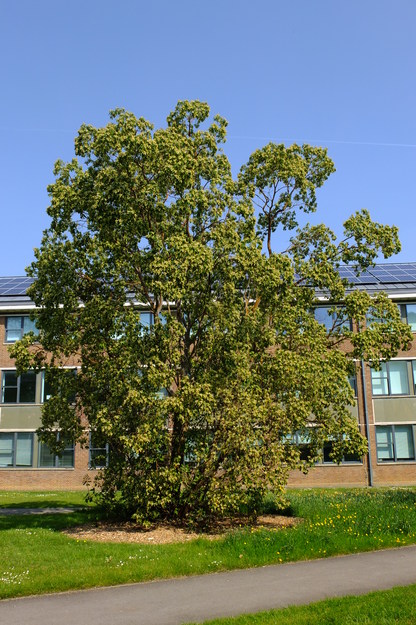
Arbutus andrachne is a species of evergreen broadleaf flowering plants (in the Ericaceae or Heath or heather family), native to the Mediterranean and the Middle East. It is a small tree, of up to about 10 metres, usually with several stems from its base (rather than a single trunk). Its mature bark is smooth and orange-red, and peels off in strips to reveal greenish new bark. The leaves are oval with smooth or slightly toothed edges. The tree produces bunches of many small green-yellow flowers in spring, followed by round fruit, covered with a network of grooves, ripening to red by autumn. The fruit are similar to those of Arbutus unedo, which is also present in Whiteknights Park, and give these species their English name of "strawberry tree". They are edible and can be used to make jam.
about this species
46 Tilia mongolica, Mongolian lime, Whiteknights Quad
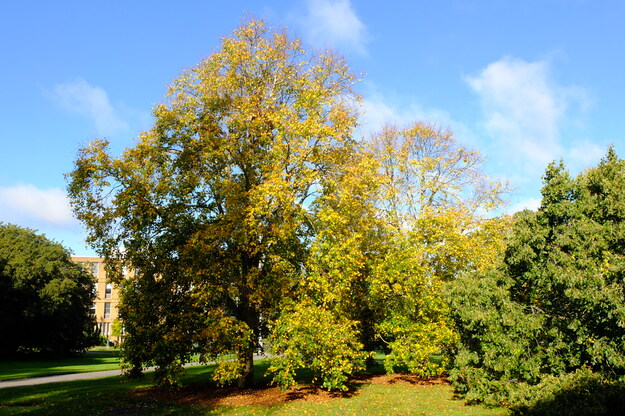
Tilia mongolica is a species of deciduous broadleaf flowering plants (in the Malvaceae or Mallow family), native to northern China. It is a slow-growing small or medium-sized tree, whose native habitat is mountainous. Its buds are red, and its leaves are glossy green, with jagged and irregular teeth. The leaves turn bright yellow in autumn. In June the tree bears clusters of numerous fragrant pale yellow flowers in summer that attract bees. As in all Tilia species, the flowers are accompanied by long ribbon-shaped leaves (bracts), which turn yellow and brown earlier than the other leaves; nonetheless, they persist on the tree into autumn, along with the clusters of small round dry fruit. "Lime" and "linden" are English words for Tilia species; they are unrelated to citrus limes, which are Citrus species.
about this species
47 Tilia henryana, Henry's lime, Whiteknights Quad
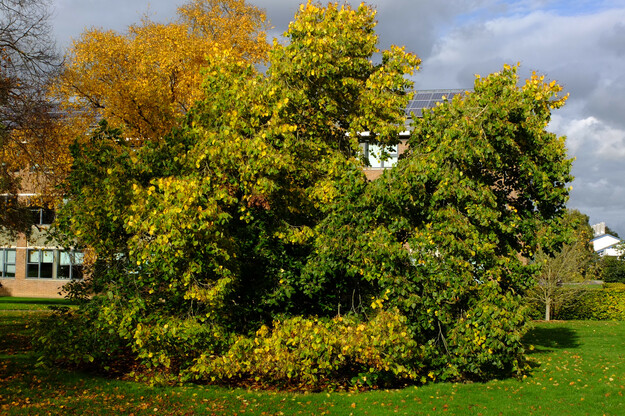
Tilia henryana is a species of deciduous broadleaf flowering plants (in the Malvaceae or Mallow family), native to central and south-eastern China. It is a tree of medium height, growing to 20 metres. It has green-yellow buds, and its leaves are yellow or even red when first open, but become shiny dark green above and paler beneath. They are heart-shaped, medium-sized and distinctive on account of the long bristles around their edges.
In late summer Tilia henryana bears tiny yellow fragrant flowers in bunches of 10–20, producing clusters of small round dry fruit. As in all Tilia species, the flowers are accompanied by long ribbon-shaped leaves (bracts), which turn yellow and brown earlier than the other leaves. Tilia henryana is often planted in botanical gardens and decorative landscapes on account of its elegant foliage and sweet-scented flowers. "Lime" and "linden" are English words for Tilia species; they are unrelated to citrus limes, which are Citrus species.
about this species
48 Taxodium distichum, Swamp cypress, Library South
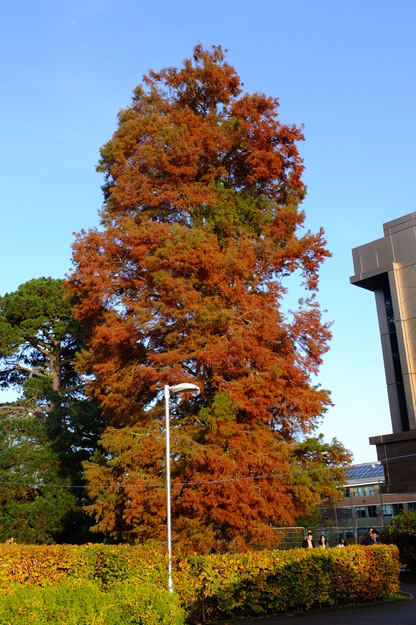
Taxodium distichum is a species of deciduous needleleaf coniferous plants (in the Cupressaceae or Cypress family), native to south-eastern North America. Taxodium distichum is a large tree adapted to wetlands and floodplains, where it develops distinctive woody "knees" that protrude from the ground, thought to aid in stability and gas exchange. It has soft, feathery green needles that turn a rich copper-brown in autumn before falling. It is widely planted as a specimen tree in parks and large landscapes for its impressive size, graceful form, and autumn colour.
about this species
49 Pinus radiata, Monterey pine, Whiteknights Quad
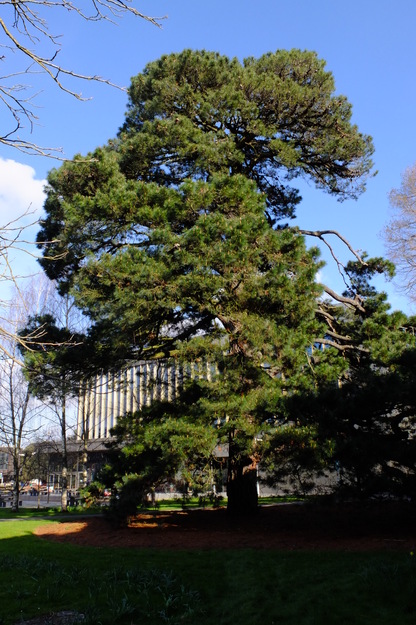
Pinus radiata is a species of evergreen needleleaf coniferous plants (in the Pinaceae or Pine family), native to the central coast of California and parts of Mexico. It has long, slender needles in bundles of three and medium-sized cones, which remain closed until opened by the heat of a forest fire; the seeds are then discharged to regenerate on the burned forest floor. In its native range it is critically endangered by pitch pine canker.
Pinus radiata has a tall, straight trunk with very rugged bark, upward-pointing branches and a rounded but irregular crown. It grows extremely rapidly (up to 2 metres per year), commonly to 30 metres in its native habitat and twice as high in cultivation. Consequently it is grown around the world, particularly in New Zealand and Australia, where it is a major source of timber for construction, paper production, and wood products such as MDF.
about this species
50 Gymnocladus dioicus, Kentucky coffee tree, Whiteknights Quad
On account of its exceptional size for its species, this tree is a British Isles champion in The Tree Register
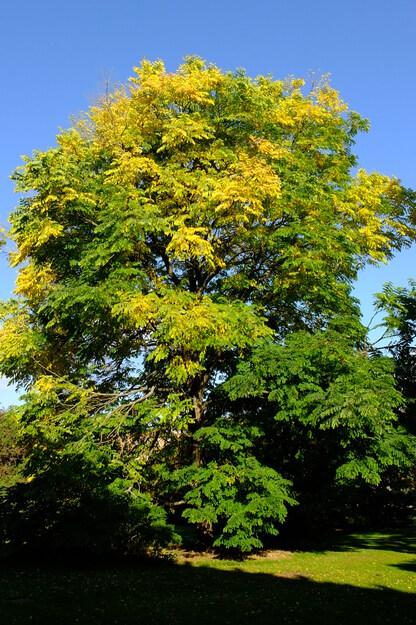
Gymnocladus dioicus is a species of deciduous broadleaf flowering plants (in the Fabaceae or Legume, pea or bean family), native to central and eastern North America. It is recognized by its coarse branching structure, thick grey bark, and complicated arrangement of leaves (bipinnate compound, in which each "leaf" in a technical sense comprises a stalk with several pairs of secondary stalks on opposite sides of it, and each secondary stalk has several pairs of "leaflets"). In winter, its bare branches, with no thin twigs, create a bold architectural form in the landscape.
The tree produces large, dark seed pods containing hard seeds that were historically roasted and eaten by native Americans, and used as a coffee substitute by early European settlers in America. The unroasted seeds and pods are toxic. The tough seed pods are too difficult for many animals to chew through and, in the wild, it only grows well in wetlands where the seed pods can rot away to allow germination.
about this species
51 Cryptomeria japonica, Japanese red cedar, Whiteknights Quad
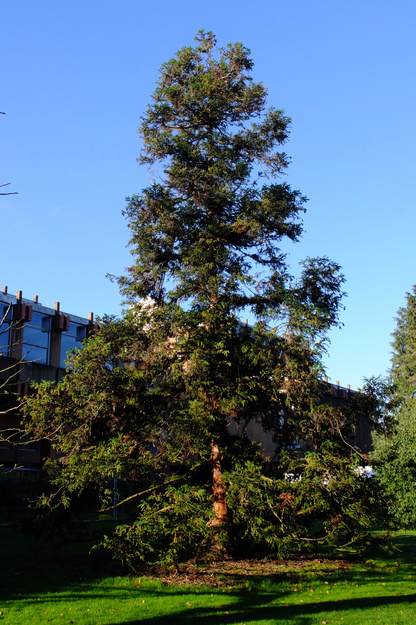
Cryptomeria japonica is a species of evergreen needleleaf coniferous plants (in the Cupressaceae or Cypress family), native to Japan and parts of China. A tall tree in its natural habitat, reaching heights of 50–70 metres, with a straight trunk and a narrow, conical crown. Its reddish-brown bark peels in long, fibrous strips, giving it ornamental interest. The tree has soft, awl-shaped needles arranged spirally along the shoots, often turning bronze in winter in cooler climates. Small, spherical cones develop at the tips of branches. Widely planted as both a forestry and ornamental species, Cryptomeria japonica is valued for its fragrant, durable wood and its elegant presence in parks and large gardens.
about this species
52 Fagus sylvatica, (Common or European) beech, Whiteknights Quad
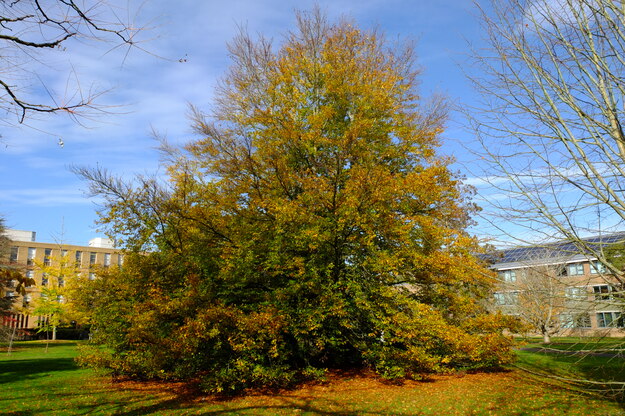
Fagus sylvatica is a species of deciduous broadleaf flowering plants (in the Fagaceae or Beech family), native to Britain and much of Europe. In British countryside, Fagus sylvatica is a monumental tree of great ecological importance. It can grow 30–40 metres tall and live for 300 years, forming a broad, dense crown with smooth, pale grey bark that remains relatively unbroken even in old age. It is often planted in parks as an impressive ornamental tree. Fagus sylvatica thrives in temperature climates on well-drained soils, such as chalk and limestone, naturally forming extensive forests. The remaining primaeval beech forests of Europe together compose a UNESO World Heritage site. Beech woods can be found nearby in the Chilterns and at Burnham. They are distinctive for having relatively little undergrowth, because of the deep shade cast by the canopy.
The tree has distinctive long, thin, pointed buds in winter, which open into glossy, oval green leaves. They resemble the leaves of hornbeam (Carpinus betulus) in their shape and arrangement of veins, but have slightly wavy edges, whereas those of hornbeam have a toothed edge. In spring the tree produces small flowers that develop into triangular beechnuts, which are edible by humans as well as wildlife. The leaves produce a beautiful yellow and golden brown display in autumn. When beech is cut short as hedging, it retains its leaves in winter; there are plenty of beech hedges in Whiteknights Park. Its wood is dense, strong, shock-resistant but bendable, and used for furniture, flooring, tools and kitchen utensils.
about this species
53 Acer sempervirens, Cretan maple, Whiteknights Quad
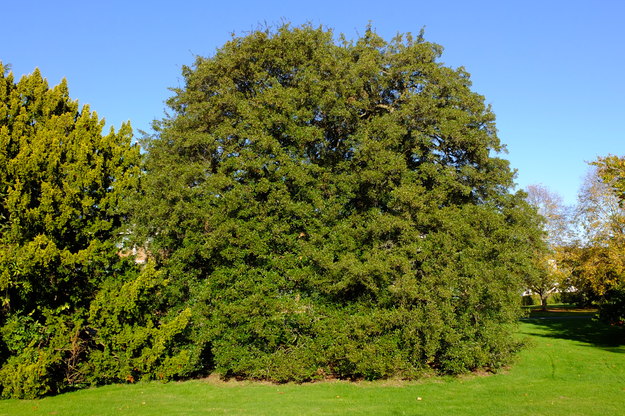
Acer sempervirens is a species of evergreen broadleaf flowering plants (in the Sapindaceae or Soapberry family), native to the Mediterranean, particularly Greece and Crete. It is a slow-growing tree, reaching 3–8 m in height, with small dark green, leathery leaves, often having a distinctive glossy appearance. It bears leaves; they look most sparse in late winter, just before they are renewed. In spring, it produces inconspicuous greenish-yellow flowers, followed by bright red paired winged seeds called samaras.
Acer sempervirens is well adapted to dry, rocky soils and hot, sunny climates, being remarkably drought-tolerant. In its native regions it has ecological role in stabilizing rocky slopes and supporting local wildlife. It is valued in landscaping for its compact, attractive form and resilience.
about this species
54 Nyssa sylvatica, Black tupelo or black gum, Whiteknights Quad
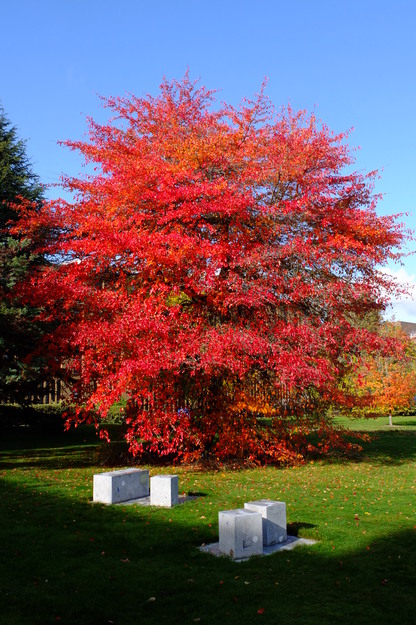
Nyssa sylvatica is a species of deciduous broadleaf flowering plants (in the Nyssaceae family), native to eastern North America. It grows to 30 metres. Its flowers appear in spring and are greenish-white. It has glossy green leaves which turn to astonishing colours of vivid scarlet, orange and purple in October.
Nyssa sylvatica provides food for many migratory birds in its native range. It is a top nectar source for bees and honey production. Its wood is heavy, hard and durable, and traditionally used for items that need to withstand friction and impact, such as pulleys and mallets.
about this species
55 Ginkgo biloba, Ginkgo, Whiteknights Quad
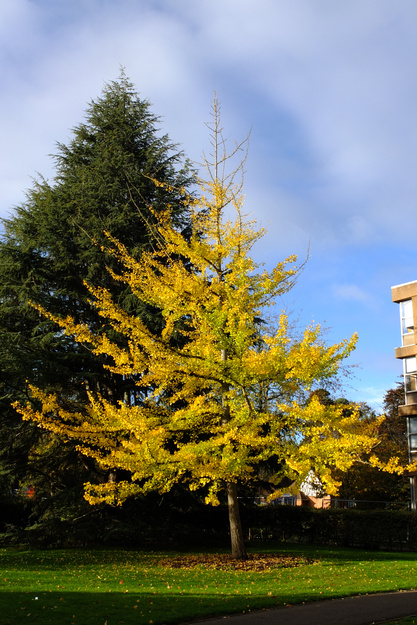
Ginkgo biloba is a species of deciduous broadleaf non-flowering plants (in the Ginkgoaceae family), native to China. The tree is easily recognized by its distinctive fan-shaped leaves, which turn a brilliant golden yellow in autumn before falling within a few days.
Ginkgo biloba is often described as a "living fossil" because trees like the present species have existed for 170 million years, and it is the sole surviving member of an ancient group of plants. It is endangered in the wild but commonly cultivated and widely planted worldwide in urban environments, being ornamental, tolerant of air pollution and disease-resistant. Gingko biloba can grow to 30 metres and the largest living trees are estimated to exceed 3,500 years old.
The wood of Ginkgo biloba is lightweight, resilient, and suitable for furniture, carved and turned objects. Its seeds have culinary uses. Various parts of the plant have a long history in traditional and contemporary herbal medicine, but with very little scientific evidence of health benefits.
about this species
56 Catalpa bignonioides, Indian bean tree or southern catalpa, Whiteknights Quad
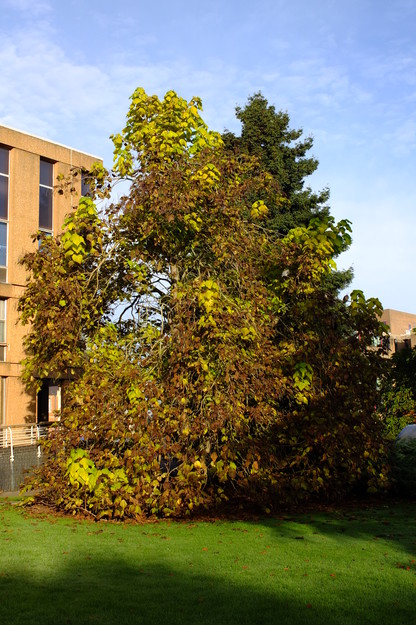
Catalpa bignonioides is a species of deciduous broadleaf flowering plants (in the Bignoniaceae or Trumpet vine family), native to south-eastern North America. It is easily recognized by its large heart-shaped leaves, showy clusters of white trumpet-shaped flowers during July, and long slender seed pods that resemble beans and often stay attached to the tree during winter.
Catalpa bignonioides grows quickly and adapts well to a range of soil conditions, which has led to its widespread planting as an ornamental shade tree. Although its wood is relatively soft, it is resistant to decay and has traditionally been used for fence posts and outdoor construction. The tree’s broad canopy and striking appearance make it a popular feature in parks and residential landscapes.
about this species
57 Magnolia kobus, Northern Japanese magnolia, Whiteknights Quad
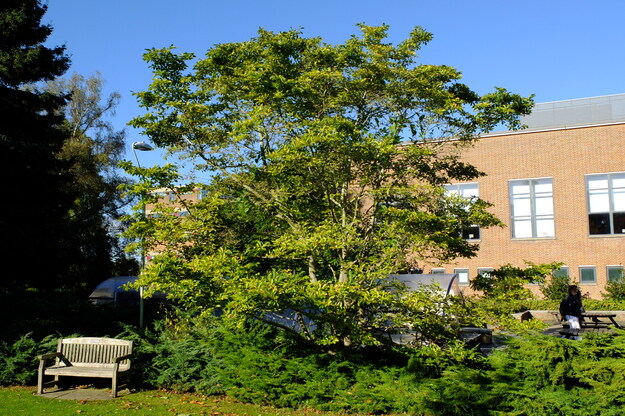
Magnolia kobus is a species of deciduous broadleaf flowering plants (in the Magnoliaceae or Magnolia family), native to Japan and Korea. It produces an early spring display of beautiful white flowers which are star-shaped and have a light fragrance. The leaves are medium-green and appear after the flowers. In autumn the leaves turn yellow and the tree bears clusters of small pink or bright red fruit.
Magnolia kobus is a common ornamental tree in gardens and parks. It thrives in temperate climates and tolerates cold winters well.
about this species
On leaving Whiteknights Quad, with Whiteknights House on your left, Juglans cathayensis and Metasequoia glyptostroboides are both on your right. They stand on opposite sides of the path towards the old brick building (Old Whiteknights House). After visiting them, return to the corner of Whiteknights House. Quercus rubra stands at this corner, by a postbox, and Liriodendron tulipifera is on the left of the path running diagonally across the lawn to the point where the route started, on Queen's Drive.
58 Juglans mandshurica, Manchurian walnut, Edith Morley West
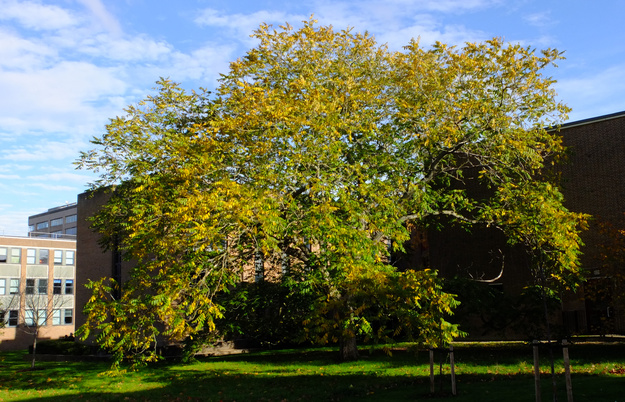
Juglans mandshurica is a species of deciduous broadleaf flowering plants (in the Juglandaceae or Walnut family), native to China, Korea and the far east of Russia. It has leaves in two rows of at least seven on either side of a midrib, like a feather, with one at the end (in botanical terminology, they are leaflets comprising a large compound leaf). In spring it bears long dangling yellow–green male catkins and upright clusters of small red female flowers, from which nuts develop, within an ovoid green husk. The nuts themselves have thick, hard, deeply ridged shells.
Juglans mandshurica is valued for its attractive appearance, nuts and timber, and has been cultivated for centuries in its native range. It commonly grows in forests and along river valleys, and is well-adapted to cold climates (down to −30°C).
about this species
59 Metasequoia glyptostroboides, Dawn redwood, Edith Morley West
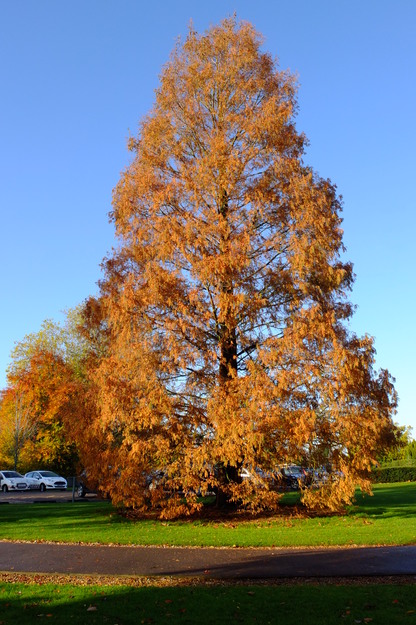
Metasequoia glyptostroboides is a species of deciduous needleleaf coniferous plants (in the Cupressaceae or Cypress family), native to China. The genus Metasequoia was known only from fossil evidence and considered extinct for 5 million years, until this species was found in the 1940s in Szechuan. It is a fast-growing tree which prefers a damp habitat and is adapted to growing on flood plains. It is critically endangered, partly due to intensive rice cultivation.
about this species
60 Quercus rubra, Red or northern red oak, Whiteknights House West
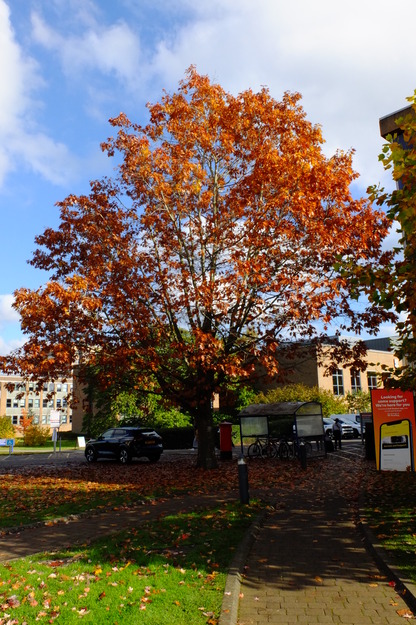
Quercus rubra is a species of deciduous broadleaf flowering plants (in the Fagaceae or Beech family), native to eastern North America. It is a large tree, growing to 20–40 metres, with a straight trunk and upward-angled branches, giving it a round-topped crown. Trees can live for 400 years.
Quercus rubra has large shiny or dark green leaves, with three to five lobes on each side and one at the end, all with pointed teeth. The leaves are larger and the lobes more numerous but less deeply divided than those of Quercus palustris. Quercus rubra is often planted in parks on account of its impressive display in autumn, when the leaves turn yellow, red and bronze.
Quercus rubra prefers moist, well-drained and slightly acidic soil. In optimal conditions, it grows quickly. It is an important species for hardwood production in North America. The wood is strong and used for flooring, veneer, interior trim, fence posts and furniture.
about this species
61 Liriodendron tulipifera, Tulip tree, Whiteknights House West
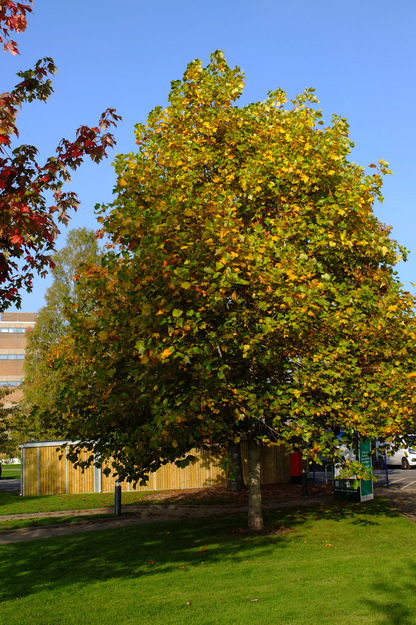
Liriodendron tulipifera is a species of deciduous broadleaf flowering plants (in the Magnoliaceae or Magnolia family), native to eastern North America. Its leaves have a unique four-lobed shape with a squared-off tip. The flowers are greenish-yellow tulip-shaped blooms with orange markings, usually high up in the canopy. The tree can reach 30–50 metres and is among the tallest hardwoods. It has a grey-brown bark which develops deep ridges as it ages. The tree grows very rapidly and is used in construction and for furniture veneer.
about this species