Tree of the day: Acer tataricum ginnala, Amur maple, Whiteknights House West
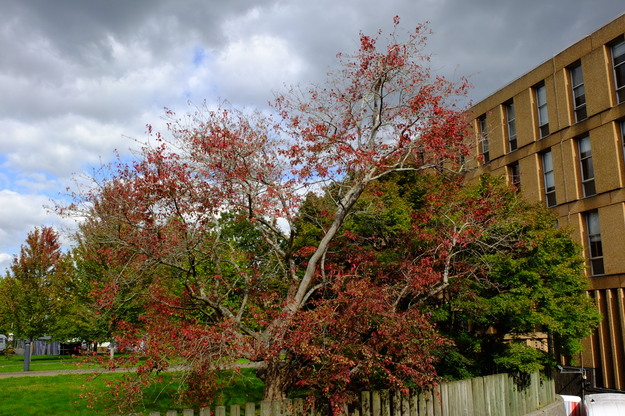
Acer tataricum ginnala is a species of deciduous broadleaf flowering plants (in the Sapindaceae or Soapberry family), native to Korea, north and central eastern China and far eastern Russia.
Acer tataricum ginnala is a species of deciduous broadleaf flowering plants (in the Sapindaceae or Soapberry family), native to Korea, north and central eastern China and far eastern Russia. It is a small tree, attaining 10 metres in height, which grows on riverbanks, in floodplains and in other damp places. It can tolerate temperatures as low as −40°C, allowing it to grow at altitudes of up to 3000 metres in its native range. It is closely related to Acer tataricum tataricum (Tatar maple); these two subspecies of Acer tataricum have disjoint native ranges, and are sometimes regarded as distinct species.
Acer tataricum ginnala has medium-sized matt green leaves, arranged in pairs on opposite sides of the stem. They are longer than they are broad, have coarsely toothed edges, and may have three or five lobes, but some have no lobes; any given tree has various shapes of leaf. The leaves turn bright yellow, orange or red in autumn. This feature, its rapid growth and its small size make Acer tataricum ginnala an attractive ornamental. In spring the tree produces bunches of many small light green flowers. Like other Acer (maple) species, its fruit are dry two-winged samaras; they are initially green, with pink tinges, turning brown by autumn. The bark of the tree is grey-brown, with shallow fissures on older plants.
about this species


See more trees and close-up photos of this species
This photo is one of 9615 photos of 891 trees in 340 species
This website is a virtual arboretum, created for interest, education and beauty. It exhibits some of the thousands of trees, of both native and exotic species, that grow in Whiteknights Park, the main campus of the University of Reading. Many of them have been planted since the university arrived in 1947, but some have been here since the 19th century or earlier, when Whiteknights was the gardens and parkland of large houses. More than a hundred of the trees are listed in The Tree Register, nine as British Isles champions (the largest or tallest of their species).
Please send any comments about this website to whiteknights-trees@reading.ac.uk.
The previous version of this website is here.
Acknowledgements
Acknowledgements
I would like to thank: Rupert Taylor, Owen Johnson, Alastair Culham, Jonathan Mitchley, Jordan Bilsborrow, Marcus Wheeler, Benoît Vannière, Miguel Teixeira and Claire Hawkins for tree identifications; Brian Hunt and Trevor Smith for testing routes and contributing text; Dylan Parkes, Martin Watts, Emilija Rudzinskaite, Brian and Trevor for collaboration on the centenary project; Dan Hodson for useful code examples; Studio Lift for website style; Brian, Trevor, Nathanaël van Twillert and Guy Raveh for comments and suggestions on website user experience; Benoît, Marcus, Steve George, Mark Wrightham, Brian, Trevor, the Friends of the University of Reading, and other friends for their encouragement during the development of the website; the University and its grounds staff for maintaining Whiteknights Park.