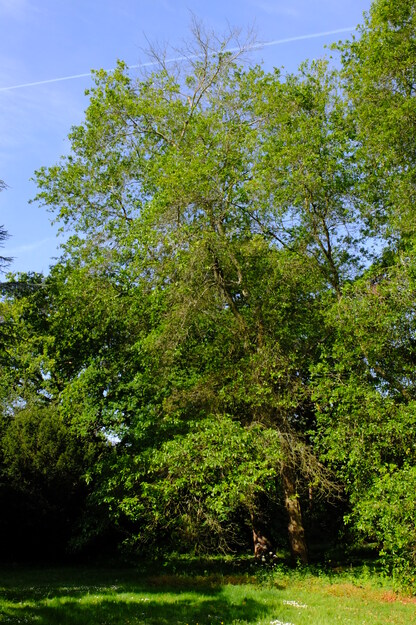
Quercus nigra is a species of deciduous broadleaf flowering plants (in the Fagaceae or Beech family), native to south-eastern and south-central North America. Depending on climate, this species can either be deciduous, with no leaves in mid-winter, or keep its old leaves until new ones appear in spring; the group in Whiteknights Park have some leaves throughout the winter. The leaves are glossy, light green when opening in April and darkening subsequently. They are of medium length, much narrower than long, usually broader at the end, and even on a single tree they have a great variety of shapes, often with three or more shallow lobes. In the autumn the tree produces small round acorns.
Quercus nigra is a medium-large tree, of up to 30 metres. The bark is light brown when young, grey-brown with many grooves in older trees. Its lifespan is short compared with many oak (Quercus) species, generally less than 200 years. It prefers to grow in moist sunny places, such as along streams and in floodplains.
External webpages
about this species


about this species
How to use the map
Drag with your finger or mouse to move the map.
 Zoom in or out. You can also do this with the mousewheel or by pinching.
Marker of the position of an identified tree, while the map is zoomed out. For the details, zoom in until you see tree markers like the following …

 Clicking on a tree marker brings up a window (called a "popup")
identifying the species of the tree there, with a small photo of it and buttons
to display more photos and information. NB only a few hundred of the thousands
of trees are marked!
7Marker of a tree of the selected species; clicking it will zoom and centre the map on this tree, and bring up a photo of it in the frame.
 Marker of a British Isles champion tree in
The Tree Register.
✕ Click the cross at the top right of any window, including this one, to get rid of it.
 Click to choose whether more than one popup can be open at once.

 Click to dismiss the open popup, or all open popups. You can also close
the popups by clicking on the map anywhere apart from a popup or marker.
Choose alternative versions of the map. The tree markers, popups, map centre and zoom are all unaffected by switching.
 Turn on a flashing dot which tracks your live location on the map, surrounded
by a circle indicating the accuracy of the location. This will work
only if your device has a satellite navigation (GPS etc.) receiver which is
enabled and can acquire a signal. You will probably be asked to allow the
website to access "location services" the first time you press this button.
The button flashes orange while trying to locate you,
and green while your location is shown. Press it again to turn it off.
 Recentre the map on your present location, while live location is active.
 Reset the map to its original centre and zoom.
To click on a tree, zoom in until you see
tree markers
Wessex lakesideSee all photos of this tree

Wessex lakesideSee all photos of this tree

On account of its exceptional size for its species, this tree is a
British Isles champion in The Tree Register
Wessex lakesideSee all photos of this tree