Tree of the day: Acer palmatum cultivar, Purple Japanese maple, Harris Garden
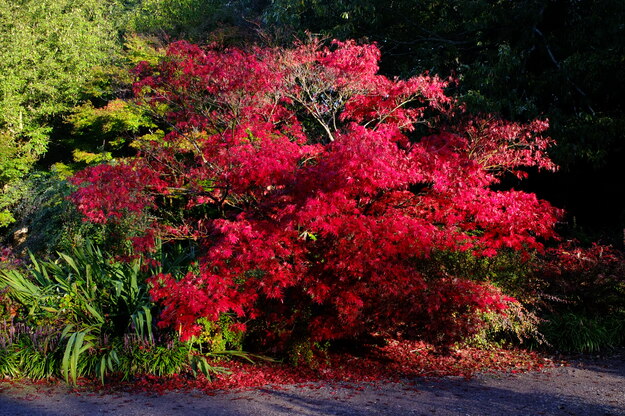
This is a cultivated variety of Acer palmatum, which is a species of deciduous broadleaf flowering plants (in the Sapindaceae or Soapberry family).
This is a cultivated variety of Acer palmatum, which is a species of deciduous broadleaf flowering plants (in the Sapindaceae or Soapberry family).
about this species


See more trees and close-up photos of this species
This photo is one of 9407 photos of 877 trees in 334 species
This website is a virtual arboretum, created for interest, education and beauty. It exhibits some of the thousands of trees, of both native and exotic species, that grow in Whiteknights Park, the main campus of the University of Reading. Many of them have been planted since the university arrived in 1947, but some have been here since the 19th century or earlier, when Whiteknights was the gardens and parkland of large houses. More than a hundred of the trees are listed in The Tree Register, nine as British Isles champions (the largest or tallest of their species).
Please send any comments about this website to whiteknights-trees@reading.ac.uk.
The previous version of this website is here.
Acknowledgements
Acknowledgements
I would like to thank: Rupert Taylor, Owen Johnson, Alastair Culham, Jonathan Mitchley, Jordan Bilsborrow, Marcus Wheeler, Benoît Vannière, Miguel Teixeira and Claire Hawkins for tree identifications; Brian Hunt and Trevor Smith for testing routes and contributing text; Dylan Parkes, Martin Watts, Emilija Rudzinskaite, Brian and Trevor for collaboration on the centenary project; Dan Hodson for useful code examples; Studio Lift for website style; Brian, Trevor and Nathanaël van Twillert for comments and suggestions on website user experience; Benoît, Marcus, Steve George, Mark Wrightham, Brian, Trevor, the Friends of the University of Reading, and other friends for their encouragement during the development of the website; the University and its grounds staff for maintaining Whiteknights Park.