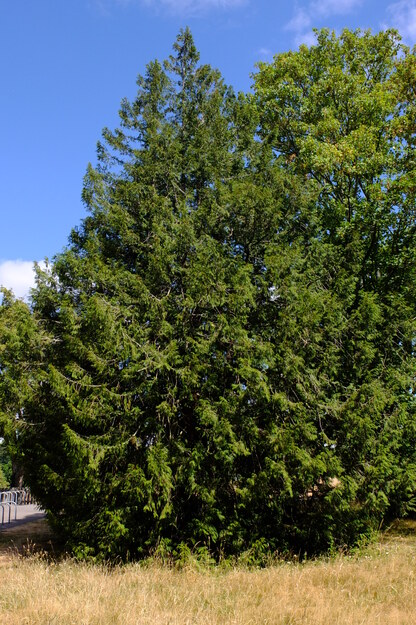
Thuja plicata is a species of evergreen needleleaf coniferous plants (in the Cupressaceae or Cypress family), native to Pacific north-west of North America. It is a very large tree, of up to 70 metres, which can live to more than 1000 years. Large specimens tend to be conical in shape, with the trunk broadening at the base. Groups of it are a majestic sight.
The leaves of Thuja plicata are scale-like (meaning they look like thin cylinders whose surface is composed of small overlapping plates; in this they are typical of Cupressaceae). They are arranged in flat branching sprays in pairs on opposite sides of a twig. The tree bears groups of small egg-shaped cones with overlapping scales, initially green and becoming woody. Its bark is red-brown and fibrous with vertical grooves.
Thuja plicata is important in the native American cultures of its natural range, providing wood for articles such as canoes, houses and totem poles, fibre from its bark used for ropes, baskets and clothing, and as a symbol of strength. It prefers mild, rainy climates and grows well in this country, where it is planted as an ornamental tree, for shelter and for timber. It wood is not strong, but it is light, very rot-resistant and does not warp. It is commonly used for garden constructions, cladding, roof shingles and boats, and also pencils.
External webpages
about this species


about this species
How to use the map
Drag with your finger or mouse to move the map.
 Zoom in or out. You can also do this with the mousewheel or by pinching.
Marker of the position of an identified tree, while the map is zoomed out. For the details, zoom in until you see tree markers like the following …

 Clicking on a tree marker brings up a window (called a "popup")
identifying the species of the tree there, with a small photo of it and buttons
to display more photos and information. NB only a few hundred of the thousands
of trees are marked!
7Marker of a tree of the selected species; clicking it will zoom and centre the map on this tree, and bring up a photo of it in the frame.
 Marker of a British Isles champion tree in
The Tree Register.
✕ Click the cross at the top right of any window, including this one, to get rid of it.
 Click to choose whether more than one popup can be open at once.

 Click to dismiss the open popup, or all open popups. You can also close
the popups by clicking on the map anywhere apart from a popup or marker.
Choose alternative versions of the map. The tree markers, popups, map centre and zoom are all unaffected by switching.
 Turn on a flashing dot which tracks your live location on the map, surrounded
by a circle indicating the accuracy of the location. This will work
only if your device has a satellite navigation (GPS etc.) receiver which is
enabled and can acquire a signal. You will probably be asked to allow the
website to access "location services" the first time you press this button.
The button flashes orange while trying to locate you,
and green while your location is shown. Press it again to turn it off.
 Recentre the map on your present location, while live location is active.
 Reset the map to its original centre and zoom.
To click on a tree, zoom in until you see
tree markers
Chancellor's EastSee all photos of this tree