Taxus baccata is a species of evergreen needleleaf coniferous plants (in the Taxaceae or Yew family), native to Europe including Britain, western Russia, the Caucasus, Asia Minor, northern Iran and north-west Africa. It is a small tree, of 10–20 metres in height, whose trunk is typically very broad and often gnarled, with red-brown bark that has many mainly vertical narrow cracks dividing it into flakes. Its leaves are short flat soft dark green needles, which mostly appear arranged in rows along both side of a stem, but which are attached spirally around the stem, as can be seen at the ends of projecting branches. The dense canopy of evergreen foliage casts a dark shade, which prevents undergrowth.
In spring, mature trees mostly bear either small grey-brown (male) pollen cones, or small green acorn-like (female) seed cones, both of which are quite inconspicuous. A few individuals have both male and female cones. The female cones develop into open-ended red berries in late summer and autumn, which are very obvious. The specific Latin name baccata means "bearing berries"; in botanical terms, however, these objects are arils, not berries. They form from the wall of a fertilised seed, whereas a berry is formed from the ovary of a fertilised flower, and Taxus baccata is not a flowering plant. The aril is edible, but all other parts of the tree are poisonous and can be lethal if eaten; the toxins can also be absorbed through the skin.
Taxus baccata is very hardy and adaptable to many conditions. It prefers limestone and chalk slopes and can form forests by itself or with other species, such as Fagus sylvatica, the common beech, where it thrives in the shade. It grows slowly and can live for many centuries; some individuals are believed to be 1000 years old. Its longevity may be assisted by the tree's ability to sprout from anywhere, and to grow back into itself; yew trees can continue to live when their heartwood has all decayed.
The timber of Taxus baccata is rot-resistant, durable, dense, fairly hard, notably strong and flexible. By virtue of these characteristics, yew wood was the usual choice for making bows in particular, as well as many other objects including musical instruments, from the earliest times in Europe. The oldest known artefact of yew is a spearhead 400,000 years old found at Clacton. In the Middle Ages its utility and its toxicity to farmed animals led to its being felled to near-extinction. In modern times, it is mostly planted as an ornamental; its slow growth and tolerance of pruning makes it popular for hedges and topiary. It has also often been planted in churchyards, perhaps because of a mystical significance, for which several explanations are suggested, concerning longevity or toxicity.
External webpages
about this species


about this species
How to use the map
Drag with your finger or mouse to move the map.
 Zoom in or out. You can also do this with the mousewheel or by pinching.
Marker of the position of an identified tree, while the map is zoomed out. For the details, zoom in until you see tree markers like the following …

 Clicking on a tree marker brings up a window (called a "popup")
identifying the species of the tree there, with a small photo of it and buttons
to display more photos and information. NB only a few hundred of the thousands
of trees are marked!
7Marker of a tree of the selected species; clicking it will zoom and centre the map on this tree, and bring up a photo of it in the frame.
 Marker of a British Isles champion tree in
The Tree Register.
✕ Click the cross at the top right of any window, including this one, to get rid of it.
 Click to choose whether more than one popup can be open at once.

 Click to dismiss the open popup, or all open popups. You can also close
the popups by clicking on the map anywhere apart from a popup or marker.
Choose alternative versions of the map. The tree markers, popups, map centre and zoom are all unaffected by switching.
 Turn on a flashing dot which tracks your live location on the map, surrounded
by a circle indicating the accuracy of the location. This will work
only if your device has a satellite navigation (GPS etc.) receiver which is
enabled and can acquire a signal. You will probably be asked to allow the
website to access "location services" the first time you press this button.
The button flashes orange while trying to locate you,
and green while your location is shown. Press it again to turn it off.
 Recentre the map on your present location, while live location is active.
 Reset the map to its original centre and zoom.
To click on a tree, zoom in until you see
tree markers
Old Whiteknights House North
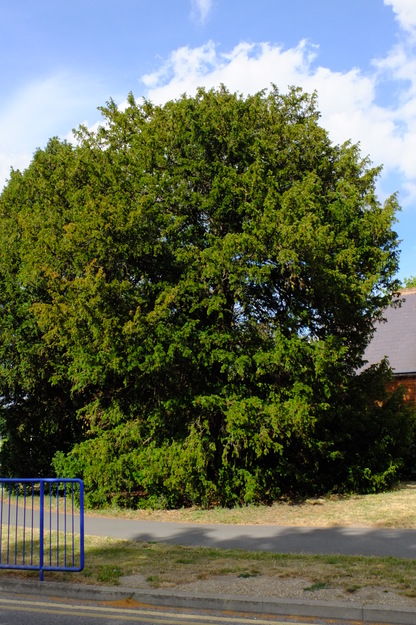
Redrow Drive

Foxhill

Foxhill
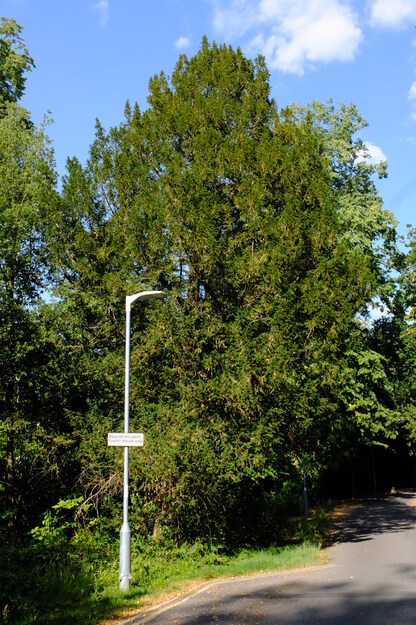
Foxhill

Park House Lodge


