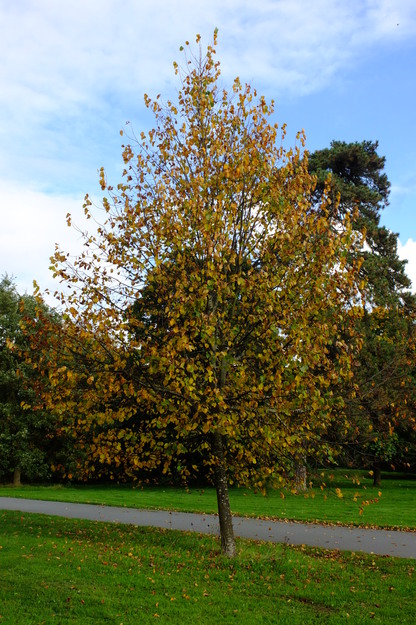
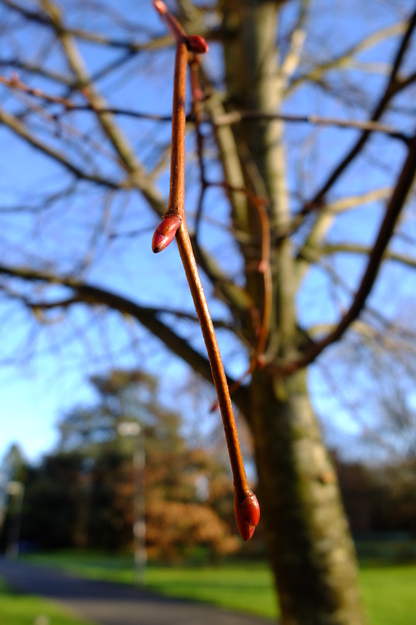
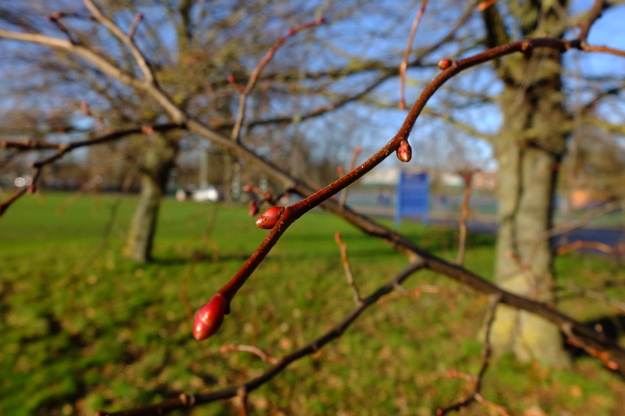
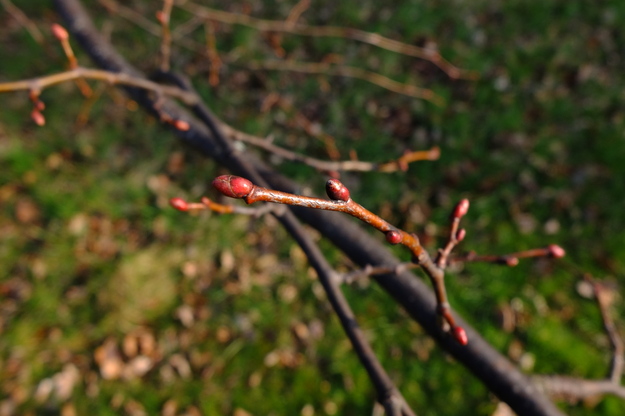
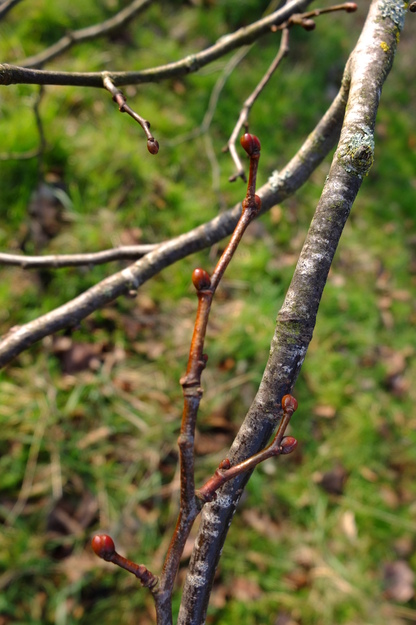
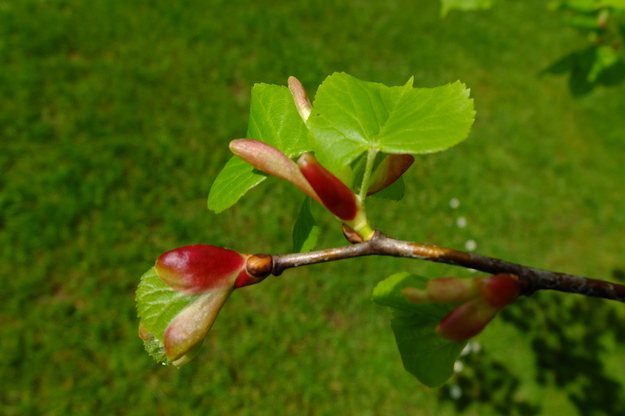
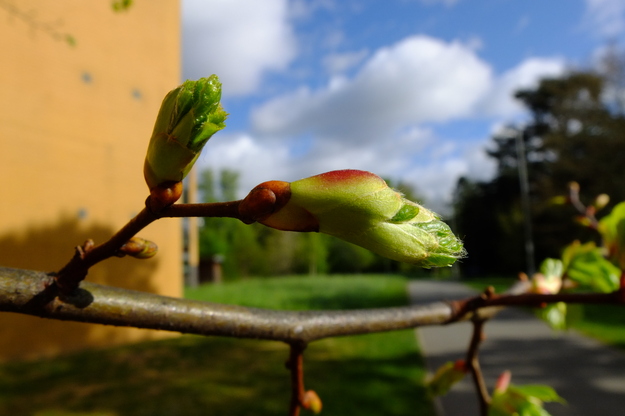
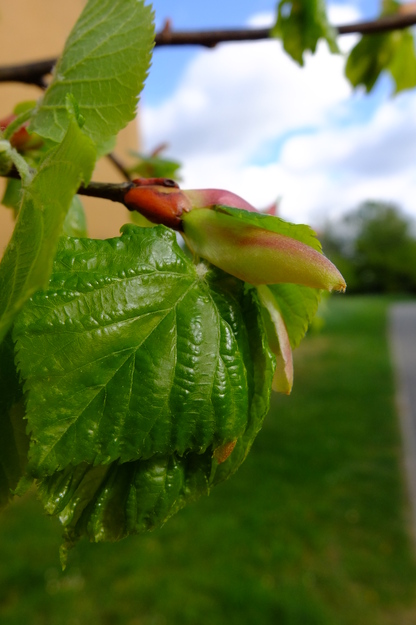
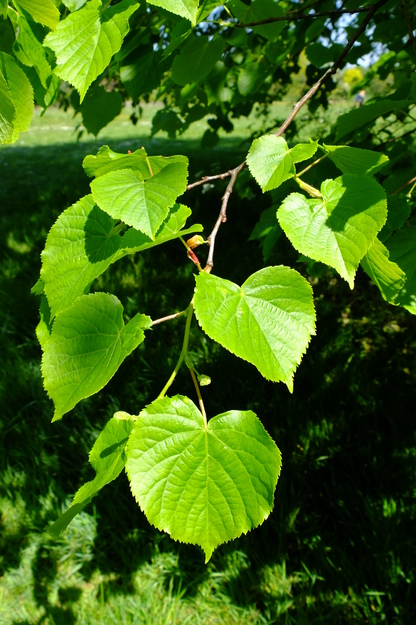
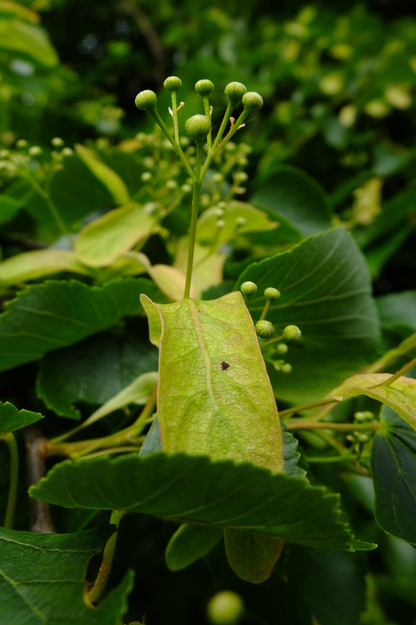
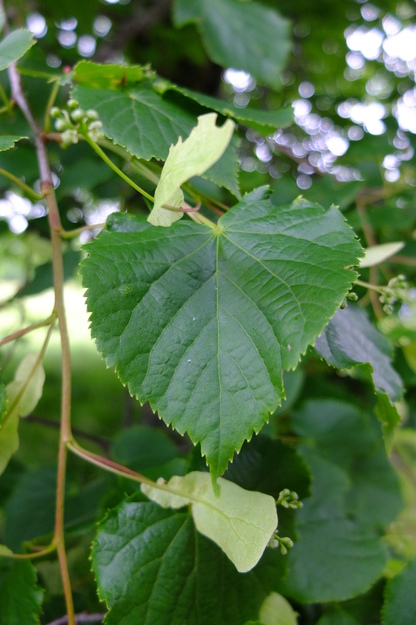
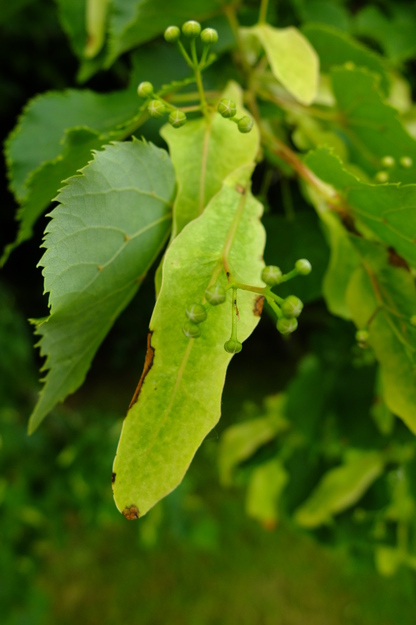
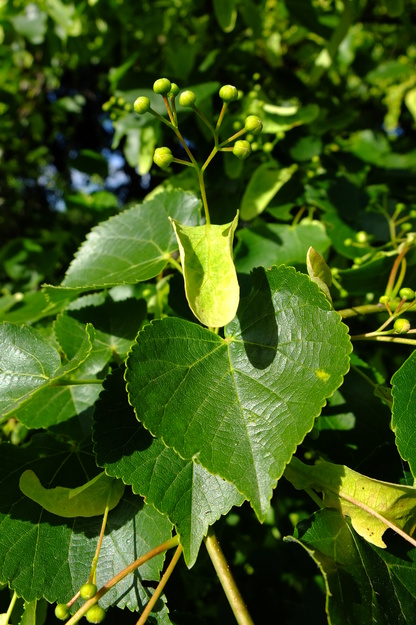
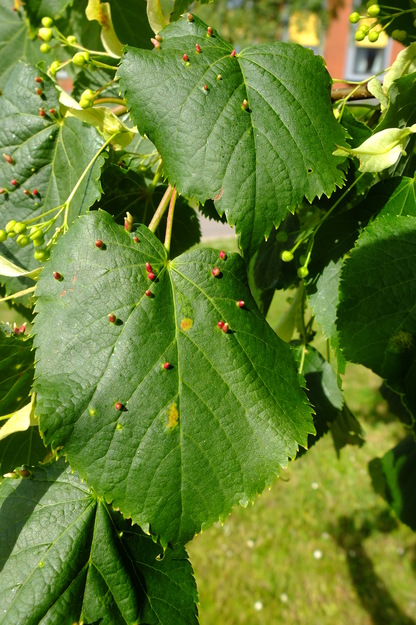
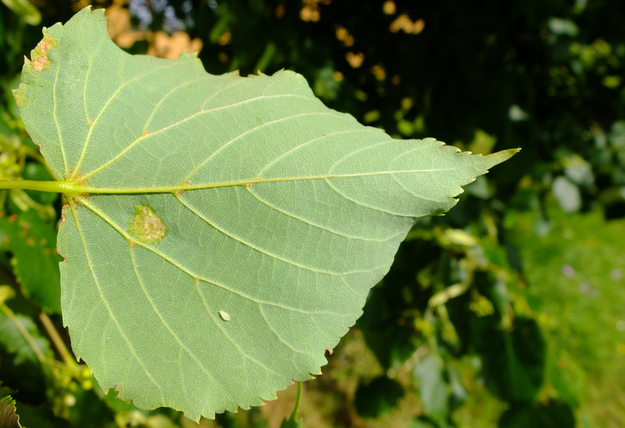
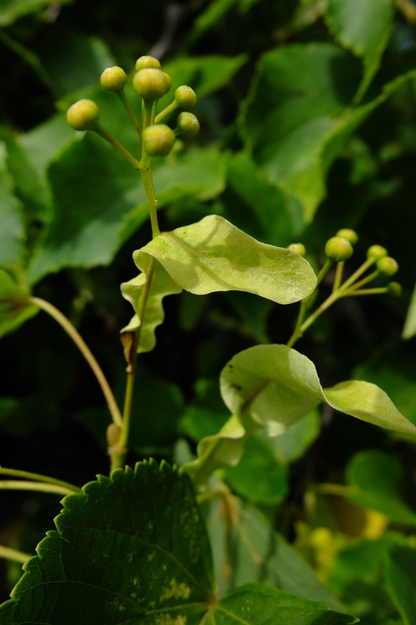
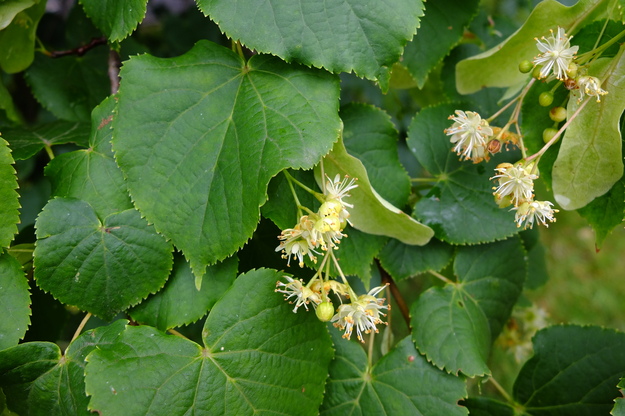
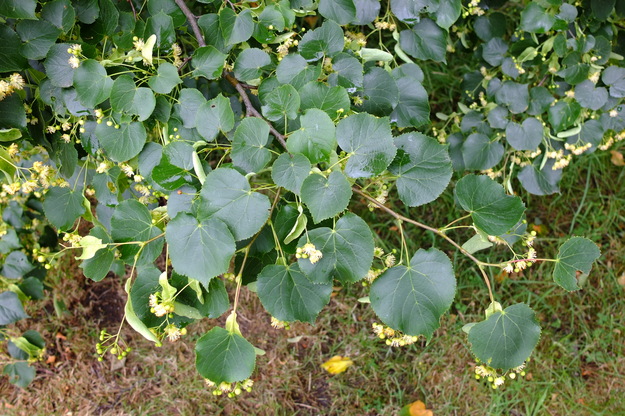
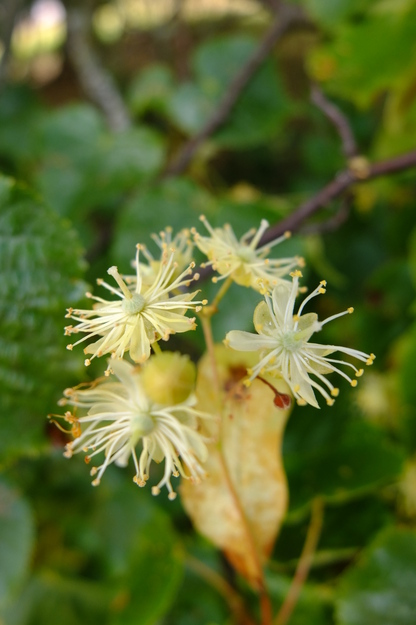
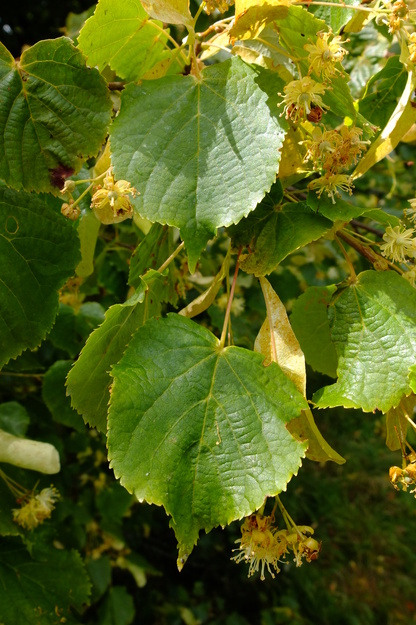
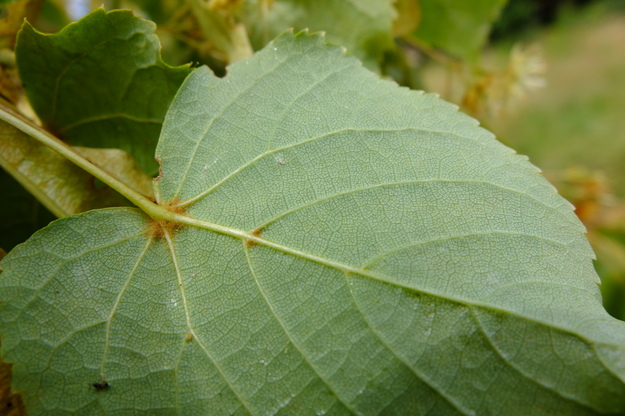
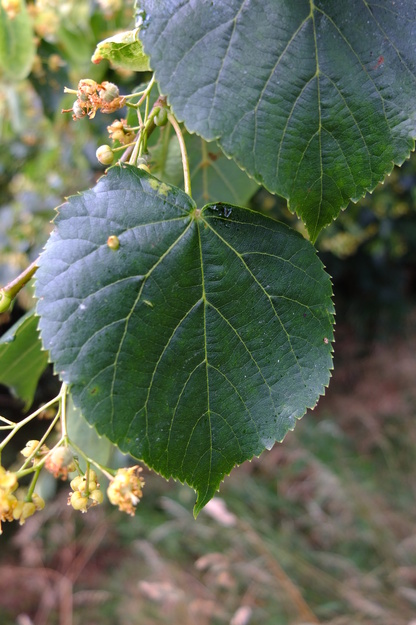
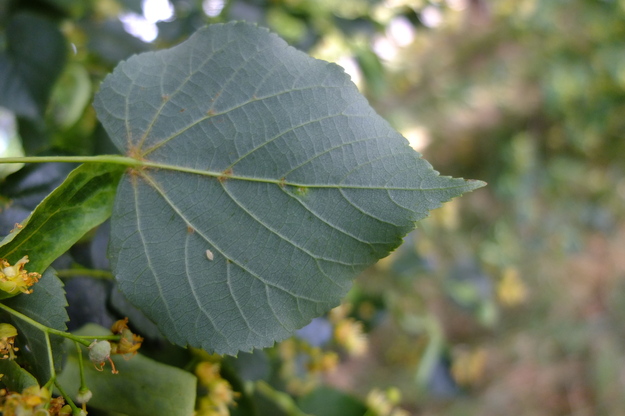
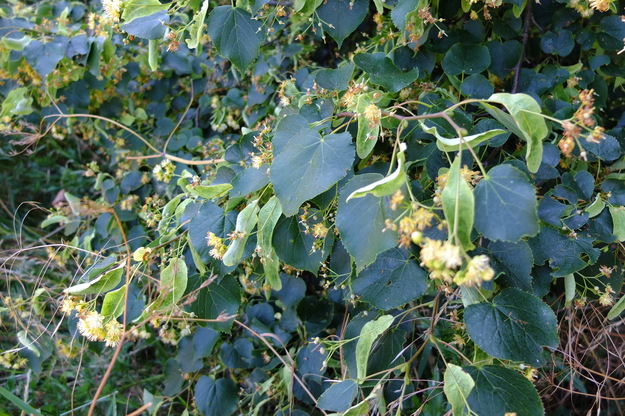
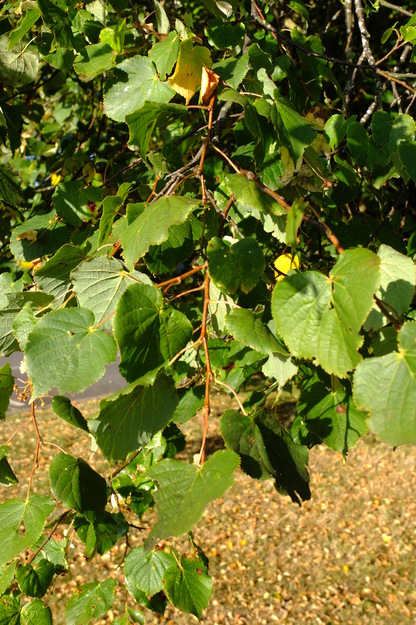
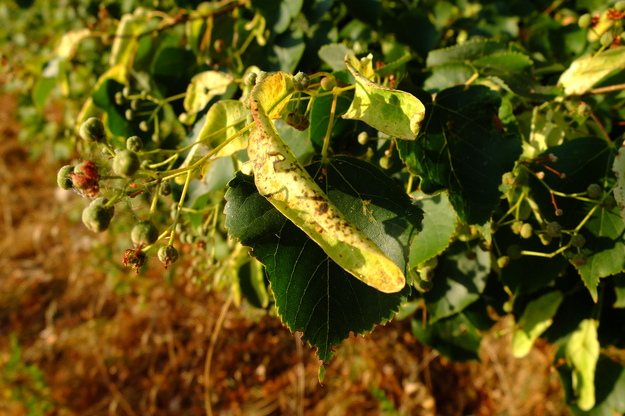
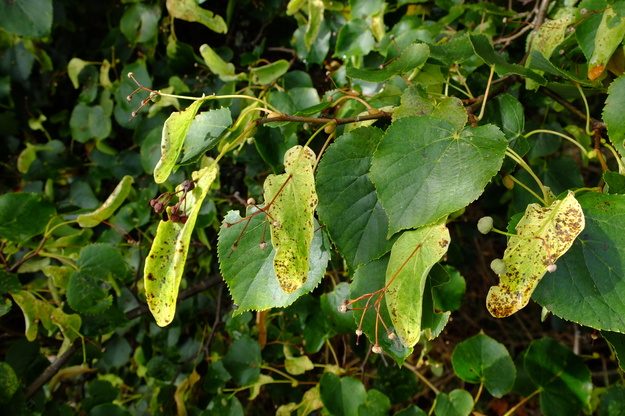
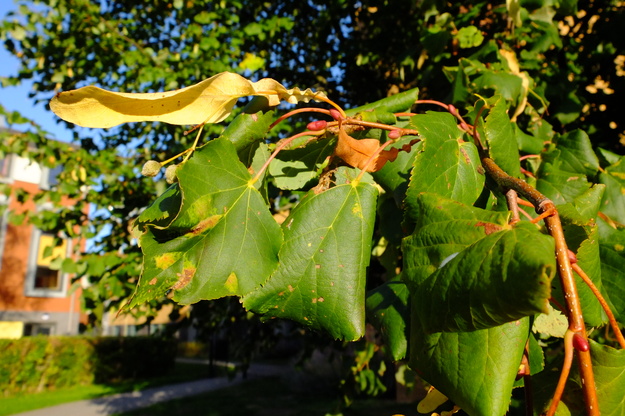
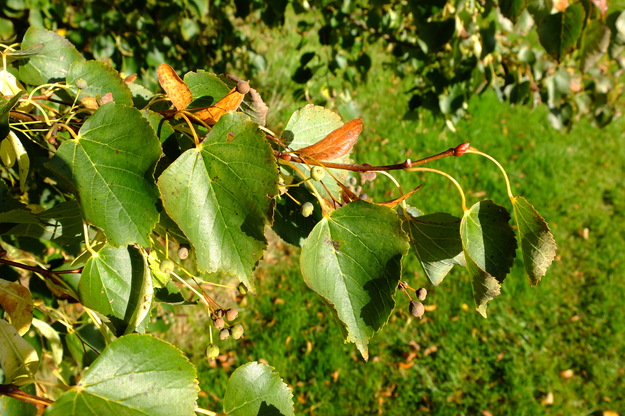
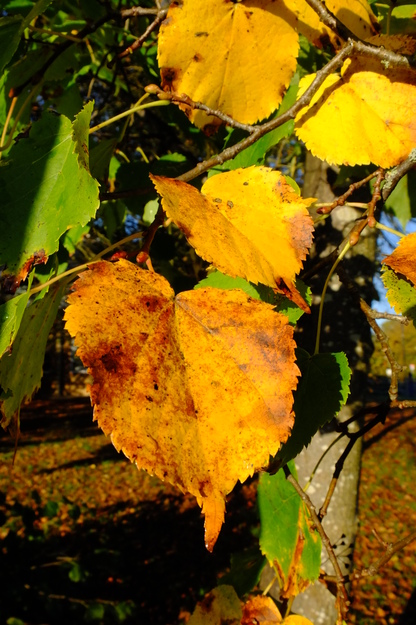
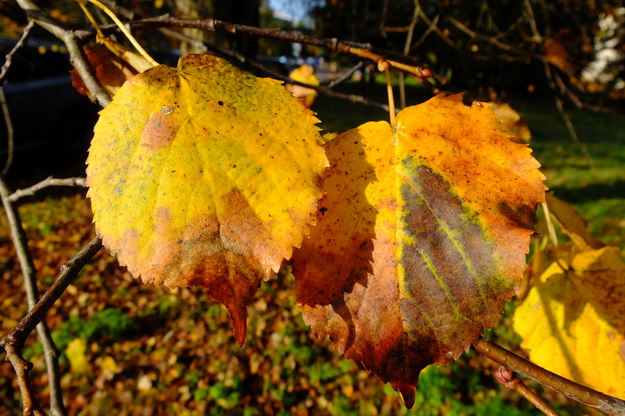
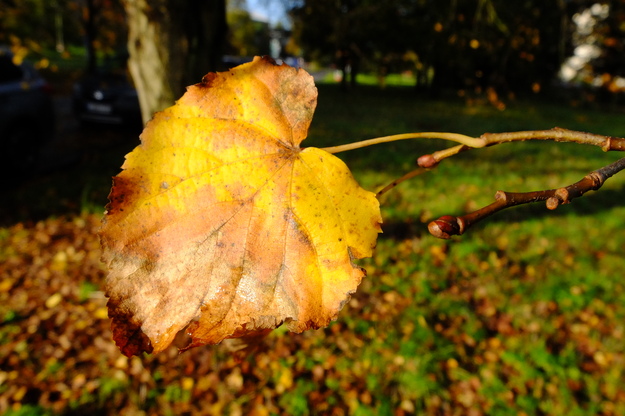
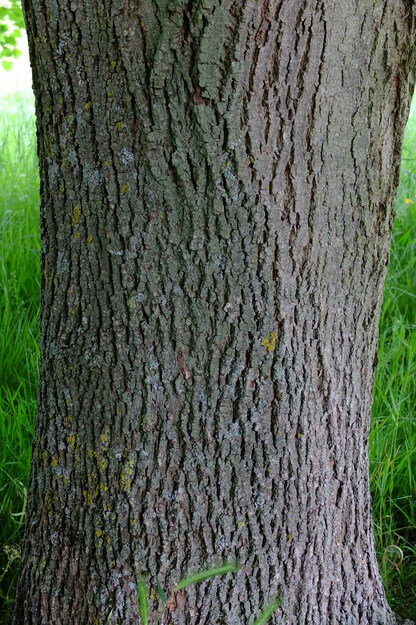
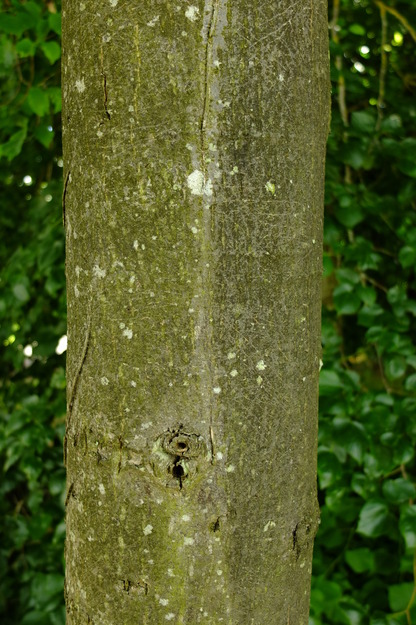
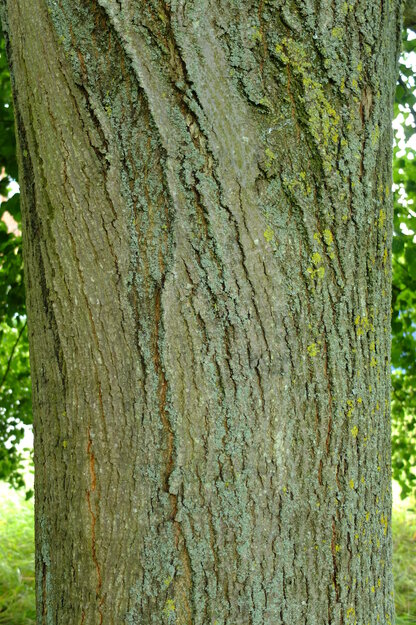
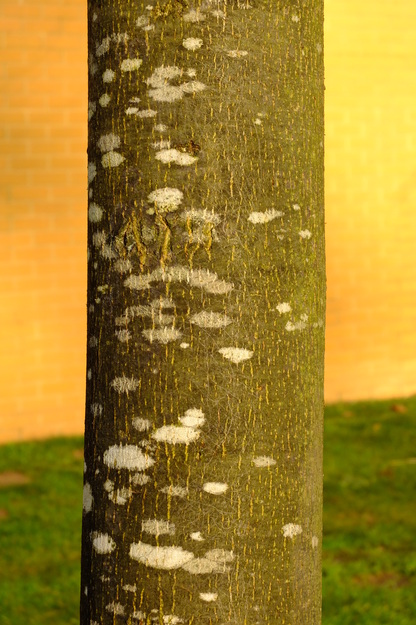
Tilia cordata is a species of deciduous broadleaf flowering plants (in the Malvaceae or Mallow family), native to Britain, Europe, western Asia and northern Iran. The tree can grow to about 30 metres tall, with a rounded or pyramidal shape, often with a surrounding of shoots growing from the base of the trunk. It has red buds in winter. Its leaves are finely toothed and heart-shaped, dark green above with a paler underside. In late June and early July it has small light yellow-green fragrant flowers in bunches of 5–10; they are attractive to bees and important for honey production. Lime flowers can also be used to make herbal tea (lime tea or linden tea, unrelated to citrus lime, which is genus Citrus). As in all Tilia species, the flowers are accompanied by long ribbon-shaped leaves (bracts), which become noticeable in summer because they turn yellow earlier than the other leaves; nonetheless, they persist on the tree into autumn, along with the clusters of small round dry fruit.
Tilia cordata is one of the three native Tilia (lime or linden) species (all present in Whiteknights Park). It can be distinguished by the tendency of its flowers to grow sideways or upwards, so that they are clearly visible above the leaves, whereas in the other species (Tilia platyphyllos and Tilia × europaea) all the flowers hang below the leaves. Also, the leaves are somewhat smaller, and their underside is hairless except for tufts of light red hairs near to the major veins.
Tilia cordata naturally grows in the forest understorey, but it is no longer common in British woods except in ancient ones. Traditionally it was cut back to the stump (the practice called "coppicing") to encourage rapid regrowth of many stems for firewood and poles (including Morris-dancing sticks). If this process is repeated a single tree, defined by its root system (since it does not have a single trunk), can live for centuries; one at the National Arboretum at Westonbirt is more than 2000 years old. The wood is white, finely-grained and soft, not strong but resistant to splitting and warping, and is used for wood carving, furniture and musical instruments.
In folklore across Europe limes are associated with fertility, justice, romance and liberty. In Germanic and Norse countries, it was the favourite tree of Freya, the goddess of love. Tilia cordata is widely planted along streets, in gardens, and in public landscapes.
External webpages
about this species


about this species
How to use the map
Drag with your finger or mouse to move the map.
 Zoom in or out. You can also do this with the mousewheel or by pinching.
Marker of the position of an identified tree, while the map is zoomed out. For the details, zoom in until you see tree markers like the following …

 Clicking on a tree marker brings up a window (called a "popup")
identifying the species of the tree there, with a small photo of it and buttons
to display more photos and information. NB only a few hundred of the thousands
of trees are marked!
Clicking on a tree marker brings up a window (called a "popup")
identifying the species of the tree there, with a small photo of it and buttons
to display more photos and information. NB only a few hundred of the thousands
of trees are marked!
7Marker of a tree of the selected species; clicking it will zoom and centre the map on this tree, and bring up a photo of it in the frame.
 Marker of a British Isles champion tree in
The Tree Register.
Marker of a British Isles champion tree in
The Tree Register.
✕ Click the cross at the top right of any window, including this one, to get rid of it.
 ✕
Click to dismiss all the popups at once.
✕
Click to dismiss all the popups at once.
Choose alternative versions of the map. The tree markers, popups, map centre and zoom are all unaffected by switching.
 Turn on a flashing dot which tracks your live location on the map, surrounded
by a circle indicating the accuracy of the location. This will work
only if your device has a satellite navigation (GPS etc.) receiver which is
enabled and can acquire a signal. You will probably be asked to allow the
website to access "location services" the first time you press this button.
The button flashes orange while trying to locate you,
and green while your location is shown. Press it again to turn it off.
Turn on a flashing dot which tracks your live location on the map, surrounded
by a circle indicating the accuracy of the location. This will work
only if your device has a satellite navigation (GPS etc.) receiver which is
enabled and can acquire a signal. You will probably be asked to allow the
website to access "location services" the first time you press this button.
The button flashes orange while trying to locate you,
and green while your location is shown. Press it again to turn it off.
 Recentre the map on your present location, while live location is switched on.
 Reset the map to its original centre and zoom.
To click on a tree, zoom in until you see
tree markers
Park HouseSee all photos of this tree
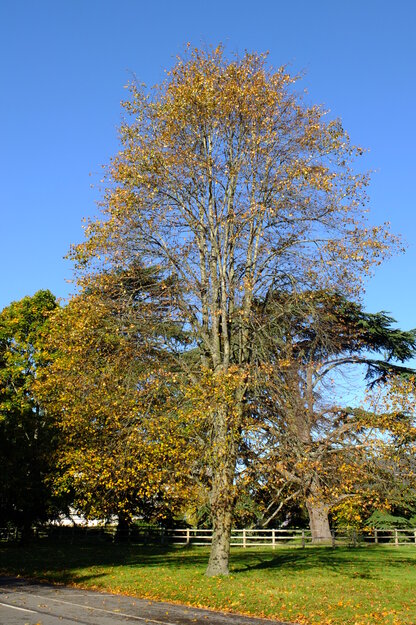
Old Whiteknights House WestSee all photos of this tree
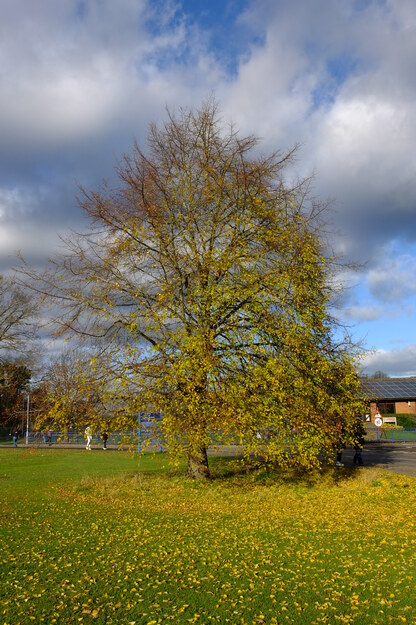
Southern meadowSee all photos of this tree
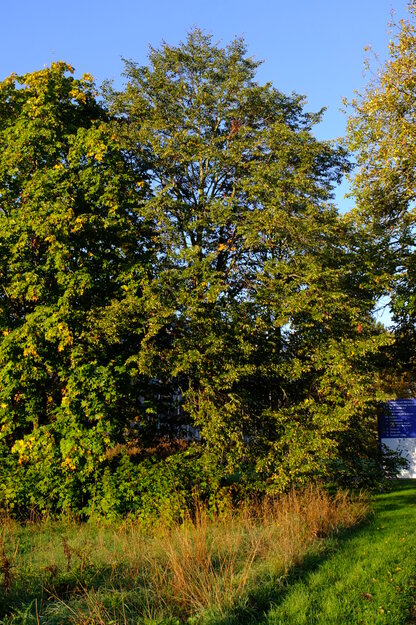
Knight NurserySee all photos of this tree
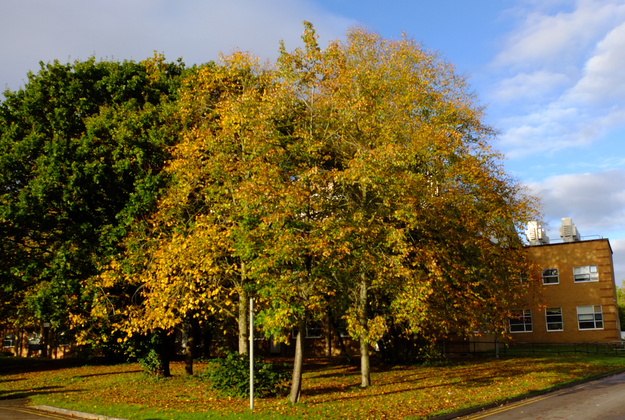
Childs lawnSee all photos of this tree