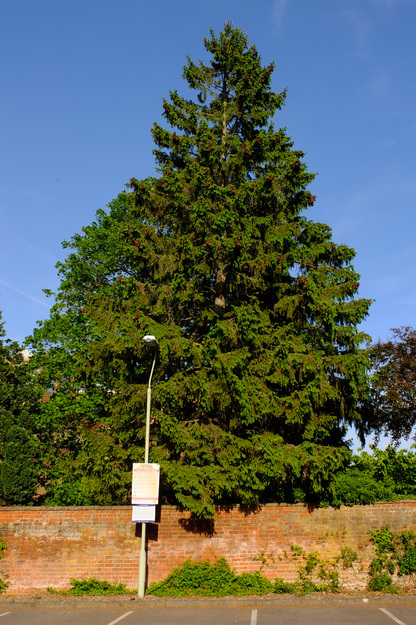
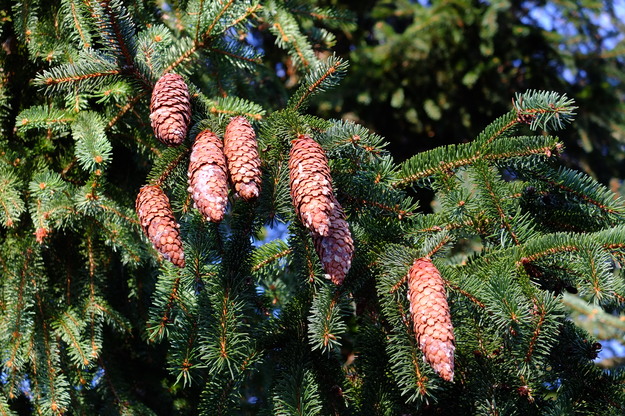
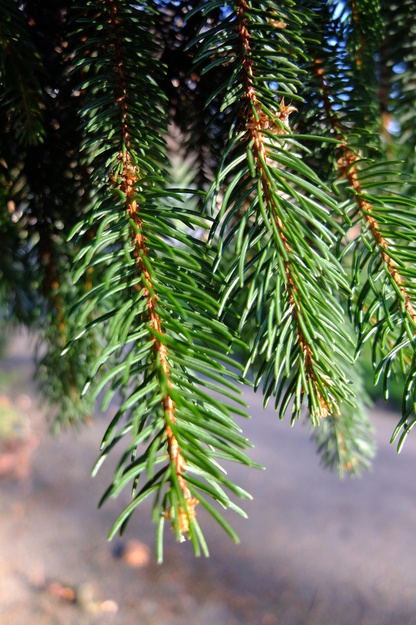
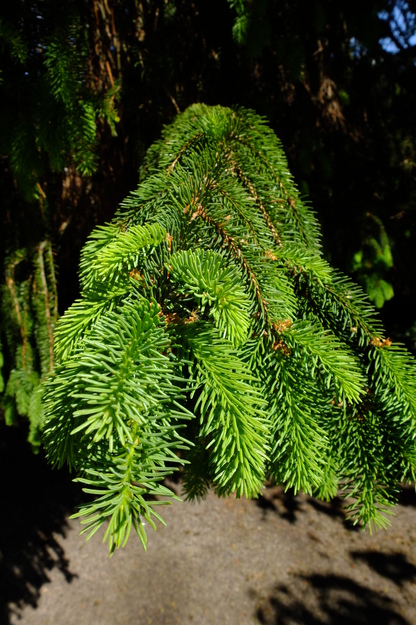
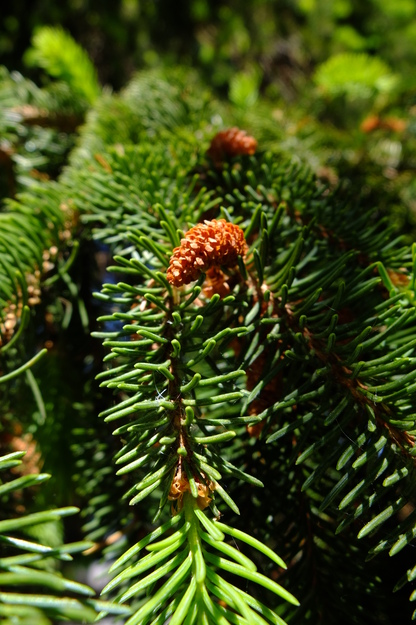
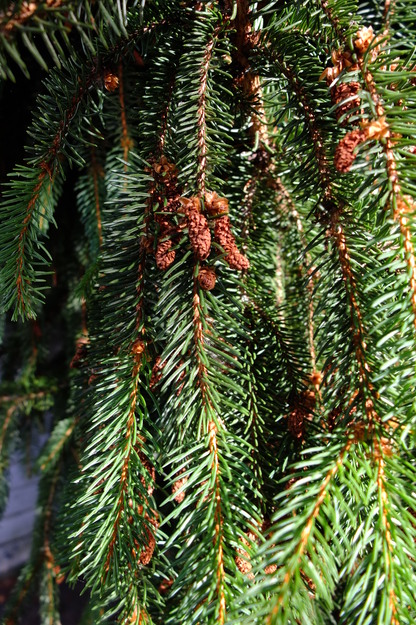
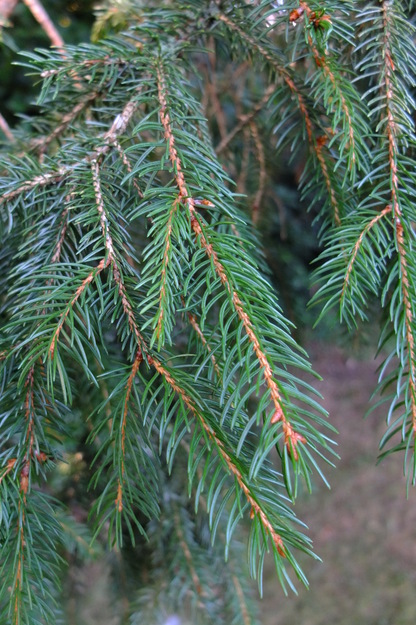
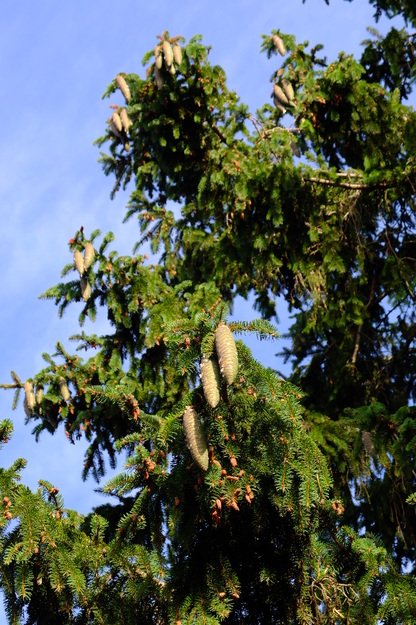
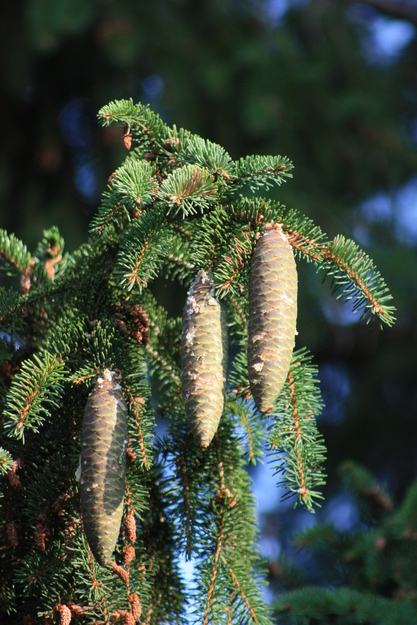
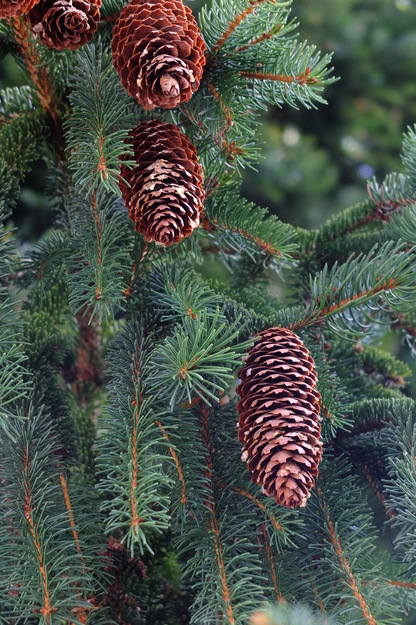
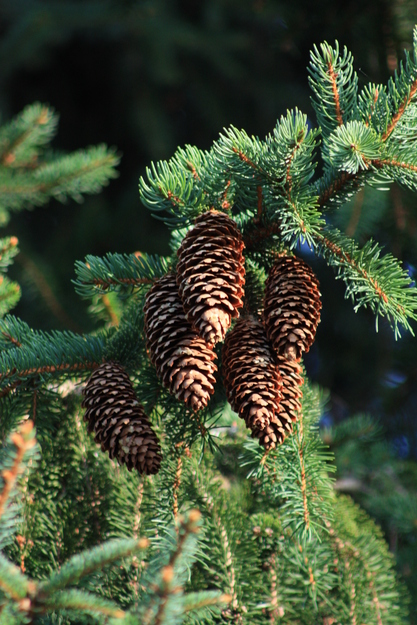
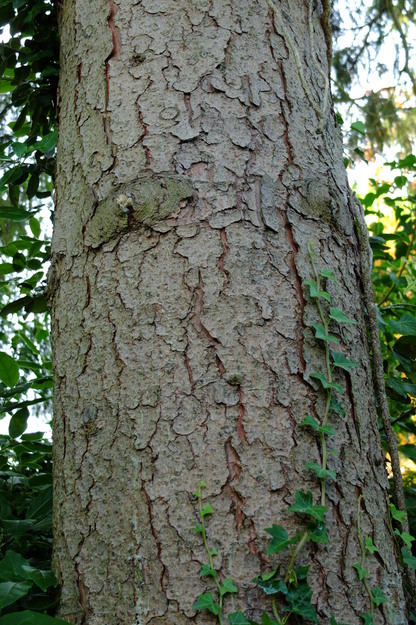
Picea abies is a species of evergreen needleleaf coniferous plants (in the Pinaceae or Pine family), native to northern, central and eastern Europe. This is a large and fast-growing tree, up to 35–55 metres tall, with a conical form, and upward-sloping higher branches. Its young bark is orange-brown, older bark grey-brown and divided irregularly by many cracks. Its leaves are dark green needles of square cross-section. In spring it produces purple or pink cones. The male cones are small; they soon turn yellow-brown and release their pollen. The female cones are initially upright. but once fertilised they become green, grower larger and turn downwards to hang from the branches, developing into exceptionally long cylindrical seed cones, which reopen and turn orange-brown as they ripen.
Picea abies grows well in cool climates and well-drained soils, forming extensive forests across Europe. It is not native in Britain, but it may have been so before the most recent ice age (during the last interglacial period, about 100,000 years ago). In the wild it lives for 300–500 years, and it is the most commonly used species for dating by the count and width of tree-rings (dendrochronology). As one of the most economically important coniferous species of the continent, it is widely cultivated, including in Britain since the 16th century. Its wood is used for construction, paper production, and musical instruments. It's also popular as a traditional Christmas tree. Every year the Norwegian capital city, Oslo, provides a Norway spruce for Trafalgar Square in London as thanks for the aid given during the Second World War.
External webpages
about this species


about this species
How to use the map
Drag with your finger or mouse to move the map.
 Zoom in or out. You can also do this with the mousewheel or by pinching.
Marker of the position of an identified tree, while the map is zoomed out. For the details, zoom in until you see tree markers like the following …

 Clicking on a tree marker brings up a window (called a "popup")
identifying the species of the tree there, with a small photo of it and buttons
to display more photos and information. NB only a few hundred of the thousands
of trees are marked!
7Marker of a tree of the selected species; clicking it will zoom and centre the map on this tree, and bring up a photo of it in the frame.
 Marker of a British Isles champion tree in
The Tree Register.
✕ Click the cross at the top right of any window, including this one, to get rid of it.
 Click to choose whether more than one popup can be open at once.

 Click to dismiss the open popup, or all open popups. You can also close
the popups by clicking on the map anywhere apart from a popup or marker.
Choose alternative versions of the map. The tree markers, popups, map centre and zoom are all unaffected by switching.
 Turn on a flashing dot which tracks your live location on the map, surrounded
by a circle indicating the accuracy of the location. This will work
only if your device has a satellite navigation (GPS etc.) receiver which is
enabled and can acquire a signal. You will probably be asked to allow the
website to access "location services" the first time you press this button.
The button flashes orange while trying to locate you,
and green while your location is shown. Press it again to turn it off.
 Recentre the map on your present location, while live location is active.
 Reset the map to its original centre and zoom.
To click on a tree, zoom in until you see
tree markers
Fountain StreetSee all photos of this tree
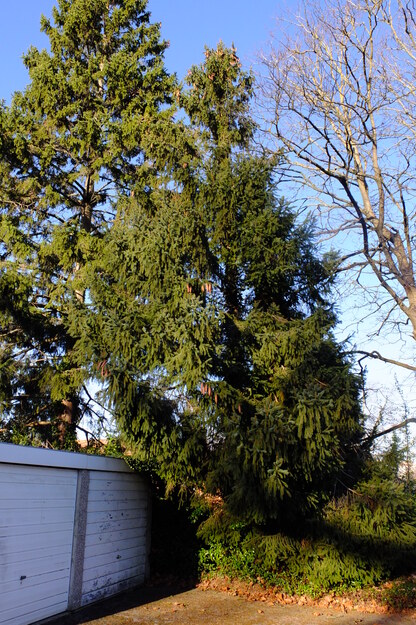
Fountain StreetSee all photos of this tree