How to use the map
Drag with your finger or mouse to move the map.
 Zoom in or out. You can also do this with the mousewheel or by pinching.

 Clicking on a tree marker brings up a window (called a "popup")
identifying the species of the tree there, with a small photo of it and buttons
to display more photos and information. NB only a few hundred of the thousands
of trees are marked!
Clicking on a tree marker brings up a window (called a "popup")
identifying the species of the tree there, with a small photo of it and buttons
to display more photos and information. NB only a few hundred of the thousands
of trees are marked!
✕ Click the cross at the top right of any window, including this one, to get rid of it.
Click to dismiss all the popups at once.
Choose alternative versions of the map. The tree markers, popups, map centre and zoom are all unaffected by switching.
 Turn on a flashing dot which tracks your live location on the map. It will work
only if your device has a satellite navigation (GPS etc.) receiver which is
enabled and can acquire a signal. You will probably be asked to allow the
website to access "location services" the first time you press this button.
It turns red while trying to locate you, then green if this succeeds. Press it
again to turn it off.
Turn on a flashing dot which tracks your live location on the map. It will work
only if your device has a satellite navigation (GPS etc.) receiver which is
enabled and can acquire a signal. You will probably be asked to allow the
website to access "location services" the first time you press this button.
It turns red while trying to locate you, then green if this succeeds. Press it
again to turn it off.
 Recentre the map on your present location, while live location is switched on.
Harris Garden Tree Route for March and early April
The Harris Garden, located in the south-west corner of Whiteknights Park, provides a peaceful retreat from the activity of the rest of the campus of the University of Reading. It has an extensive collection of trees and shrubs offering year-round interest, in a diversity of settings, including formal gardens, parkland, woodland and orchard. It was thoughtfully designed in the 1970s as a botanical garden for horticulture, education, research and conservation, reflecting the university's long-standing commitment to plant science and landscape design.
The route begins outside the Harris Garden gate. It mostly follows the main path clockwise (as viewed on the map) around the perimeter of the Harris Garden.
The route is shown by the red line on the map, and described
by the text below. The map stays in a fixed position on the screen, while the
description scrolls. The trees included in the route are marked by red circles
on the map. Each of these featured trees is shown and described in a white box
in the text. The trees on the route are numbered in order of visiting; the
number in each red circle on the map (e.g.  42)
corresponds to the number in the button at the top left corner of the box
describing the tree (e.g. ). If you click or press a
numbered button in the description, the map will centre and zoom in on the
corresponding tree. Similarly, the map will centre and zoom in on a numbered
red circle if you click or press it, and in addition the description will
scroll to bring the corresponding tree description into view.
42)
corresponds to the number in the button at the top left corner of the box
describing the tree (e.g. ). If you click or press a
numbered button in the description, the map will centre and zoom in on the
corresponding tree. Similarly, the map will centre and zoom in on a numbered
red circle if you click or press it, and in addition the description will
scroll to bring the corresponding tree description into view.
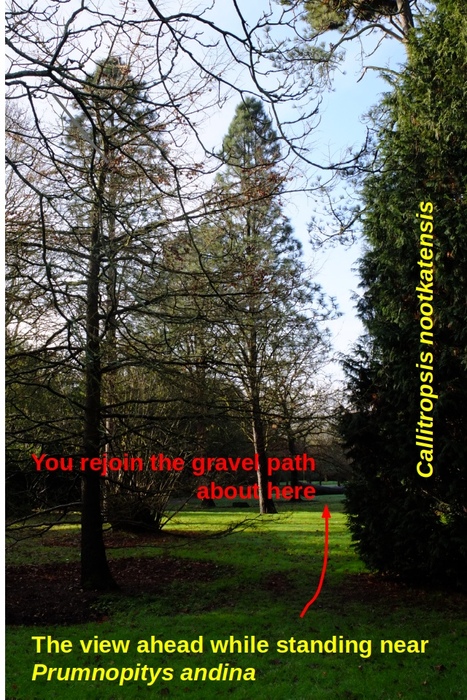
Please note that the photos of the trees that feature in this route aren't always viewed from the direction by which you'll approach them. They are taken from angles that give the best view or which are least overshadowed. On the other hand, the annotated photos are intended for navigation; they show the outlook that you will have while following the route, with some of the featured trees that lie ahead indicated in red and yellow. A few other trees, not included in the route, are also indicated on these photos, in grey and white.
The first tree on the route, Eucalyptus pauciflora, stands to the right of the gate. Although it's rooted inside the Harris Garden fence, it's easier to see it from the outside.
Eucalyptus pauciflora, Snow gum
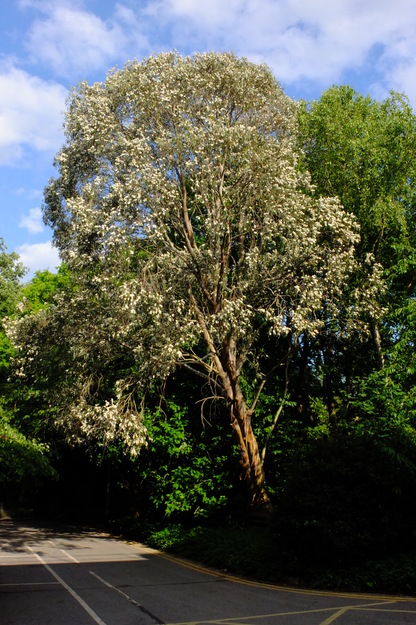
Evergreen broadleaf flowering (angiosperm) plant of the Myrtaceae or Myrtle family, native to alpine and subalpine regions of south-eastern Australia.
Eucalyptus pauciflora can be recognised from its smooth bark that sheds in patches, revealing a striking mosaic of white, cream, grey, and pale green. It flowers in late May and early June. Snow gums play an important ecological role by stabilising soils and providing habitat in harsh mountain landscapes.
Magnolia stellata is on the right just after you've come through the gate, before you reach the lawn. Prunus serrulata is a little further, on the edge of the lawn.
Magnolia stellata, Star magnolia
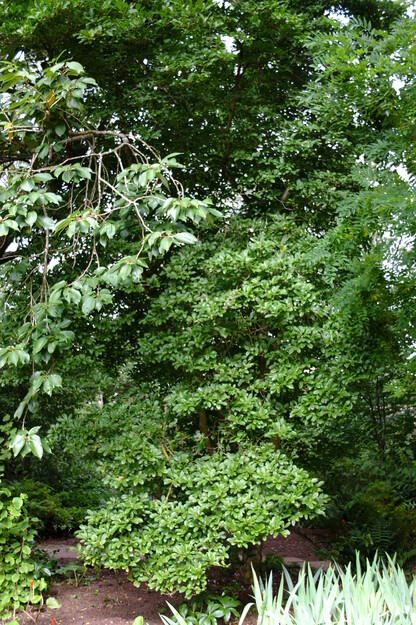
Deciduous broadleaf flowering (angiosperm) plant of the Magnoliaceae or Magnolia family, native to Japan.
This is a compact tree or large shrub. From furry buds developing in winter, masses of fragrant, star-shaped white to pale pink flowers emerge on bare branches in early spring. Its leaves are fairly light green and turn yellow in autumn, when it produces bright red fruit.
Prunus serrulata 'Tai-haku', Great white cherry
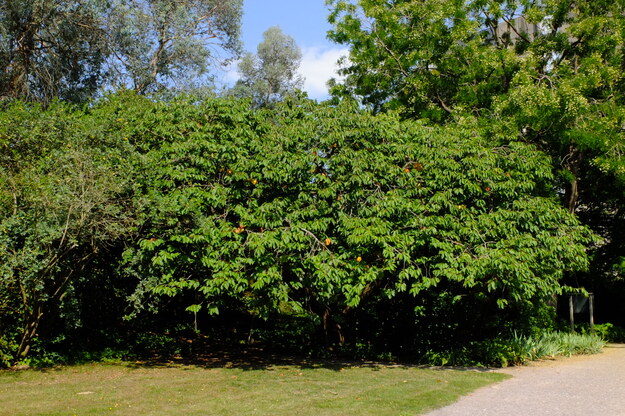
Deciduous broadleaf flowering (angiosperm) plant of the Rosaceae or Rose family, native to east Asia.
Prunus serrulata is celebrated for its spectacular spring blossom, comprising profuse clusters of pale pink to white flowers. In Japan it has a cultural significance, marked during the cherry blossom festival, when its flowering symbolises renewal and the fleeting nature of life. In the early 20th century the 'Tai-haku' variety was thought to be extinct but fortunately in the 1920s a specimen was found in a garden in Sussex that had been grown from plants sent from Japan years earlier.
Acer griseum is the small tree with red bark next to the path, on the right of the lawn. When you are standing on the path and facing Acer griseum, Laurus nobilis is the larger tree behind it.
Acer griseum, Paper-bark maple
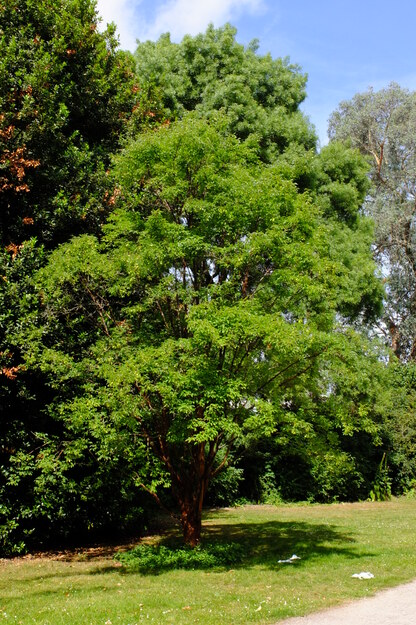
Deciduous broadleaf flowering (angiosperm) plant of the Sapindaceae or Soapberry family, native to central China.
Acer griseum is a small to medium-sized tree with ornamental qualities. It has distinctive cinnamon-brown bark, which peels away in thin, papery strips to reveal smooth layers beneath. It has green leaves in groups of three (in botanical terms, three leaflets comprising each compound leaf). They turn brilliant shades of red, orange, and scarlet in autumn.
Laurus nobilis, Bay tree or laurel

Evergreen broadleaf flowering (angiosperm) plant of the Lauraceae or Laurel family, native to the Mediterranean.
Laurus nobilis is a shrub or small tree, widely cultivated for both ornamental and culinary purposes. It has glossy, dark green, aromatic leaves that are commonly used as bay leaves in cooking. Being slow-growing and tolerant of pruning, it is often used for hedging, topiary or as a container plant. Laurus nobilis is the "laurel" of classical history, from which crowns were made for athletic champions. It produces small yellowish flowers in spring, followed by dark purple berries in autumn.
Prunus serrula is on the left side of the path at the point where the lawn ends, with Corylus avellana 'Contorta' to its left.
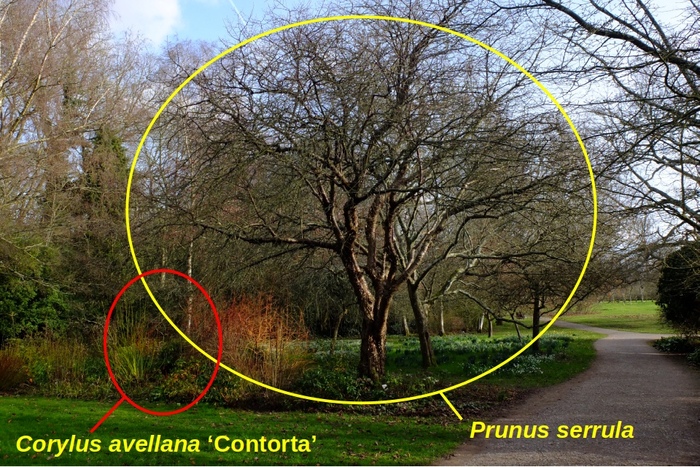
Corylus avellana 'Contorta', Corkscrew hazel
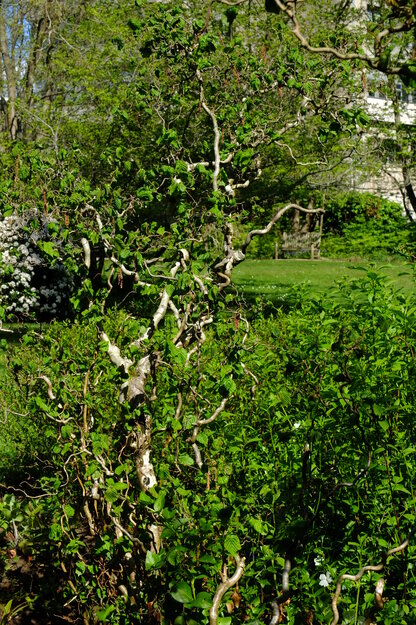
Deciduous broadleaf flowering (angiosperm) plant of the Betulaceae or Birch family, a cultivated variety.
This is a slow-growing hardy shrub with highly ornamental, twisted and corkscrew-like branches. These distorted stems provide great visual interest, especially in winter when the plant is leafless. It is popular as a specimen plant in gardens, where its unusual structure can be fully appreciated. In late winter to early spring it produces yellow catkins before the emergence of the rounded green leaves, which turn yellow in autumn.
Prunus serrula, Tibetan cherry
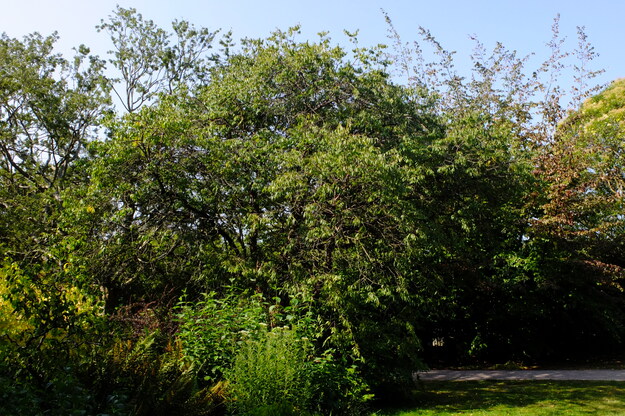
Deciduous broadleaf flowering (angiosperm) plant of the Rosaceae or Rose family, native to western China and the Himalayas.
Prunus serrula is admired primarily for its striking smooth glossy mahogany-red bark that peels in thin, papery strips. For this year-round ornamental interest, it is planted as a specimen tree in gardens and parks. In spring, the tree produces modest clusters of small white flowers, followed by small black cherries.
The next three trees are on the left of the path.
On the opposite side of the path, you may notice a group of banana plants, which have enormous oblong leaves. They are not trees in a botanical sense, because their stems aren't woody. They have to be wrapped in polythene during the winter to protect them from frost. Our climate is not warm and sunny enough for them to produce bananas.
Malus transitoria, Cut-leaf crab apple
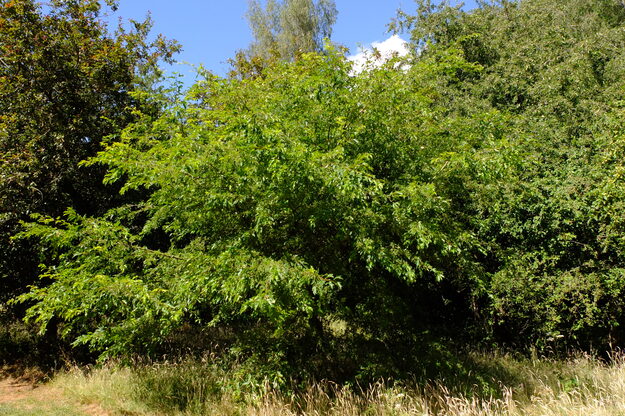
Deciduous broadleaf flowering (angiosperm) plant of the Rosaceae or Rose family, native to western China.
This is a small tree with an elegant form and ornamental appeal. It produces masses of delicate white flowers in spring, often tinged with pink in bud, followed by small yellow fruits that persist into autumn and winter, providing food for birds. The leaves are oval and finely toothed, turning soft shades of yellow in autumn.
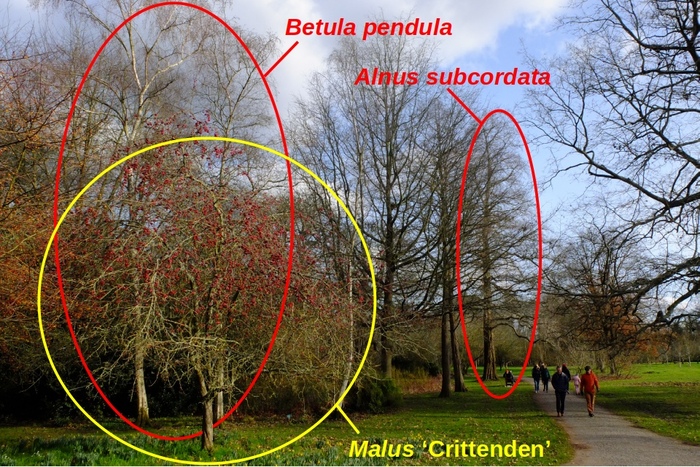
Malus 'Crittenden', Crittenden crab apple
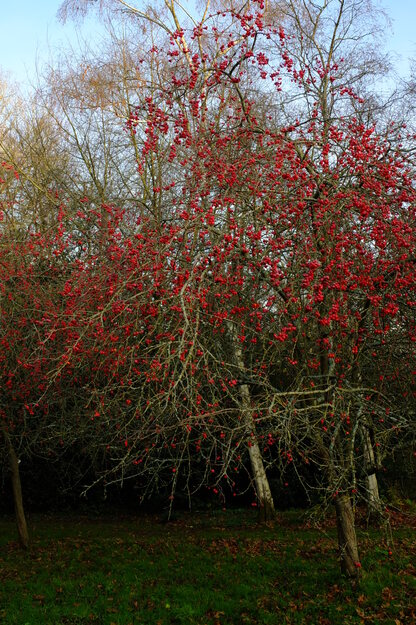
Deciduous broadleaf flowering (angiosperm) plant of the Rosaceae or Rose family, a cultivated variety.
This tree has a neat rounded form and offers interest in all seasons. In spring it produces a profusion of soft pink buds that open into white flowers. These are followed by small, glossy red fruits that persist into autumn and can last throughout winter, adding color and providing food for birds.
Betula pendula, Silver birch

Deciduous broadleaf flowering (angiosperm) plant of the Betulaceae or Birch family, native to Britain, Europe and parts of Asia.
Betula pendula is a slender tree, widely recognised for its elegant form and distinctive white, papery bark. It has light, triangular green leaves that turn bright yellow in autumn, and delicate, pendulous branches that give the tree a graceful appearance. In spring it produces catkins, which are important for wildlife.
Don't take the path on the right near Malus 'Crittenden'; go straight ahead towards Alnus subcordata, which is a tall tree on the left of the path.
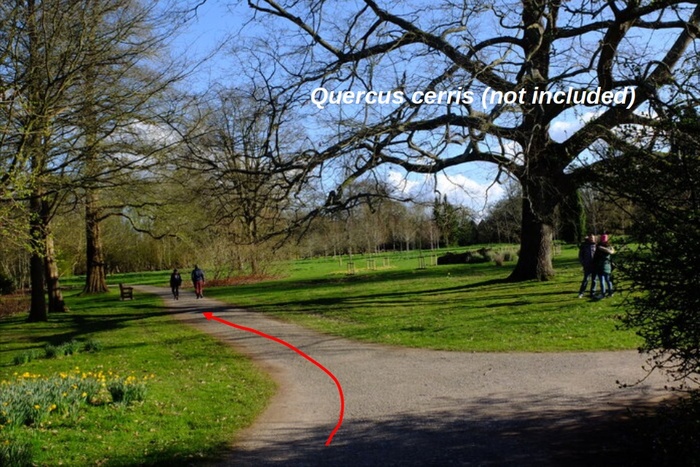
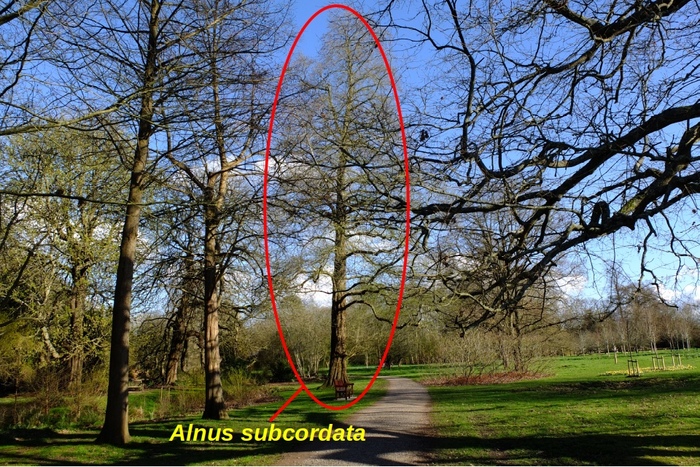
Alnus subcordata, Caucasian alder
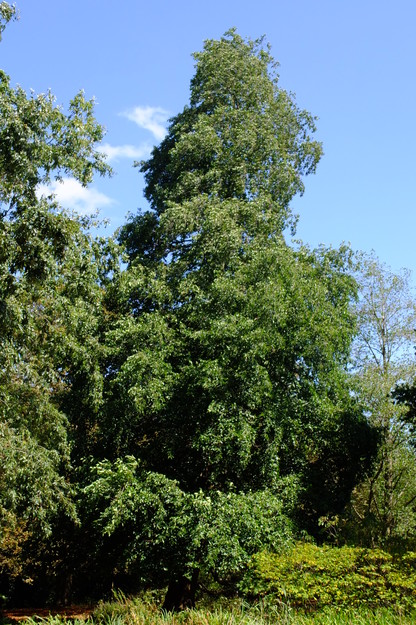
Deciduous broadleaf flowering (angiosperm) plant of the Betulaceae or Birch family, native to the Caucasus and northern Iran.
Alnus subcordata is a medium to large rapidly growing tree which tolerates moist conditions. Its broad rounded green leaves have a slightly heart-shaped base and turn yellow in autumn before falling. In spring, the tree produces long male catkins and smaller female cones, which persist on the branches through winter. Like other alders, Alnus subcordata has nitrogen-fixing roots that improve soil fertility, making them useful in woodland planting, land restoration, and along riverbanks or wet sites.
The group of Gleditsia caspica stand on the right side of the path.
Gleditsia caspica, Caspian locust
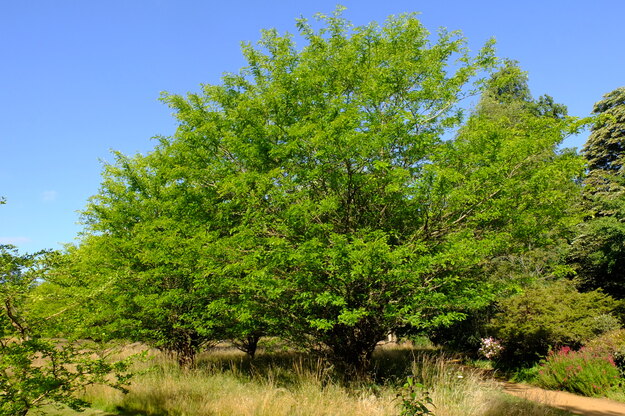
Deciduous broadleaf flowering (angiosperm) plant of the Fabaceae or Legume, pea or bean family, native to the Caspian region of western Asia.
This species is valued for its distinctive appearance and tolerance of challenging conditions. It has an open, spreading crown with finely divided, pinnate leaves that create a light, airy canopy and turn yellow in autumn. The tree is notable for its strong, often branched thorns along the trunk and branches, as well as its long, twisted seed pods that develop after flowering. It is sometimes planted as a specimen tree in parks and large gardens for its architectural form and resilience.
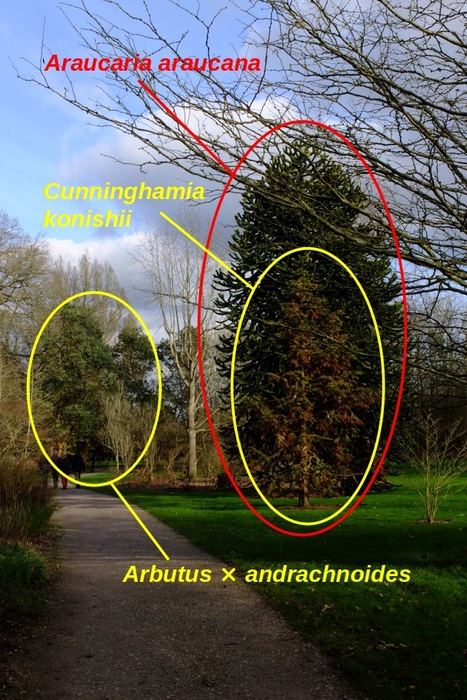
Cunninghamia konishii, Taiwan fir

Evergreen needleleaf coniferous (gymnosperm) plant of the Cupressaceae or Cypress family, native to Taiwan and parts of southern China.
Cunninghamia konishii is appreciated for the ornamental value of its tall, straight form and dense, glossy foliage, and also yields durable timber. It has stiff, dark green, needle-like leaves arranged spirally along the branches, which give the tree a formal, symmetrical appearance. In its native habitat it can grow into a large forest tree, while in cultivation it is slower growing and used as a specimen for parks and arboreta.
Araucaria araucana, Monkey puzzle tree
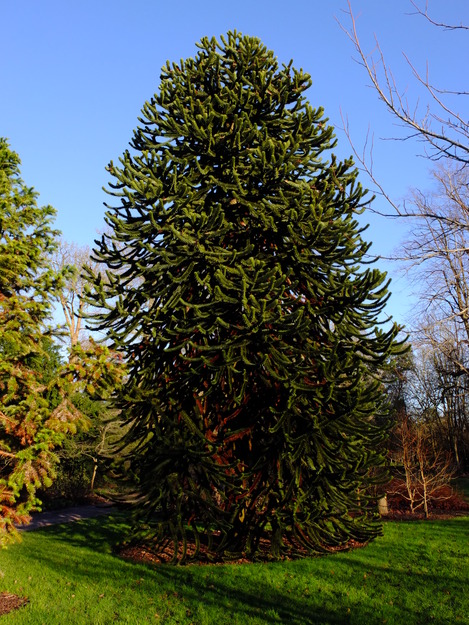
Evergreen spiny-leaf coniferous (gymnosperm) plant of the Araucariaceae family, native to temperate forests of Chile and Argentina.
Araucaria araucana is adapted to volcanic soils and harsh mountain climates. It is easily recognized by its thick, armour-like, triangular leaves that spiral densely around its branches, giving the tree a dramatic, prehistoric appearance. Its popular name derives from a comment that climbing it would be a puzzle for a monkey. Growing up to 30–40 metres tall, it develops a straight trunk with a distinctive umbrella-shaped crown as it matures. Male and female cones grow on separate trees, with the large female cones producing edible seeds that have long been an important food source for Indigenous communities. Araucaria araucana is both an ecological and cultural symbol in its native range, though it is now considered endangered due to logging and habitat loss.
Arbutus × andrachnoides, Hybrid strawberry tree

Deciduous broadleaf flowering (angiosperm) plant of the Ericaceae or Heath or heather family, a hybrid species.
An ornamental shrub or small tree resulting from a natural cross between Arbutus unedo and Arbutus andrachne. It is especially admired for its smooth, cinnamon-red bark that peels to reveal lighter tones beneath. The tree typically grows 4–8 metres tall and bears glossy, dark green leaves along with clusters of small, urn-shaped white flowers in autumn, often appearing alongside round, red fruits (hence "strawberry" in its name) from the previous season.
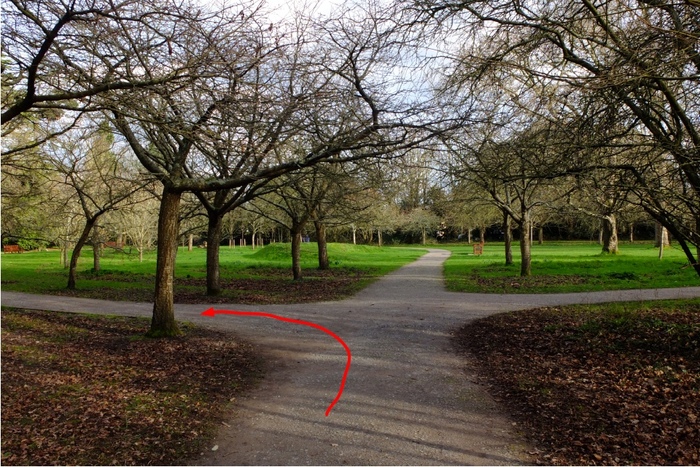
After Arbutus, you come to a place where four paths converge. Take the left turn from the crossroads. Cryptomeria japonica is off to the left of the path at the crossroads.
Cryptomeria japonica, Japanese red cedar
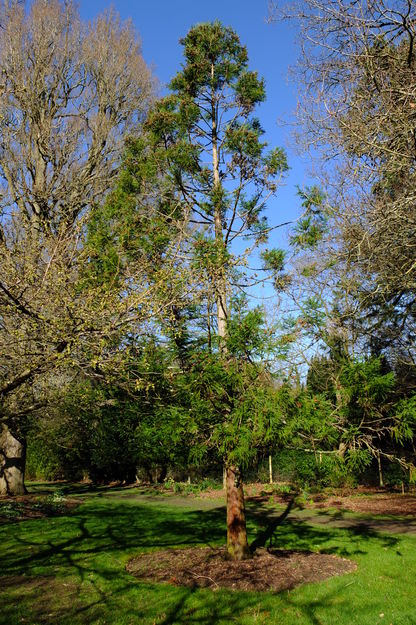
Evergreen needleleaf coniferous (gymnosperm) plant of the Cupressaceae or Cypress family, native to Japan and parts of China.
A tall tree in its natural habitat, reaching heights of 50–70 metres, with a straight trunk and a narrow, conical crown. Its reddish-brown bark peels in long, fibrous strips, giving it ornamental interest. The tree has soft, awl-shaped needles arranged spirally along the shoots, often turning bronze in winter in cooler climates. Small, spherical cones develop at the tips of branches. Widely planted as both a forestry and ornamental species, Cryptomeria japonica is valued for its fragrant, durable wood and its elegant presence in parks and large gardens.
Continue along the path leading left from the crossroads.
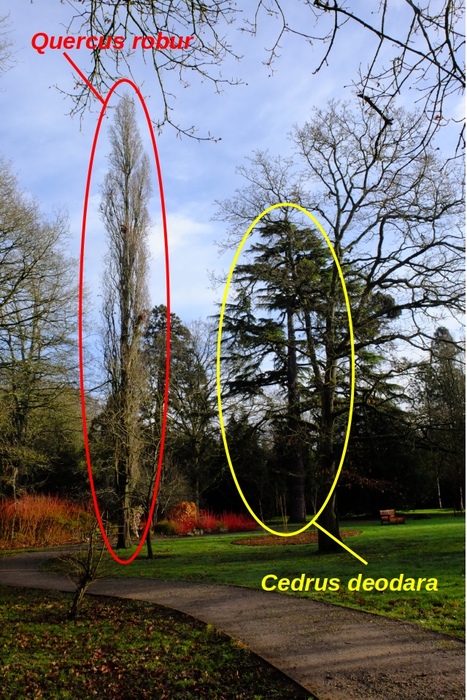
Quercus robur cultivar, Fastigiate pedunculate oak

Deciduous broadleaf flowering (angiosperm) plant of the Fagaceae or Beech family, a cultivated variety.
This is a fastigiate variety (meaning "having closely bunched erect parallel branches") of the common oak Quercus robur. Fastigiate oaks have an columnar form, appearing almost like a conifer from a distance. They are planted to form avenues or tall hedging.
Turn left on the path just before Cedrus deodara.
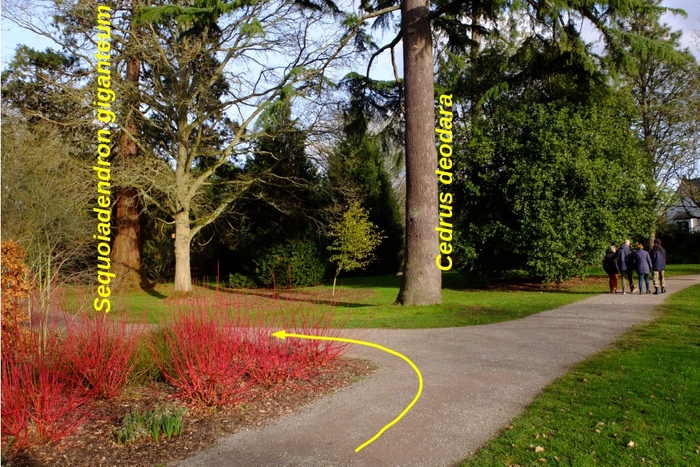
Cedrus deodara, Deodar cedar or deodar
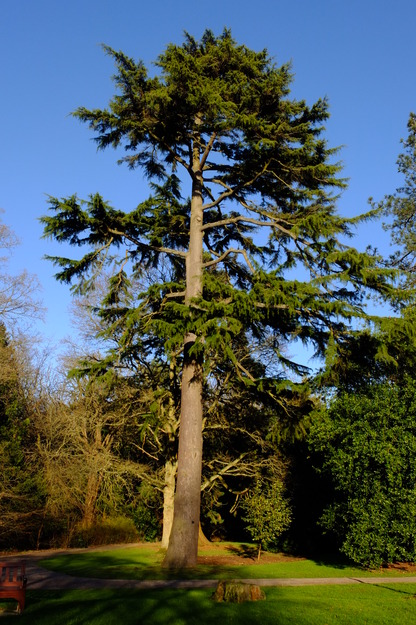
Evergreen needleleaf coniferous (gymnosperm) plant of the Pinaceae or Pine family, native to the western Himalayas.
A majestic tree, growing up to 40–50 metres tall, distinguished by its drooping branch tips and soft, bluish-green needles arranged in dense clusters. The tree produces upright, barrel-shaped cones that gradually disintegrate to release their seeds. Its wood is valued because of its durability, rot-resistant character and fine grain. The inner wood is aromatic and used to make incense. Its name derives from the Sanskrit meaning "wood of the gods". The deodar is widely planted as an ornamental tree in parks and large gardens around the world.
Sequoiadendron giganteum, Giant redwood or Wellingtonia
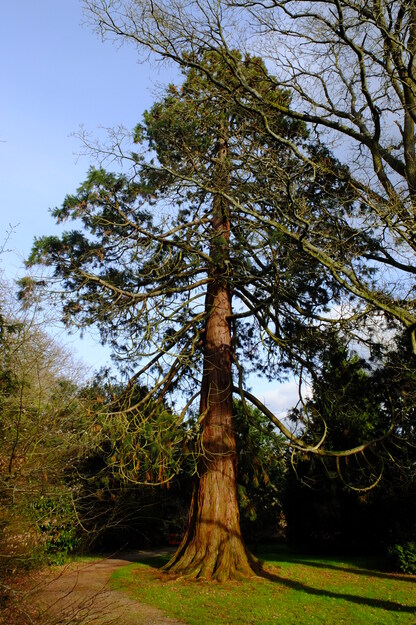
Evergreen needleleaf coniferous (gymnosperm) plant of the Cupressaceae or Cypress family, native to western slopes of the Sierra Nevada in California.
By volume the largest tree in the world, Sequoiadendron giganteum can reach up to 95 m in height and 12 m in diameter, and live for more than 3000 years.
When it was introduced to Britain in 1853, the species was named Wellingtonia giganteum after the Duke of Wellington. Although this scientific name was discontinued, the species is still called Wellingtonia as a common name in the UK. Wellingtonia Avenue in Finchampstead is an avenue of over 100 Sequoiadendron giganteum planted alongside the road in the 1860s as a memorial to the Duke.
After Sequoiadendron giganteum, as you come round the corner, Prumnopitys andina is by the garden wall, and Magnolia × soulangeana is on the right of the path. The pair of trees beyond the magnolia on the right are Callitropsis nootkatensis.
Magnolia × soulangeana, Saucer magnolia
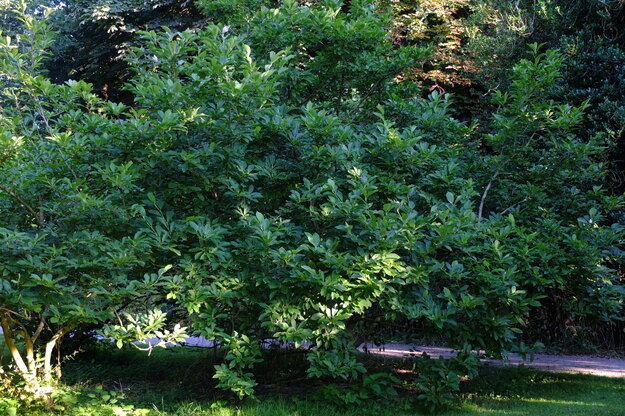
Deciduous broadleaf flowering (angiosperm) plant of the Magnoliaceae or Magnolia family, a hybrid species.
The saucer magnolia is an ornamental tree admired for its spectacular early spring flowers, making it a favourite choice for gardens and parks where its dramatic floral display can be fully appreciated. It is a hybrid between Magnolia denudata and Magnolia liliiflora and typically grows 5–10 meters tall with a broad, spreading crown. It produces large, goblet-shaped blossoms in shades of white, pink, and purple, creating a striking display. The leaves are large, oval, and bright green, turning yellow-brown in autumn.
Prumnopitys andina, Chilean plum yew or ileuque
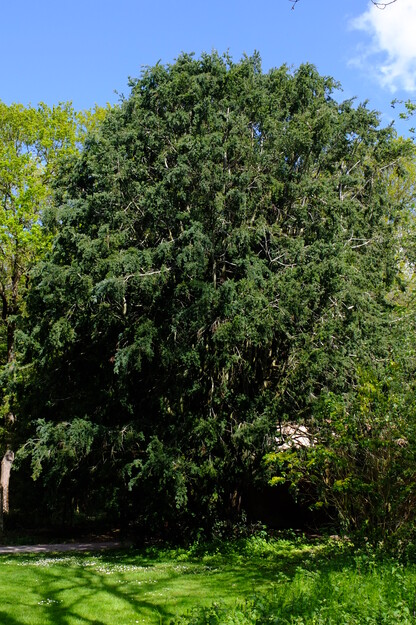
Evergreen needleleaf coniferous (gymnosperm) plant of the Podocarpaceae or Podocarp family, native to the Chilean Andes.
This species gets its English common name because its foliage superficially resembles that of the European yew and because its female cones resemble a small plum. The female cones transform into fleshy, berry-like structures upon maturity and have been an important food source for Indigenous communities for thousands of years. The wood is a yellowish colour and is used in furniture and construction.
Callitropsis nootkatensis, Nootka cypress
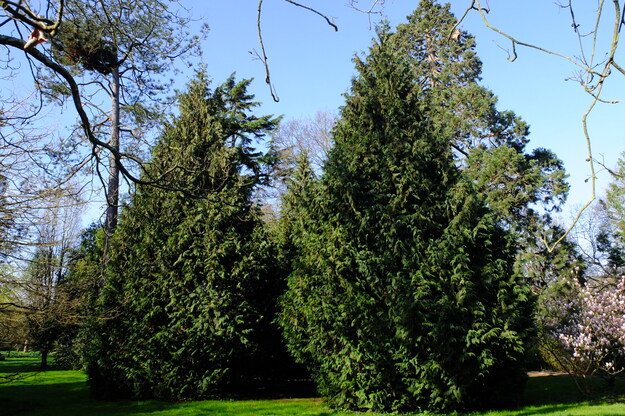
Evergreen needleleaf coniferous (gymnosperm) plant of the Cupressaceae or Cypress family, not native in Britain.
Head across the grass to rejoin the path. When you meet it, follow it leftwards. If you don't want to cross the grass, you can retrace your steps to the junction by Cedrus deodara, and turn left there (not the way you came from).
Follow the path until it begins to bend to the right, around a circular open area. There are many varieties of ornamental cherry around this circle.
Prunus cultivar, Ornamental cherry
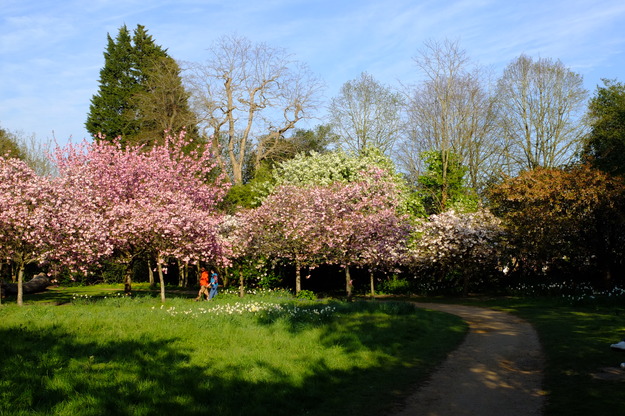
Deciduous broadleaf flowering (angiosperm) plant of the Rosaceae or Rose family, a cultivated variety.
The Cherry Bowl was planted in 1995. The collection of Japanese flowering cherries has been selected to demonstrate the range of flower variation as well as autumn colour. They are arranged around a circular clearing, and underplanted with bulbs and wild flowers.
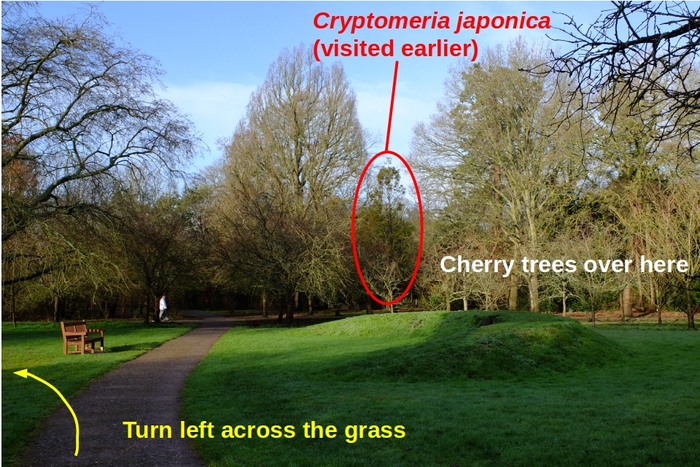
From the cherry circle, head across the grass towards Betula papyrifera. This is a group of three trees of the same species, one with a label. If you don't want to go across the grass here, you can stay on the path and turn left when you reach the crossroads, then turn off the path across the grass towards Betula papyrifera where there's a large log on the grass and small conifers.
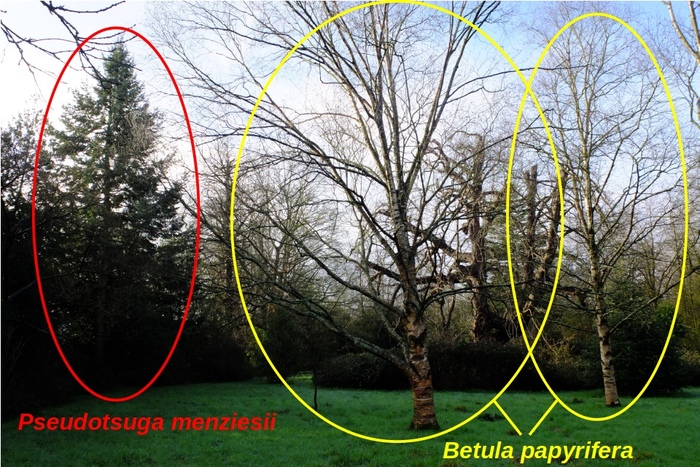
Betula papyrifera, Paper-bark or paper or canoe-bark birch
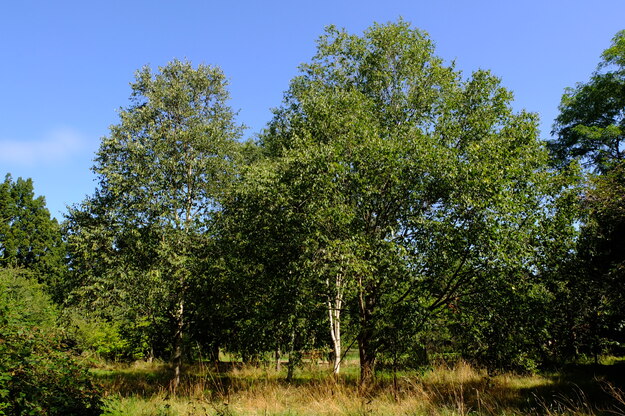
Deciduous broadleaf flowering (angiosperm) plant of the Betulaceae or Birch family, native to northern North America.
Betula papyrifera is admired for its striking white bark that peels away in thin, papery layers. The bark beneath, and the bark of younger trees, can be orange or pink. Typically growing 15–25 metres tall, it has an open, rounded crown and ovate, serrated green leaves that turn bright yellow in autumn. In spring, the tree produces slender catkins that release seeds dispersed by the wind. Paper-bark birch thrives in cool climates and well-drained soils, often colonizing areas after fire or disturbance. Historically, its bark was widely used by Indigenous peoples for making canoes, containers, and shelters, while today the tree is valued for ornamental planting, wildlife habitat, and its ecological role in early forest succession.
Pseudotsuga menziesii, Douglas fir
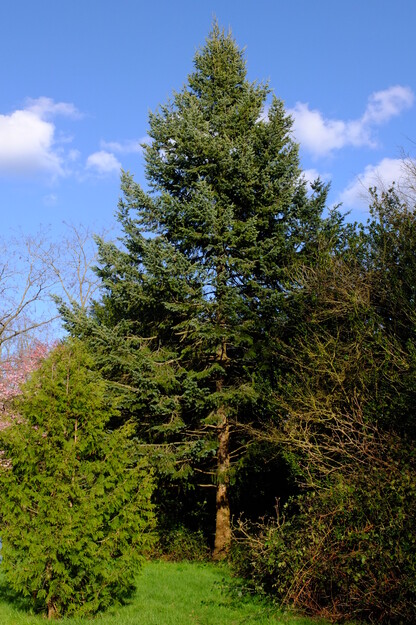
Evergreen needleleaf coniferous (gymnosperm) plant of the Pinaceae or Pine family, native to western North America.
A tree with a straight trunk and conical crown, growing 20–100 metres tall; the larger ones grow in coastal regions. It has soft, flat, dark green needles with a citrus-like scent when crushed. It produces distinctive cones with three-pointed bracts protruding between the scales, making it easy to identify. Pseudotsuga menziesii is widely planted in forestry because it is fast-growing and yields strong, durable wood, as well as in parks and large gardens for its impressive size and stately appearance. Its thick bark gives it excellent fire resistance and it can live for more than 1000 years.
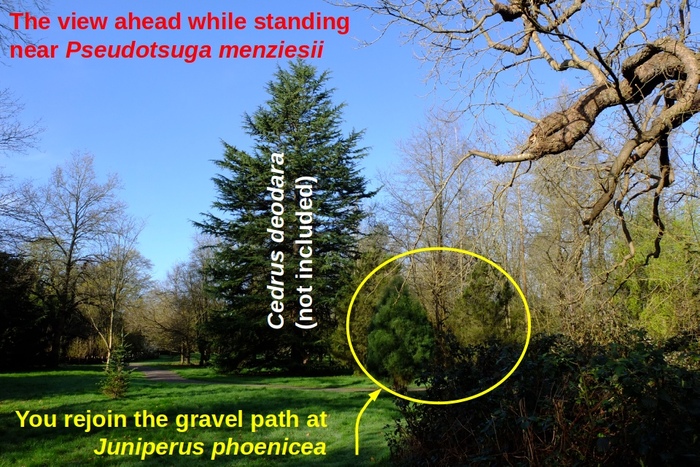
Rejoin the path at Juniperus phoenicea. There is a pair of them, one of which is labelled. Turn left on the path there.
Juniperus phoenicea, Phoenician juniper
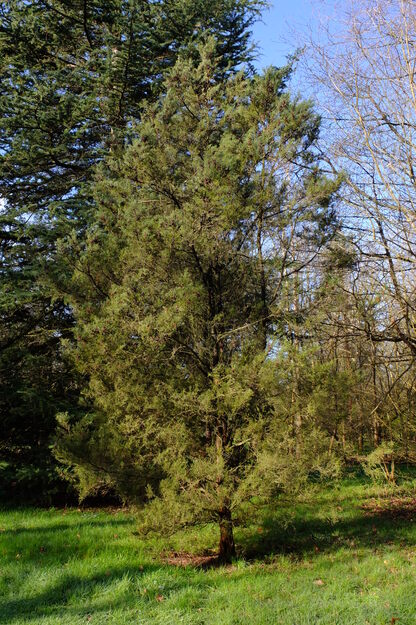
Evergreen needleleaf coniferous (gymnosperm) plant of the Cupressaceae or Cypress family, native to western Mediterranean.
Juniperus phoenicea usually grows as a dense shrub or small tree reaching 4–8 metres in height. It produces small, spherical berry-like cones that ripen from green to reddish-brown. Well adapted to hot, dry climates and poor, rocky soils, Juniperus phoenicea is commonly found in coastal areas and open woodlands, where it helps stabilize soils and provides habitat for wildlife. Its hardy nature also makes it useful for ornamental planting in dry landscapes with Mediterranean climates.
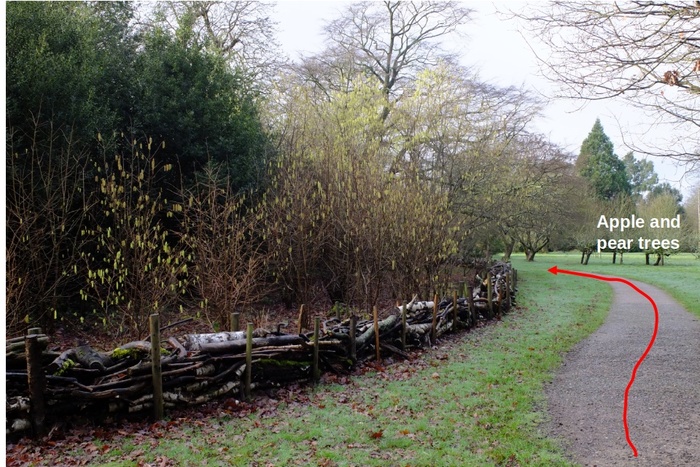
Where the fence made of branches ends on the left, a rectangular open grassy area begins on the right, with several species of pear tree. Pyrus elaeagrifolia is at the far end of this open area. It's in the back left corner of the rectangle, if you are standing on the path and facing into the open area.
Pyrus elaeagrifolia, Oleaster-leaved pear
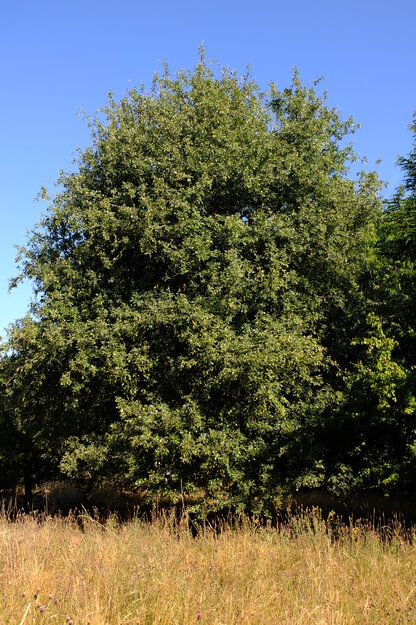
Deciduous broadleaf flowering (angiosperm) plant of the Rosaceae or Rose family, not native in Britain.
Continuing along the path, you come to Picea smithiana on the left, and a pair of Picea omorika (one of them with a label) on the right.
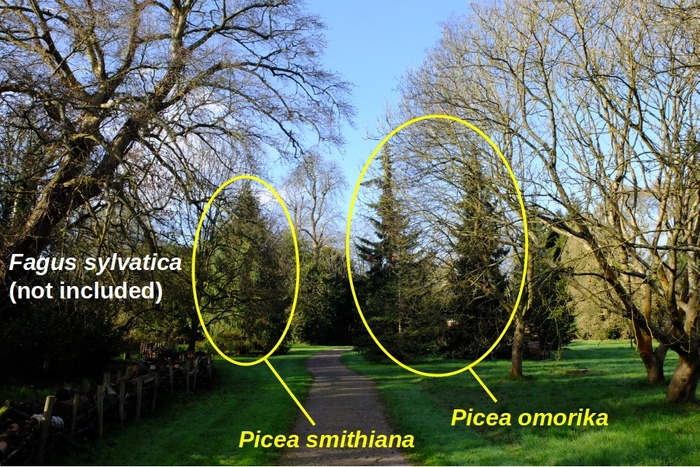
Picea smithiana, Morinda or West Himalayan spruce
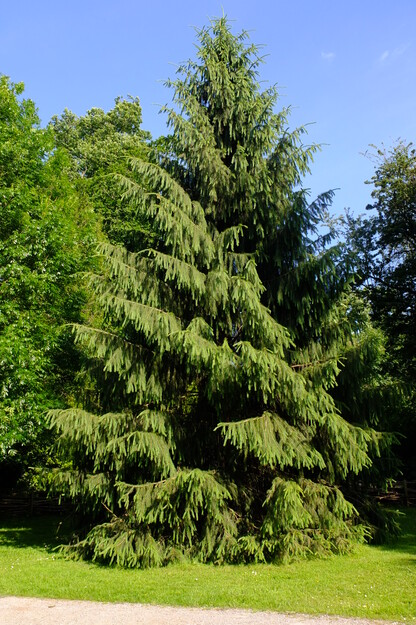
Evergreen needleleaf coniferous (gymnosperm) plant of the Pinaceae or Pine family, native to the western Himalayas.
Picea smithiana grows in mountainous forests at high elevations. It can reach heights of 40–50 metres and is especially notable for its long, slender, drooping needles that give the branches a weeping appearance. The tree forms a tall, conical crown with sweeping branches and produces long, cylindrical cones that hang downward from the branch tips. It's valued as an ornamental tree in large parks and gardens because of its distinctive shape and foliage.
Picea omorika, Serbian spruce

Evergreen needleleaf coniferous (gymnosperm) plant of the Pinaceae or Pine family, native to part of the Balkan Peninsula.
Picea omorika has dark green needles with silvery-white undersides, giving the foliage a distinctive shimmering appearance. It is widely planted as an ornamental tree in gardens, parks, and avenues because of its elegant, narrow form. It grows moderately slowly and tolerates a range of soils and urban conditions. It produces small purple-brown cones and maintains a spire-like shape, even at maturity.
Quercus suber stands a little way from the right-hand side of the path, on the same side as Picea omorika. Head across the grass to reach it, with a beech hedge on your left. (The hedge surrounds a small building.)
Quercus suber, Cork oak
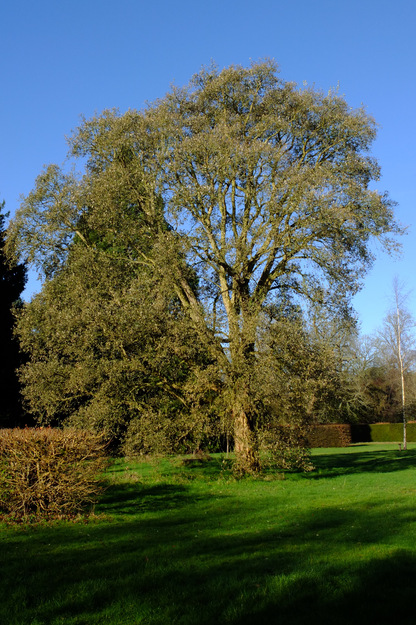
Evergreen broadleaf flowering (angiosperm) plant of the Fagaceae or Beech family, native to the western Mediterranean.
The thick, rugged bark of Quercus suber protects the tree from forest fires. It can be sustainably harvested every 9–12 years to produce natural cork without harming the tree. This provides the main source of cork for sealing wine bottles, cork flooring and the cores of cricket balls. Cork oak is adapted to hot, dry summers and poor soils. It grows up to 20 metres tall, with a broad, spreading crown and leathery, dark green leaves. It produces acorns that serve as an important food source for wildlife.
When you are standing with Quercus suber on your right, the Picea orientalis (a pair of them) are in front of you.
Picea orientalis, Oriental or Caucasian spruce
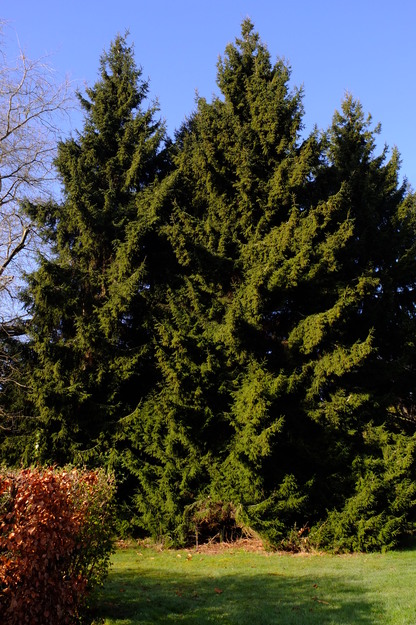
Evergreen needleleaf coniferous (gymnosperm) plant of the Pinaceae or Pine family, native to the Caucasus and northern Turkey.
Picea orientalis is a large tree, growing to about 40 metres tall in the wild, with unusually short needle leaves. In April and May it bears numerous short red pollen cones, which are quite obvious on the tree. Later in the year it has long slender seed cones, which are grey, purple and brown.
At Picea orientalis, turn left and follow the hedge back to the path. Turn right on the path (away from point where you left the path) and continue to reach the next group.
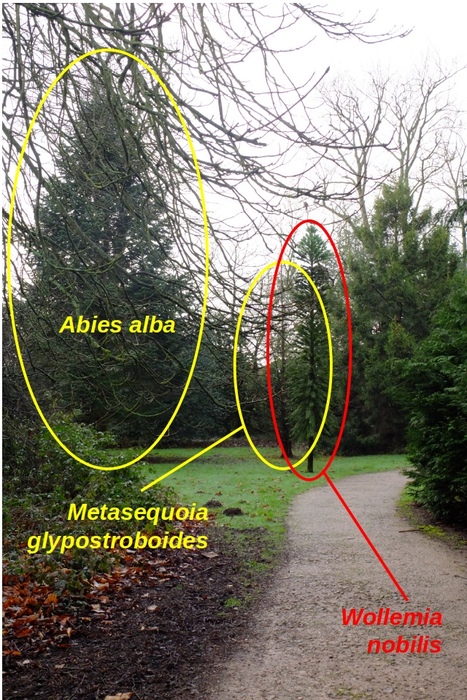
Wollemia nobilis, Wollemi pine

Evergreen spiny-leaf coniferous (gymnosperm) plant of the Araucariaceae family, native to Australia.
Although it's commonly known as the Wollemi pine, it's not a true pine. It was discovered in 1994 in a gorge in the Wollemi National Park in New South Wales. Scientists studying the tree noted that the foliage closely resembles fossils of species dating back as far as the Jurassic Period, around 200 million years ago. The Wollemi pine is classified as critically endangered with fewer than 100 adult trees known to be growing in the wild. Many thousands of Wollemi pines have been grown from seeds, cuttings and tissue culture at the Botanic Gardens of Sydney and been made available to botanic gardens around the world. Male and female cones occur on the same tree; female cones appear on higher branches and are much more rounded than the narrow male cones.
Abies alba, Silver fir
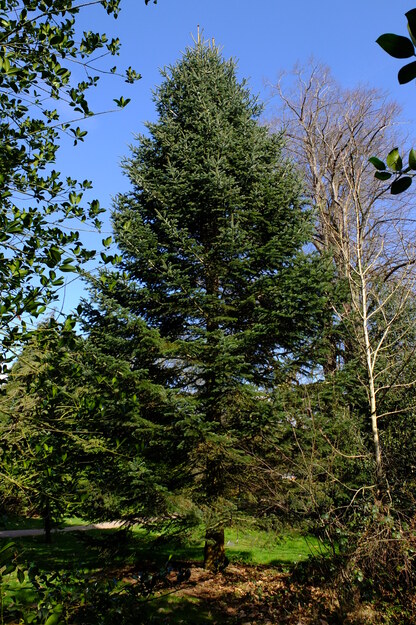
Evergreen needleleaf coniferous (gymnosperm) plant of the Pinaceae or Pine family, native to mountainous regions of central and southern Europe.
Abies alba grows tall, with smooth grey bark, flat dark-green needles with silvery undersides, and upright cylindrical cones that sit prominently on its branches. Its needles are soft and not sharply pointed, making them pleasant to the touch. The tree is valued for its lightweight, pale wood used in construction, furniture, and paper production.
Metasequoia glyptostroboides, Dawn redwood
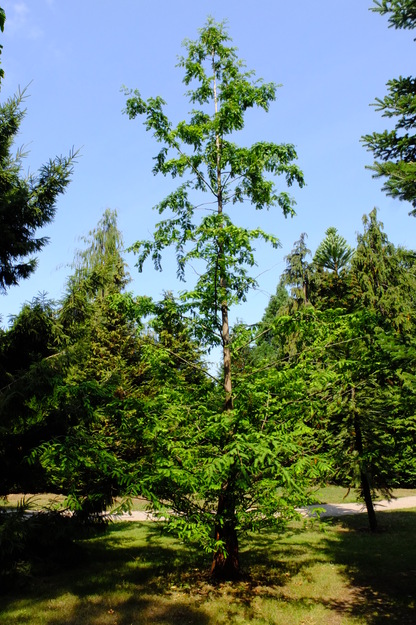
Deciduous needleleaf coniferous (gymnosperm) plant of the Cupressaceae or Cypress family, native to China.
The genus Metasequoia was known only from fossil evidence and considered extinct for 5 million years, until this species was found in the 1940s in Szechuan. It is a fast-growing tree which prefers a damp habitat and is adapted to growing on flood plains. It is critically endangered, partly due to intensive rice cultivation.
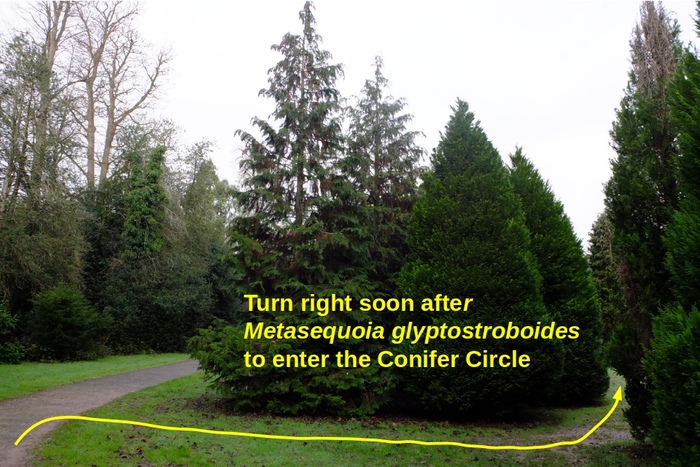
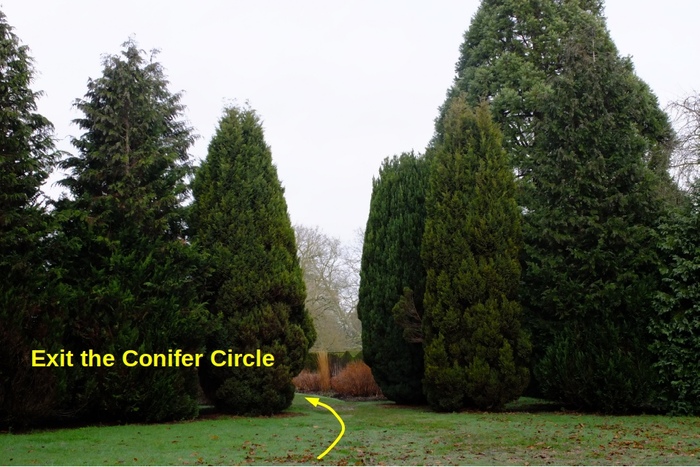
Just beyond Metasequoia glyptostroboides, turn right off the path through the gap into the Conifer Circle. Chamaecyparis lawsoniana is on the right as you enter the Circle.
Chamaecyparis lawsoniana, Lawson cypress
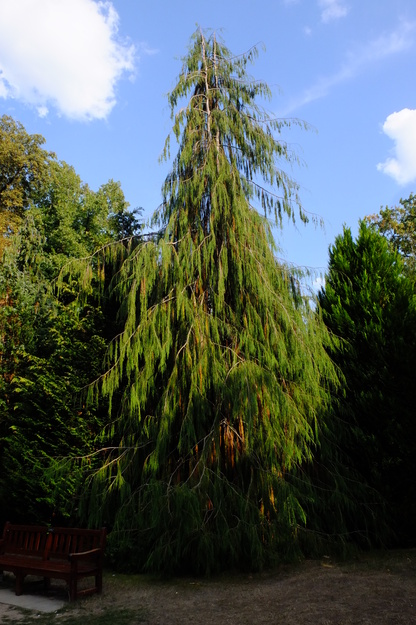
Evergreen needleleaf coniferous (gymnosperm) plant of the Cupressaceae or Cypress family, native to north-west North America.
Chamaecyparis lawsoniana can live for 600 years and reach heights of 50 metres in the wild, forming a narrow, conical crown with drooping branches covered in fine, scale-like foliage that emits a scent when crushed, variously described as resinous and pungent. The small, round cones mature from green to brown, and the bark is reddish-brown and fibrous, peeling in thin strips. Chamaecyparis lawsoniana wood is light, strong, rot-resistant and aromatic. The species has a wide range of ornamental cultivars, commonly planted in gardens and landscapes.
This tree is a weeping cultivar of the species, either 'Waterfall' or 'Imbricata pendula'.
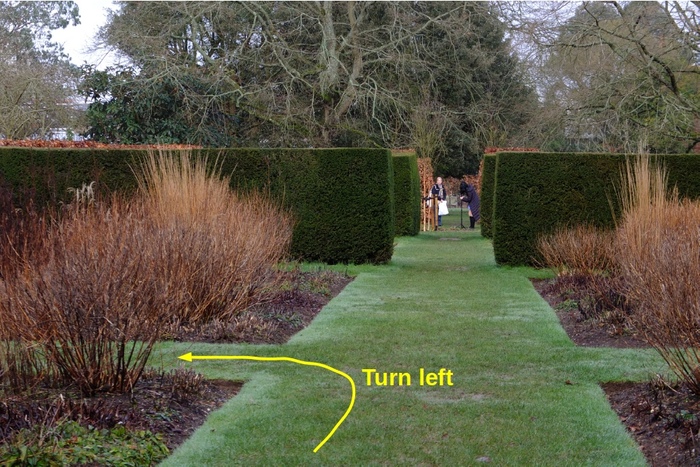
Take the first left. Sophora denudata is on the right after the exit from the formal garden.
Sophora denudata, Petit tamarin des Hauts
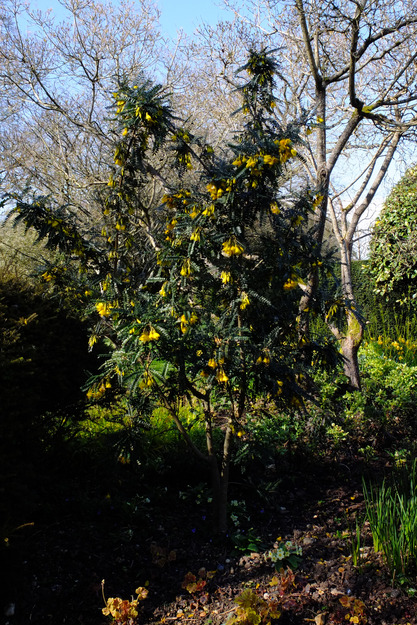
Evergreen broadleaf flowering (angiosperm) plant of the Fabaceae or Legume, pea or bean family, not native in Britain.
Turn right just beyond Sophora denudata and follow the bed (on your right), under a small tree (Carpinus orientalis), to reach Magnolia denudata in the bed on your right.
Magnolia denudata, Yulan magnolia
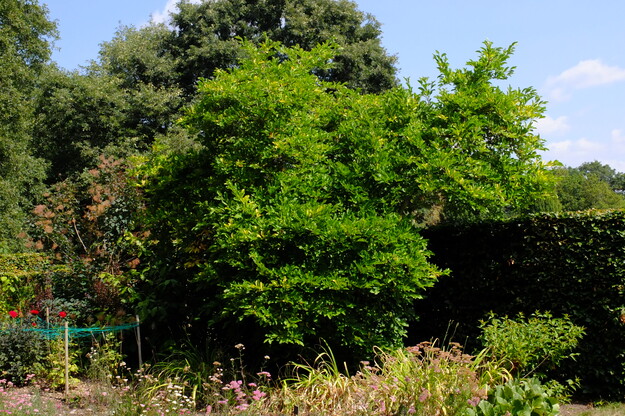
Deciduous broadleaf flowering (angiosperm) plant of the Magnoliaceae or Magnolia family, native to central and eastern China.
Magnolia denudata is an elegant tree which has long been cultivated. It is planted in temple grounds as as a symbol of purity and nobility. In early spring, before the leaves emerge, the tree produces large, fragrant, cup-shaped white flowers that stand upright on the bare branches.
From Magnolia denudata, turn round and go back, almost the way you came, but trending away from the planted border, across the grass, and then across the main path to reach Fagus sylvatica 'Dawyck'.
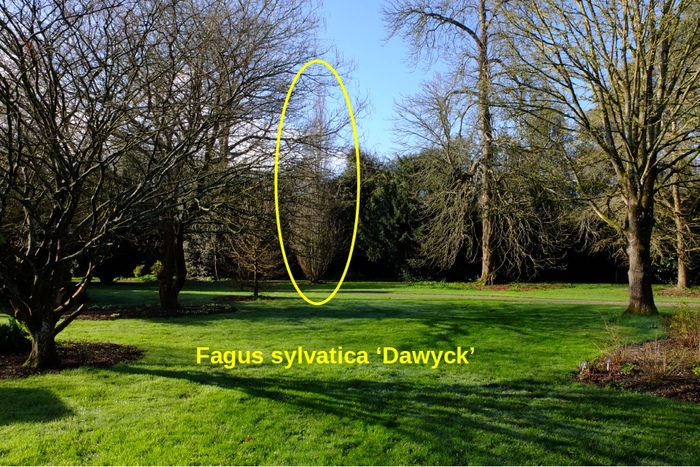
Fagus sylvatica cultivar, Fastigiate beech

Deciduous broadleaf flowering (angiosperm) plant of the Fagaceae or Beech family, a cultivated variety.
This is a Dawyck beech, a fastigiate variety (meaning "having closely bunched erect parallel branches") of the common beech Fagus sylvatica. It is named after the Dawyck estate near Peebles in Scotland, where it was discovered, probably in the early 19th century.
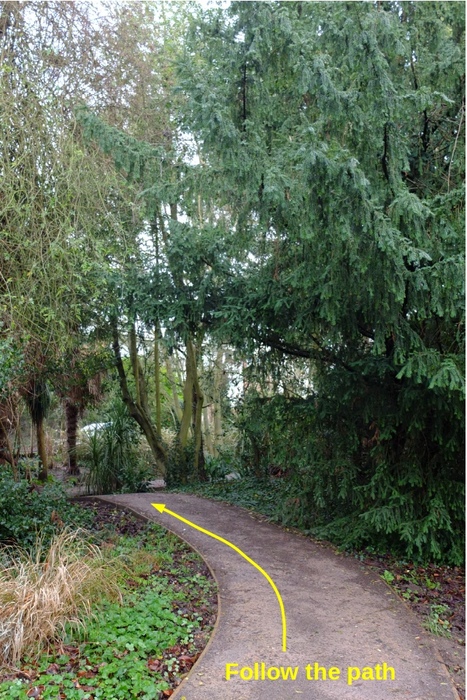
On the far side of Fagus sylvatica, take the small path towards Pepper Lane.
Eucalyptus globulus, Blue or southern blue gum
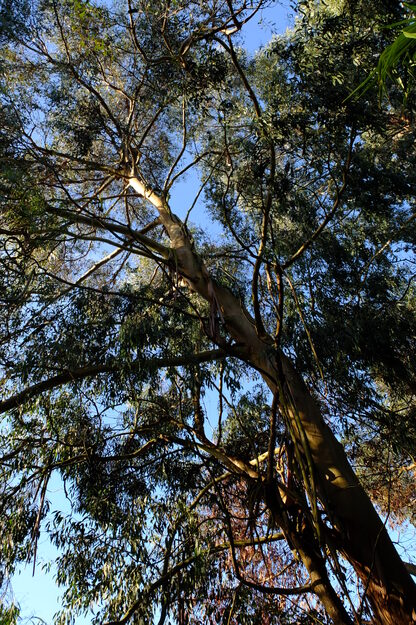
Evergreen broadleaf flowering (angiosperm) plant of the Myrtaceae or Myrtle family, native to south-eastern Australia and Tasmania.
This is one of the fastest-growing Eucalyptus species and can reach heights of 45–60 metres in favourable conditions. It is recognised by its smooth bark that peels away in long strips, revealing pale blue, grey, or cream-colored surfaces beneath. Its long, aromatic leaves contain oils widely used in medicinal products, particularly for their antiseptic and decongestant properties. In spring and summer, Eucalyptus globulus produces large, creamy-white flowers rich in nectar that attract pollinators. The species name is from the Latin globulus, "little ball" or "small sphere", referring to the shape of the fruit. The wood is used to make didgeridoos, a traditional Australian Aboriginal wind instrument. Due to its rapid growth and valuable timber, the species is widely planted around the world for forestry, paper production, and ornamental purposes.
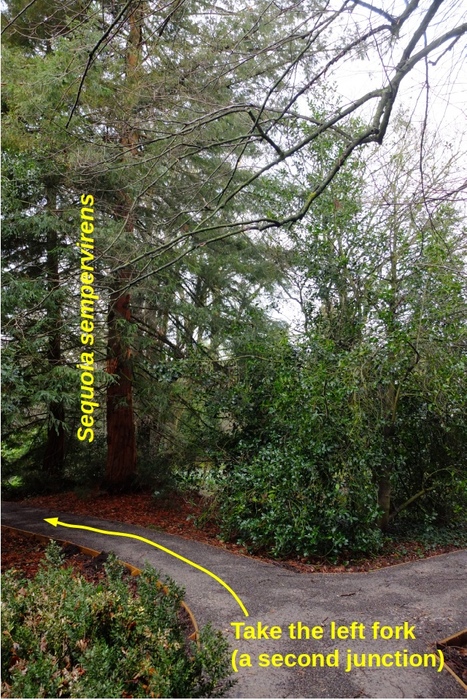
Sequoia sempervirens, Coast redwood
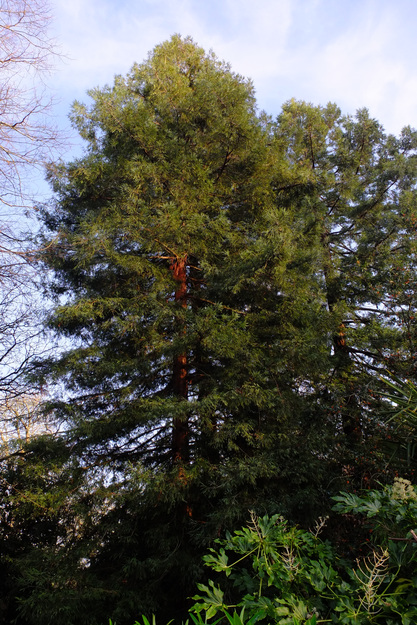
Evergreen needleleaf coniferous (gymnosperm) plant of the Cupressaceae or Cypress family, native to a narrow band along the Pacific coast of North America.
This species includes the tallest living trees (up to 115 m) and are also among the longest-living trees on Earth. In their native range, coast redwoods benefit from stable temperatures and reasonable rainfall, and they absorb water from fog through their leaves. The bark is soft, fibrous and very thick, up to 35 cm, and protects mature trees from fire damage. Its bright red-brown colour is the reason for the name "redwood".
The coast redwood is one of the most valuable timber species in the lumbering industry, valued for its beauty, light weight, and resistance to decay. Coast redwoods are closely related to the giant sequoia, Sequoiadendron giganteum. Although the giant sequoia is not as tall, it is even longer-lived and more massive than the coast redwood.
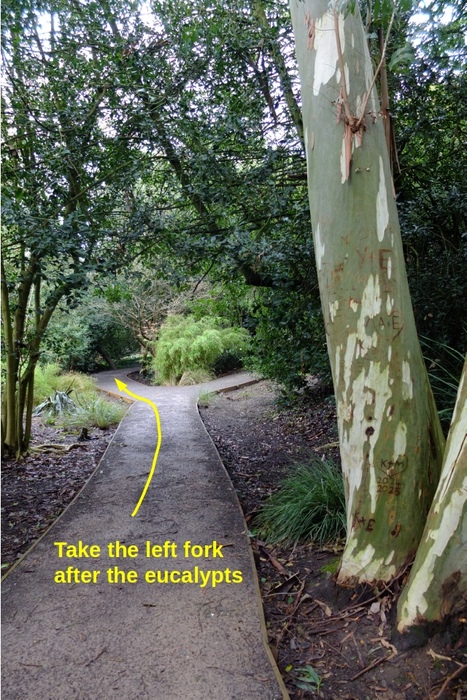
Having visited Sequoia sempervirens, retrace your steps to the last junction, and turn left there (not the way you came from). After a short distance you emerge from trees onto the main path along the northern boundary of the Harris Garden. Turn right on this path.
Eucalyptus perriniana, Spinning gum

Evergreen broadleaf flowering (angiosperm) plant of the Myrtaceae or Myrtle family, native to south-eastern Australia.
Eucalyptus perriniana typically grows 5–10 metres tall and is well known for its distinctive juvenile leaves, which are round, blue-grey, and appear to be pierced by the stem, giving the impression that they "spin" around the branch in the wind. As the tree matures, the leaves may become longer and more lance-shaped. The bark is smooth and sheds in patches, revealing pale grey or cream-colored surfaces beneath. In summer, the tree produces small white flowers that attract pollinators. It is often planted as an ornamental tree in gardens and parks, on account of its unusual foliage and cold tolerance compared to many other Eucalyptus species.
At Eucalyptus perriniana, turn right, across the grass, towards Quercus cerris. This is a large tree (with a label). There are two other large trees of the same species along the main path, one with a large branch reaching down to the ground, which children enjoy climbing.
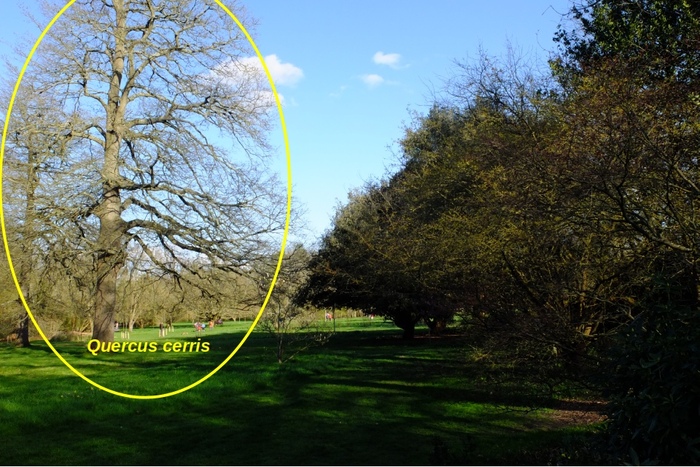
Quercus cerris, Turkey oak

Deciduous broadleaf flowering (angiosperm) plant of the Fagaceae or Beech family, native to south-eastern Europe and Asia Minor, and naturalised in Britain.
Turkey oak was introduced to the UK as an ornamental tree in the 18th century. It can act as host to the gall wasp, whose larvae damage the acorns of native British oaks. Its wood is liable to cracking so is only used for fencing and similar roles.
From Quercus cerris, continue in the same direction to Juniperus communis.
Juniperus communis, (Common) juniper

Evergreen needleleaf coniferous (gymnosperm) plant of the Cupressaceae or Cypress family, native to Britain, parts of Europe, Asia and North America.
This is a columnar variety of Juniperis communis, a hardy species with one of the widest natural distributions of any woody plant, being adaptable to poor soils, cold climates, and exposed sites. It plays an important ecological role by providing shelter and food for wildlife while also being valued in landscaping for its resilience and distinctive appearance. It can grow as a low, spreading shrub or a small tree up to about 10 metres tall, depending on environmental conditions. The plant has sharp, needle-like leaves arranged in whorls of three and produces small, berry-like cones that mature to a bluish-black color. These "juniper berries" are widely known for their use in flavouring foods and beverages, particularly gin.
At Juniperus communis, turn left towards Quercus petraea. this is also in the direction of Alnus subcordata, which we visited early in the route.
Quercus petraea, Sessile oak
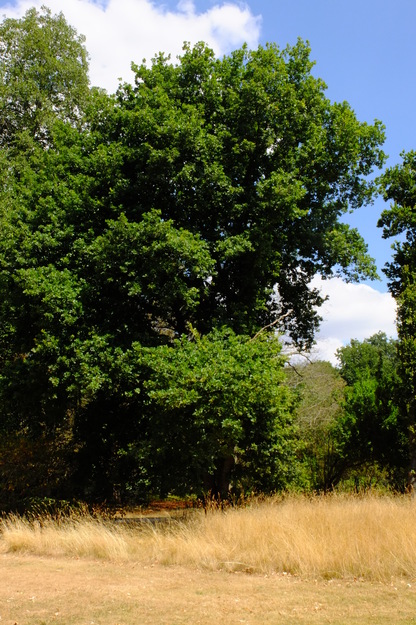
Deciduous broadleaf flowering (angiosperm) plant of the Fagaceae or Beech family, native to Britain and most of Europe.
Quercus petraea is a large tree, which can grow 30–40 metres tall. It develops a broad, rounded crown supported by a strong trunk with rugged, grey-brown bark. The acorns, unlike those of the closely related Quercus robur, are "sessile", meaning they grow directly on the twigs with no stem. During autumns with good acorn crops animals are traditionally grazed under the trees. Quercus petraea is highly valued for its durable hardwood, which has long been used in construction, furniture making, and barrel production. It has had significant impact on British history through its use in wooden ship-building.
On the far side of Quercus petraea, you rejoin the path. Turn left to return to the entrance of the Harris Garden.